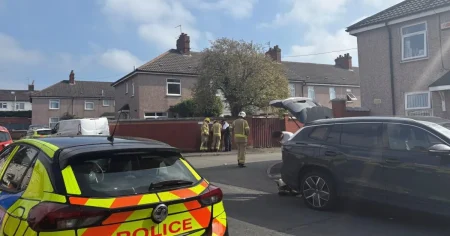




It was the kind of moment that tends to freeze itself in the minds of everyone involved—not because it was heroic or inspiring, but because it was sudden, frightening, and completely avoidable. On a September day in Selby, a young woman named Jessica Louise Simms, just 20 years old and living on The Crescent, found herself face to face with emergency workers who had come to help her. But instead of gratitude or relief, the scene spiraled into something darker. Simms threatened a paramedic and a firefighter with a broken bottle, turning a moment of potential care into a moment of terror. When police arrested her, the chaos did not stop: she damaged the police cell she was taken to, adding more charges to a list that was already growing. Weeks later, at York Magistrates’ Court, the full weight of that day came crashing down. The court ruled that the offences were so serious that only an immediate custodial sentence could be justified. Simms was sent to a young offenders’ institution for 12 months—a stark turning point for a woman whose life, until now, had already shown worrying signs of going off the rails. It was the kind of sentence that is supposed to hurt, but also to shake someone awake.
To understand the gravity of what happened, it helps to imagine the scene through the eyes of the emergency workers. A paramedic and a firefighter, both trained to run toward danger rather than away from it, arrived to assist a young woman in distress. Their job is to protect life, to soothe panic, to treat injuries, to make people feel safe in their most vulnerable moments. Instead, they were met with the jagged edge of a broken bottle. The threat of a weapon is never just a threat—it is a violation of the trust that allows emergency workers to do their jobs at all. Every second they spend defending themselves is a second they cannot spend helping someone else. And every call like this one sends a ripple through the system, delaying response to people who might be having heart attacks, car accidents, or quiet crises of their own. That is perhaps the cruelest part of what Simms did: not just the fear she inflicted in that moment, but the invisible harm she caused to strangers she will never meet, people whose ambulance or police response was delayed because the crews were tied up dealing with the aftermath of her choices.
The court heard that the incident on September 17 was not an isolated lapse in judgment. That same day, Simms had walked into Selby train station even though she was barred from doing so by a Community Protection Notice. That notice had been put in place after a series of previous convictions, including assaulting a police officer, impersonating a police officer, and causing the wasteful employment of police. Those are not the actions of a person who simply made one bad mistake; they suggest a pattern of behaviour, a repeated willingness to push against authority and disrupt the systems that exist to keep communities safe. Impersonating a police officer, in particular, is not a prank or a childish game. It can sow confusion, undermine public trust, and leave real victims unsure whether the person in front of them is legitimate. And causing the wasteful employment of police means that officers were pulled away from genuine emergencies to deal with a situation that should never have been created. By the time Simms stood in the dock, it was clear that this was not a one-off incident. It was a recurring story, one that had already consumed hours of police time and now threatened to consume her youth.
At the sentencing, the magistrate did not mince words. The offences were serious enough that a non-custodial punishment would have been unjust. Simms was given a 12-month sentence at a young offenders’ institution, a place designed for people her age who have committed crimes serious enough to lose their liberty but who are still young enough that rehabilitation remains a central hope. No separate penalty was imposed for breaching the Community Protection Notice, but that was not the end of it. She was also re-sentenced for the earlier assault on a police officer, receiving an additional three months’ detention, which will run at the same time as her 12-month sentence rather than being added on top. On top of the prison time, she was ordered to pay £79 in compensation—a small sum compared to the emotional cost of what she put her victims through—and a £187 surcharge, a levy that helps fund services for victims of crime. Those financial orders might seem almost symbolic compared to the loss of freedom, but they serve as a reminder that actions have costs, and that someone must pay them. The court’s decision to impose an immediate custodial sentence sent a clear message that threatening emergency workers is not a misdemeanor to be brushed aside, but a serious crime with serious consequences.
Police forces, understandably, welcomed the outcome. PC Emily Blackwell, of the Selby Neighbourhood Policing Team, spoke directly to the impact of Simms’ actions. “Jessica Simms’ actions have wasted countless hours of police, ambulance and other emergency service time, diverting resources away from genuine incidents and people who are in real need of assistance,” she said. That single sentence captures the hidden toll of behaviour like this. When someone threatens a paramedic or a firefighter, they are not just hurting one person; they are stealing from the entire community. They are taking time that could have been used to save a child’s life, comfort a grieving family, or catch a dangerous offender. PC Blackwell went on to say that the sentence “sends a clear message that such behaviour is not a game and will not be tolerated.” She thanked the officers and partner agencies who worked to bring the matter before the courts, and she emphasized that emergency services exist to protect the public, safeguard vulnerable people, and keep communities safe. “Those who deliberately waste these valuable resources can expect to be held accountable for their actions,” she added. Her words were pointed, but they also carried a deeper truth: that the people who respond to emergencies are not disposable tools, but human beings with families, fears, and limits.
And that, perhaps, is where the real human story lies. It would be easy to write Jessica Louise Simms off as just another offender, another headline, another statistic in a long list of people who made life harder for the people we rely on. But the fuller story is sadder and more complicated. She is only 20 years old, an age at which life is supposed to be full of possibility. She now faces a year locked away from the world, her freedom stripped away, her reputation shattered. Somewhere along the way, something went deeply wrong—whether it was trauma, addiction, mental illness, bad influences, or a combination of all of them, we may never know. That does not excuse her actions, and it does not make the fear she caused any less real. But it does mean that there is more to this than a single villain and a single victim. The paramedic and the firefighter were victims of a terrifying encounter. The police officers who had to deal with her were victims of her aggression. And Simms herself is also, in a painful sense, a victim of her own choices, a young woman who has now lost her liberty and must face the consequences of everything she has done. If her time in the young offenders’ institution can somehow help her understand the weight of her actions, and if it can give her the support she needs to rebuild her life, then perhaps there is still hope for her. But that hope rests on her willingness to change, and on the understanding that the emergency workers she threatened were simply people trying to do their jobs—people who deserve to return home safe at the end of their shifts. For now, the sentence has been handed down, the message has been sent, and a young woman from Selby has been given a very hard lesson about the value of the people who risk their lives to help others. Only she can decide what she does with that lesson.