


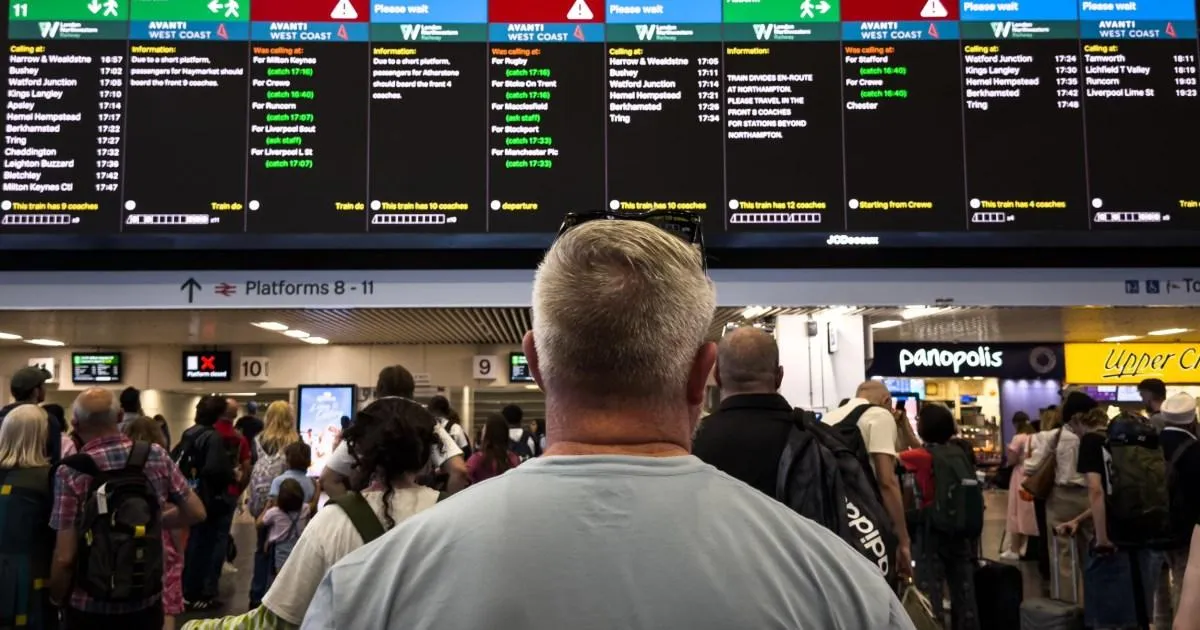
For millions of rail passengers, London Euston has long been something more than a transport hub—it has been a test of patience, a daily exercise in frustration, and, all too often, the place where a good day goes off the rails. It has earned the unenviable title of the capital’s “worst” station, a reputation forged in the chaos of last-minute platform announcements, the misery of overcrowded waiting areas, and the particular dread associated with its toilets, which have been humorously but brutally crowned the worst train station loos in London. Anyone who has stood beneath those cavernous ceilings, craning their neck at the departure board while clutching a coffee and a deadline, knows exactly why Euston inspires such strong feelings. The good news is that someone in power has finally listened. Transport Secretary Heidi Alexander has announced a £50 million cash injection that will transform the station over the next three years, with an initial £11 million dedicated to the things passengers care about most: more seating, better waiting areas, and a long-overdue refurbishment of those infamous lavatories. It is a recognition that a station isn’t just a place to pass through—it’s a place where people live parts of their daily lives, waiting, worrying, hoping, and sometimes simply trying to find somewhere to sit down without feeling like an obstacle to the relentless flow of commuters.
The single most visible change will be the phasing out of the last-minute platform announcement, a feature of Euston life that has caused more than its fair share of anxiety and adrenaline spikes. If you’ve ever been standing in the concourse when a platform number finally flashes up just minutes before departure, you know the scene: hundreds of travelers suddenly lurching into motion, dragging suitcases, holding hands with children, muttering apologies, and sprinting toward the barriers as if the train itself might vanish if they don’t reach it in time. It’s dramatic, but it isn’t efficient, and it certainly isn’t kind. That experience is on its way out within the next year. Network Rail has already been experimenting with different boarding arrangements, including earlier boarding on Avanti West Coast services and continuous boarding on London Northwestern Railway trains, and the early signs have been enough to convince officials that a calmer, more orderly approach is possible. The huge departures board will stay—passengers said they wanted it, and their feedback has been taken seriously—but the hope is that by giving people more time and more information, the station will feel less like a high-stakes game and more like a place with a sensible, human rhythm. Beyond the announcements, the physical space of the concourse is also being reimagined. The assisted travel lounge has already been given a fresh new look, a customer information hub has opened at the back of the concourse, and the upstairs balcony now has extra seating and charging points, meaning you can actually rest your phone and your legs at the same time. More seats are being added on the east side of the concourse too, small but meaningful gestures that signal a shift toward passenger comfort rather than pure throughput.
Crucially, this £50 million investment is separate from the longer-term Euston Masterplan and the HS2 project, which means it isn’t a distant promise buried in a grand, complicated future—it’s money for the here and now, for the station as it exists today, serving the millions of people who rely on it every day. The timing is also significant, because it comes alongside a much bigger conversation about the future of the railways themselves. The news that Avanti West Coast, the operator responsible for many of those Euston departures, will be placed under public ownership from March 7, 2027, has landed like a thunderbolt, and it is part of a broader wave of nationalisation under the Labour government. South Western Railway, c2c and Greater Anglia were already brought back into public hands in 2025; West Midlands Trains, Govia Thameslink Railway and Chiltern Railways have followed this year; and Great Western Railway is set to join them in December. All of these services will eventually operate under the banner of Great British Railways, an organisation explicitly designed to put “passengers and customers first.” For anyone who has spent years watching the railways fragment into a confusing patchwork of private operators, each with their own excuses and customer service scripts, the idea of a unified, publicly accountable network feels like a breath of fresh air. The hope is that public ownership will mean more than just a new logo on the side of a train—it should mean real improvements in punctuality, reliability, and the simple, vital feeling that the system is working for you, not the other way around.
The government isn’t stopping at Euston, either. An additional £10 million has been set aside for other stations along the West Coast Main Line, on top of a much larger £840 million pledge to improve infrastructure across the route. The promise is straightforward: faster and more reliable services, a particular focus on routes in and out of Manchester, and better WiFi and 5G mobile coverage so that passengers can actually work, stream, or simply scroll in peace without losing signal every time the train enters a tunnel. Transport Secretary Heidi Alexander’s words carried a real sense of frustration and resolve when she said: “For years, we’ve heard stories of Avanti underperforming, with passengers left paying the price. Enough is enough.” That sentiment will resonate with anyone who has stood on a cold platform, stared at a delay board, and wondered why basic service feels so hard to achieve. She went on to promise that bringing Avanti into public ownership at the earliest opportunity—next March—is part of a Labour government “committed to putting essential services back in public hands,” connecting people to opportunity and delivering growth in every postcode. It is a bold statement of intent, and it was matched by a measured response from Andy Mellors, managing director at Avanti West Coast, who said the company would “work closely with the government to ensure a seamless transition into public ownership while remaining focused on delivering for our customers and communities.” Whether that transition feels seamless to passengers remains to be seen, but at the very least, there is now a clear direction of travel.
Euston is not the only London station undergoing a transformation, and it’s worth stepping back to appreciate just how much change is sweeping through the capital’s transport network. South Kensington Tube station, for example, is expected to undergo an extensive £120 million upgrade designed to tackle overcrowding and improve accessibility—two issues that will be familiar to anyone who has tried to navigate the Underground at peak times. Meanwhile, Liverpool Street station is about to embark on a colossal £1.2 billion redevelopment that will revamp the entire building and “future-proof” it for the estimated 200 million passengers expected to pass through in the decades ahead. The scale of that ambition is staggering, but it reflects a growing recognition that London’s infrastructure cannot simply be patched up forever; it needs to be reimagined. There is also the prospect of a brand new Overground line in west London, running between Hendon and Hounslow, which could open up new connections and take pressure off existing routes. Taken together, these projects paint a picture of a city that is not resting on its laurels, a city willing to invest in the railways, stations, and lines that will carry its future. It is easy to get cynical about grand announcements and glossy renderings, but behind the numbers and the jargon are real, tangible improvements that will shape how millions of people experience their daily journeys.
So what does all of this mean for the ordinary passenger standing on the concourse at Euston, perhaps for the hundredth or thousandth time? It means that the chaos of the last-minute dash may soon be a memory, replaced by a more thoughtful, less frantic approach to boarding. It means there will be somewhere to sit, somewhere to plug in your phone, and—yes—a toilet that does not feel like a punishment. It means the operators responsible for the trains you rely on will be accountable to the public rather than to shareholders, and that the broader infrastructure supporting those trains will receive the investment it has needed for decades. No one should pretend that a single £50 million package will solve every problem overnight, or that the nationalisation of Avanti is a magic wand that will instantly make every train run on time. But there is something genuinely hopeful in the direction of travel, a sense that the people in charge have finally stopped treating passengers as an inconvenience and started treating them as the entire point of the railway. For a station that has carried the burden of being called London’s worst, that change in attitude is perhaps the most important upgrade of all. The work will take time, and patience will still be required, but for the first time in a long while, the future of Euston looks less like a stressful endurance test and more like a place designed for people—with the seats, the signals, and the simple dignity that every traveler deserves. In a city that never stops moving, the least a station can do is let you breathe.