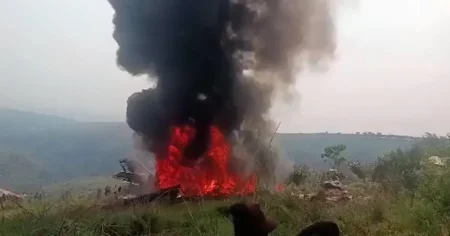



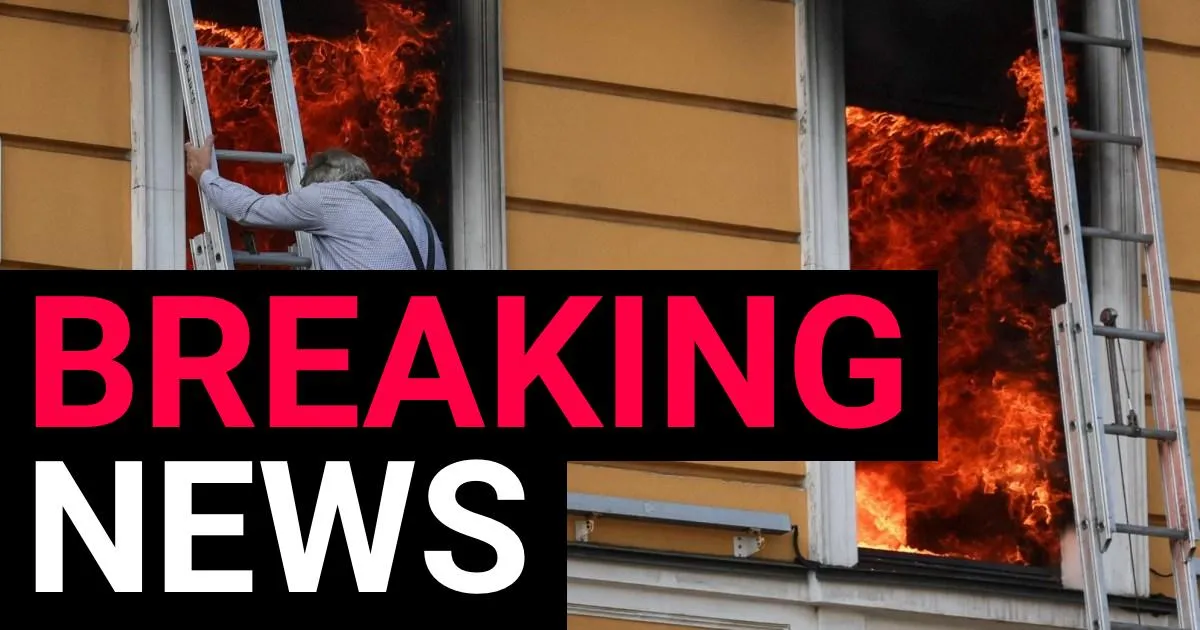
Harrowing footage has emerged from the centre of Kyiv, showing people trying to escape a burning building after a Russian drone strike. The National Academy of Sciences building, located in the Shevchenkivskyi district, has been engulfed in smoke and flames. In the video, people can be seen climbing out of windows as fire rages behind them. One man manages to escape using a ladder, while thick black smoke billows around him. The blast was caused by a jet-powered drone, and the administrative building has been devastated. The footage is raw, chaotic, and deeply unsettling. It captures a moment in which ordinary life was interrupted by violence, and ordinary people were forced to become survivors. The building, once a symbol of scholarship and national pride, now appears in photographs as a nightmare of orange flame and grey smoke. For those watching from the safety of their homes, the scene is difficult to process. This is not a battlefield, not a trench, not a missile silo. It is an academic institution in a city centre, part of the everyday fabric of Kyiv. Yet in a war that has repeatedly blurred the line between civilian and military life, it has become just another target. The people inside were not soldiers. They were staff, researchers, and visitors going about their day. In a matter of minutes, their world turned into an inferno. The video does not show how they all got out, but it does show that they were willing to risk everything to escape. That alone is worth remembering.
What makes the footage so harrowing is not just the fire itself, but the human movement around it. There is something primal in watching a person climb out of a window, not knowing whether the air outside will be safer than the flames inside. In one photograph from Reuters, a man is seen escaping through a window while thick smoke billows around him. In another, a different man descends from the building using a ladder that appears to have been placed by someone below. These acts of escape are not heroic in the cinematic sense. They are slower, messier, and far more terrifying. Every gesture, the way a hand grips a ledge, the way feet search for a rung, speaks to a level of fear that words cannot easily capture. The drone strike happened quickly, but the process of fleeing, of waiting for a turn on the ladder, of watching where the flames spread, must have felt like an eternity. The building is not a residential block or a crowded shelter, but an administrative building of the National Academy of Sciences. That detail matters. It means the people inside were not fighters. They were administrators, researchers, support staff, perhaps people simply trying to do their jobs. They were not in a trench or on a front line. They were in an office, and then suddenly the office had become a furnace. The footage also shows the speed with which normal life can collapse in wartime. One moment, the building is standing. The next, smoke is everywhere, and everyone is scrambling for air. The ladder becomes a lifeline. The window becomes a door. The street below, usually unremarkable, becomes a place of salvation. Watching these images, one is reminded that survival in war is often reduced to small, immediate choices. Does the smoke rise faster than I can move? Is the ladder steady? Is there someone below to catch me? For the people in the footage, those questions were answered in seconds, and the answers will stay with them forever.
As the fire raged, Kyiv’s mayor, Vitaliy Klitschko, moved quickly to confirm what had happened. On Telegram, he wrote: “An unmanned aerial vehicle (UAV) has crashed into a non-residential building in the Shevchenkivskyi district, in the capital’s city centre. A fire has broken out.” His words, deliberately composed in the measured tone of a city leader, could not fully convey the chaos unfolding behind him. Within the same hour, Oleksandr Sazanovych, head of the Shevchenkivskyi District State Administration, delivered the hardest news of all: “Unfortunately, there are injuries and fatalities. All emergency and relevant services are working at the site. I ask residents not to approach the scene and not to interfere with the work of the services.” These statements, brief and dry, are the official language of a war that has become routine in its brutality. The mention of injuries and fatalities is buried inside a bureaucratic request for residents to stay away. But there is no routine for the people who were inside the building, nor for the families who waited to hear whether their loved ones had made it out. The mayor’s appeal and the administrator’s warning are part of a pattern that Kyiv residents have come to recognize: a strike, a fire, a tape around the perimeter, and then the slow, agonizing process of counting the injured and the dead. The local authorities were on the scene quickly, along with emergency and relevant services, but their work is delicate. Some people may have been trapped. Some may have been hurt in the panic. Others may have been killed by the blast itself. The official statements cannot answer all of those questions immediately. They can only ask for space and patience, while the rest of the world watches from a distance, waiting for the next update, scrolling through photographs of smoke and ladders and open windows.
This attack on the National Academy of Sciences building must be understood within the larger pattern of Russia’s war on Ukraine. Since the full-scale invasion began, Ukrainian cities have been subjected to waves of drone and missile strikes that often appear to have little military value but enormous human cost. The target here, an administrative building of the national academy, is not a weapons depot or a command centre. It is part of the country’s scientific establishment, a symbol of Ukraine’s enduring commitment to knowledge, research, and international cooperation. Whether the drone was aimed at the building specifically or was part of a wider barrage that happened to find its mark, the effect is the same: a piece of the country’s civilian and intellectual infrastructure has been destroyed. The loss goes beyond the physical structure. Every scientific institution holds decades of accumulated work: research notes, archives, data, and the collective memory of a community. A fire consumes those things quickly, and the smoke that billows from the building carries with it not just the remains of furniture and documents, but the labour of years, perhaps generations. In a time of war, the destruction of such a place is also an attack on the idea that there is a future beyond conflict. The scientists and staff who worked there were part of a society trying to preserve normal life while defending itself. Now they are survivors of an attack on that normalcy. The footage of them escaping through windows is a cruel reminder that even the most orderly spaces can become deadly in an instant, and that no one is truly outside the reach of the war. Strikes like this also test the resilience of the Ukrainian people, who have shown again and again that they can rise from the rubble. But resilience has a cost. Each attack adds another layer of trauma, another set of names to remember, another building to rebuild. And while the world may grow tired of the headlines, for the people of Kyiv, each drone strike is not a statistic. It is a moment when the ground shakes, the fire appears, and the only thought is: get out.
In the aftermath, the human cost becomes clearer. Emergency workers at the site face the difficult task of searching through the damaged building, looking for anyone who may still be inside and collecting the evidence of what happened. Firefighters battle flames that may take hours to extinguish, especially in a large administrative structure with many floors and narrow hallways. Medical teams stand by, ready to treat the injured as they are brought out. The people who escaped through the windows are likely in a state of shock, wrapped in blankets, trying to answer questions from police while their minds are still back in the burning corridor. The grief of the families is something that no photograph can capture, but it is present in every announcement of injuries and fatalities. The National Academy of Sciences is not just an institution; it is a community of people who care about discovery and about Ukraine’s place in the world. Scientists, engineers, and support staff come to work every day not to fight, but to build. That such a community would be targeted by a drone is a reminder that this war is not restricted to battlefields. It reaches into offices, laboratories, archives, and the most ordinary places of daily work. For those who survive, the psychological effects may last far longer than the fire. The sound of a drone overhead, the smell of smoke, the image of a colleague climbing out a window, these become part of their personal history. They will carry the memory of this day with them, even after the building is repaired or rebuilt. The broader Ukrainian scientific community also feels the blow. Attacks on institutions such as this force a difficult question: how do you sustain a culture of knowledge when the spaces that house it are under fire? The answer, for many, is to keep going, to move research to safe locations, to continue teaching and writing and experimenting in whatever conditions remain. But no one should mistake their determination for immunity. The strike on the academy building is a wound to the whole society, and the healing will take time.
As the footage continues to circulate, it does something that no official statement can. It makes the war immediate. It invites us to imagine ourselves in that building, looking at the smoke, hearing the alarms, feeling the heat. The man descending the ladder is not anonymous; he is a person whose face we cannot see but whose fear we can feel. The people watching from the street, the emergency teams rushing in, the neighbours who saw smoke rising above familiar rooftops, all of them are part of a story that is still unfolding. This strike on the National Academy of Sciences building in Kyiv is one more chapter in a war that has already lasted too long and cost too much. It is also proof that the Ukrainian people are not prepared to surrender their cities, their institutions, or their future. They climb out of windows when they have to, and they rebuild when they can. The international community, which has offered support in many forms, must continue to pay attention. Not just to the big headlines or to the military gains and losses, but to these individual moments of escape and tragedy. Because it is in these moments that the true nature of the war is revealed: not as a battle over territory, but as a struggle between destruction and the human will to survive. The smoke over the academy building will clear. The dead will be mourned. The wounded will recover or carry their scars. And in the months and years to come, the story of the man on the ladder will become part of Kyiv’s memory. But memory is not enough. There needs to be justice. There needs to be accountability. And there needs to be a determination, both in Ukraine and in the world beyond it, to ensure that such scenes become rarer, and eventually impossible. The footage ends, but its echoes do not. For anyone who watches it, the image of a burning academy, and the people fleeing through its windows, will remain as a reminder of what is at stake in a war that continues to test the limits of human endurance. In the end, the drone did not destroy the Academy’s spirit. It only made the world see, once again, what Ukraine is fighting for.