


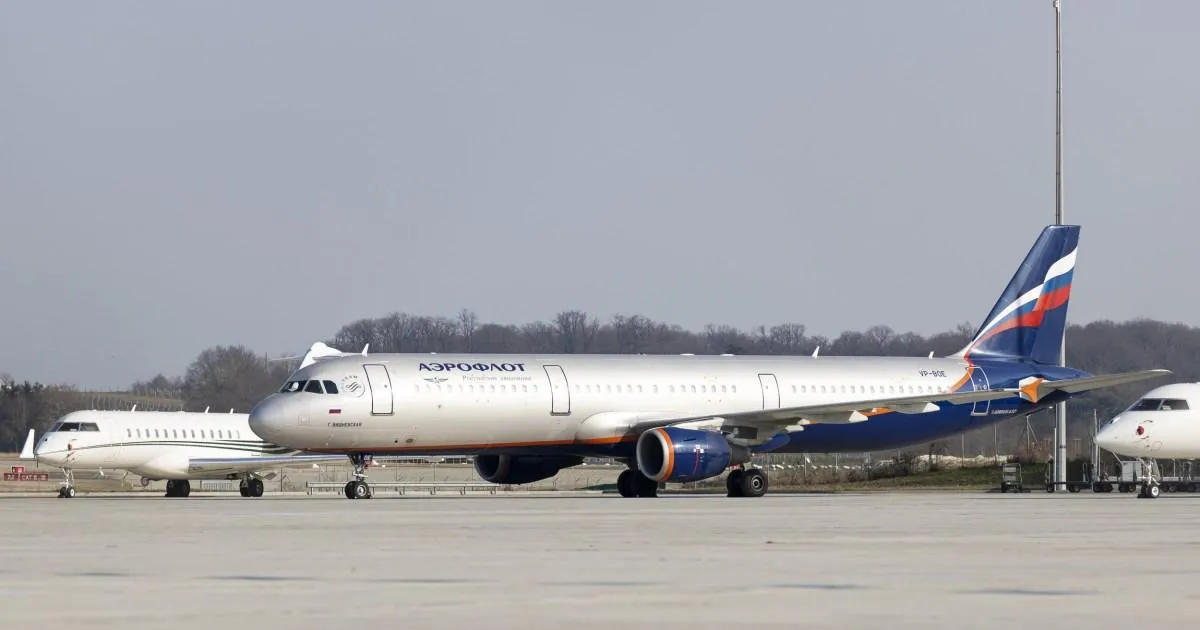
On a windswept corner of Geneva airport’s tarmac, an Aeroflot Airbus A321 sits exactly where it was parked on 27 February 2022. The white-and-blue fuselage, still carrying the name Galina Vishnevskaya, has not moved since. It was meant to be a short stopover, a routine turn on a route between Russia and Switzerland. Instead, the plane has become one of the strangest unintended monuments to the war in Ukraine: a modern airliner grounded not by mechanical failure, but by geopolitics. Around it, other aircraft taxi, take off and land, busy with the ordinary business of flight. The Galina Vishnevskaya does none of that. It has been standing in the same spot for more than four years, slowly weathering under rain, snow and the sharp Alpine sun. The aircraft, registered VP-BOE, was due to fly home when Switzerland, following the European Union’s lead, closed its skies to all Russian aircraft. The decision came just one day after the plane touched down. In that sudden reversal, the machine’s future was sealed. It could not return to Moscow. It could not fly to any other European destination. It could only remain where it was, racking up costs, gathering dust, and waiting for a diplomatic solution that has not arrived. Named after a celebrated Russian soprano, the aircraft now seems a silent figure in a drama it never chose to join. Each day it waits, the bill grows, the condition worsens, and the world moves on, occasionally glancing at this frozen piece of aerospace engineering as if it were a museum exhibit rather than a functioning jet that once carried hundreds of passengers across borders.
The story of this stranded jet begins in the late winter of 2022, when Russia’s full-scale invasion of Ukraine was only days old. On 27 February, flight VP-BOE, an Airbus A321 operated by Aeroflot, landed in Geneva. It was a normal landing on what should have been an unremarkable turnaround. But within twenty-four hours, the political landscape shifted under its wheels. Switzerland, which has long presented itself as neutral, joined the European Union in banning Russian aircraft from its airspace. The plane, which had arrived with the assumption that it would soon be boarding passengers for the return journey, was suddenly illegal. The pilot could not file a flight plan. The airline could not send a replacement crew. The plane was no longer a conveyance; it was a liability. It is easy to imagine the confusion and helplessness of everyone involved: the crew who may have been told to wait, the ground staff who watched an international crisis unfold in real time, the lawyers and officials trying to understand what a single parked jet meant in a world of cascading sanctions. The airplane itself, of course, felt nothing. But the people whose jobs depended on it did. There was no dramatic seizure, no flashing lights. Just a quiet, bureaucratic order that left a multi-million-dollar machine stranded on foreign soil, exactly where it had touched down. In the days and weeks that followed, Russian aircraft across Europe found themselves in similar predicaments. Some were impounded, some were turned away, and some, like the Galina Vishnevskaya, were simply left behind. For this plane, the wait has now stretched into years, and with each passing season the possibility of it ever flying again grows more remote.
Airplanes are designed to move. When they do not, they begin to decay in ways that are invisible to the casual observer. The Galina Vishnevskaya has been exposed to the elements for more than four years, and its condition is now a matter of real concern. The seals around doors and windows dry out. The tires slowly lose pressure. The hydraulic systems, the fuel systems, the delicate electronics that make modern flight possible—all of them suffer when a machine is left idle. According to reports, the aircraft has accumulated around £1.4 million in parking and ground handling charges, a figure that rises like an overdue hotel bill with no one willing to pay it. It is unclear whether the plane was left fuelled and catered for its intended return journey. If any food remained onboard, it would have rotted long ago, and the smell would almost certainly attract pests and insects. There is something almost grotesque about that detail: a beautiful, expensive aircraft slowly becoming a home for vermin because no one is allowed to touch it. The plane is not being maintained. It is not being serviced. It is simply sitting there, exposed to Swiss weather, while the forces that once kept it airborne are no longer able to operate. It has become a ghost ship, but a ghost ship with a galley, a cabin, a cockpit full of instruments that will never again be switched on. In a way, the deterioration is a metaphor for the broader consequences of sanctions: not just closed airspaces and frozen assets, but the slow, unglamorous decay of things that were once alive with purpose.
Beyond the simple sadness of an abandoned plane, there is a legal tangle worthy of a Dickens novel. The aircraft was operated by Aeroflot, but it was not actually owned by the airline. It was leased through a complex arrangement involving GTLK, Russia’s State Transport Leasing Company, and one of GTLK’s Irish subsidiaries. This is a common structure in the world of aviation finance, where airlines frequently lease aircraft from specialized companies rather than buying them outright. But when sanctions were imposed, the structure became a trap. The Irish subsidiary, caught between European law and Russian ownership, was ordered to be wound up by a high court in 2023. It is now part of the largest insolvency process of its kind in Ireland, with assets valued at around €4 billion. That staggering number gives some sense of the scale: this is not a single forgotten airplane, but a whole network of financial arrangements, legal entities, and international obligations that have collapsed into a messy legal battle. The Galina Vishnevskaya is just one small piece of that wreckage. It cannot be returned to Aeroflot because the sanctions forbid it. It cannot be easily sold or moved because the ownership is disputed. It cannot be repaired because no one has the legal authority to work on it. So it sits in legal purgatory, a pawn in a game that is being played in courtrooms far away, while the wind blows across the runway and the Swiss authorities wonder what will ultimately happen to this enormous, expensive piece of debris.
Even if the legal questions were resolved tomorrow, the aircraft would still face an impossible obstacle: it could not be made airworthy. Russian airlines are currently banned from sourcing parts from major manufacturers such as Airbus and Boeing. The supply chain that keeps modern airliners flying has been severed, and without official access to spare parts, maintenance becomes a fantasy. Some Russian airlines have found ways around this, turning to the so-called grey market, where parts are obtained through third parties, often in ways that skirt or openly violate sanctions. In August, a court in Florida found that a former Aeroflot employee had used fake labels to ship nearly one million dollars’ worth of American-made parts to the airline. It was a striking example of the lengths to which people will go to keep Russian planes in the air, but it also highlighted how desperate and dangerous the situation has become. For the Galina Vishnevskaya, however, even that shadowy solution seems out of reach. The plane is too exposed, too well known, too deeply entangled in legal proceedings. No one is going to smuggle parts into Geneva to repair a stranded aircraft that sits in plain view of airport security. No one is going to risk the additional sanctions and criminal charges that would come with such a rescue mission. The realistic conclusion, according to aviation analysts, is that the aircraft will never fly again. It will remain in Geneva until some future political settlement, or until it is finally broken up and hauled away, a process that would itself be expensive and legally complicated. For now, the most likely fate for this once-proud airliner is to become one more casualty of a war that has already destroyed countless lives, homes, and futures.
Perhaps the cruelest irony lies in the aircraft’s name. Galina Vishnevskaya was not just any Russian singer. She was an international star, a woman of immense talent and courage, who knew what it meant to be exiled from her own country. At the height of the Cold War, she and her husband, the great cellist Mstislav Rostropovich, fell out with Soviet authorities. They were stripped of their citizenship and forced to live abroad for many years, becoming symbols of artistic freedom and defiance in the face of political repression. To name an Aeroflot jet after her was, in a small way, to honour that legacy. Now the plane named after a woman who survived exile has itself become an exile, trapped in a foreign country, unable to go home. The comparison is not perfect—a machine cannot suffer, cannot feel homesick, cannot hope—but it is still strangely moving. The Galina Vishnevskaya is not the only Russian asset stranded abroad. A heavy cargo plane operated by Volga-Dnepr Airlines was seized by Canadian authorities after being stuck at Toronto Pearson airport, and last month a court rejected an appeal from the airline, leaving the enormous Antonov AN-124 in limbo. Across the world, these machines have become accidental monuments to a war that no one expected to last this long. They are not soldiers, not politicians, not even refugees in the human sense. But they are reminders that when borders close and alliances shift, even the most ordinary objects can become collateral damage. And so the Aeroflot A321 remains in Geneva, silent, weather-beaten, accumulating debt and dust, waiting for a peace that may never come. It is a frozen note in an unfinished song, a plane that once carried people through the sky and now carries nothing but the weight of a geopolitical crisis.