


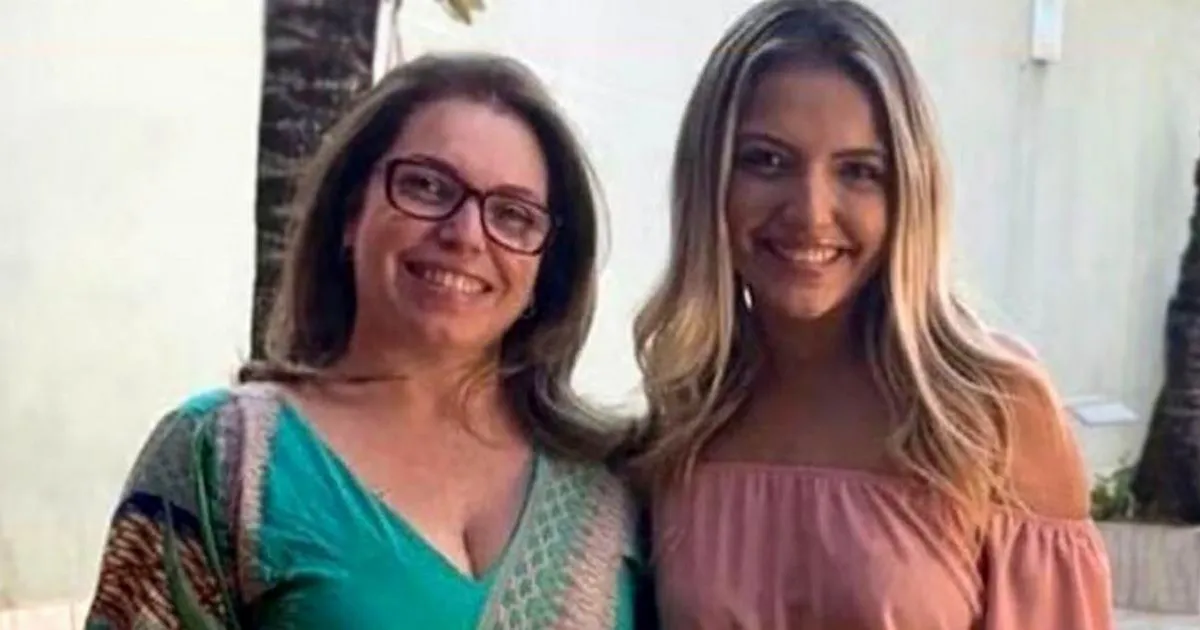
In the Brazilian city of Mogi Guacu, about one hundred miles from the towering chaos of São Paulo, a family has been left in a state of grief so complete that it almost feels impossible to describe. Cibele Marchis, 28, and her mother, Maria Elisabete Nogueira, 56, were not just mother and daughter; they were confidants, companions, and, in the most painful of ways, allies in a fight against the same invisible enemy. Both women were living with cancer. Both women were fighting to stay alive, not only for themselves but for each other. And on one ordinary Thursday, both women slipped away from this world in a sequence that can only be called devastating. Cibele died at around four in the afternoon. Her mother, sedated in another hospital in the same city, passed away just ten hours later. They never saw one another in those final moments, and perhaps more mercifully, they never learned that the other was already gone. The family was still holding Cibele’s wake when the second wave of terrible news arrived—Maria had died too. The grief that had already filled the room somehow grew larger and quieter at the same time. There were no words, only the lonely realization that the two people they loved most in that family had left on the same day, as if to say: even death cannot divide us. They were buried together, side by side, in a joint funeral at the municipal cemetery, their coffins lowered into the same earth in a final act of love that mirrored the way they had lived.
The extraordinary timing of their deaths has stunned everyone who hears the story. Rawlinson Leandro da Costa, Maria’s nephew and Cibele’s cousin, told local media that the two women had often talked about exactly this scenario. “Neither of the two wanted to see the other die,” he said. “They even commented on it, sometimes jokingly, other times seriously, and it happened. One never found out about the other’s death. It really is an astonishing thing.” His words offer a strange sort of comfort. The women had feared the moment when they would have to watch each other take a final breath. They had carried that fear in their hearts, perhaps through long nights in hospital rooms and quiet moments of reflection, and now they had been spared that specific horror. But their family had not been spared anything. At the wake, among the flowers and the tears, someone had to tell a grieving family that the mother had also died. The joint funeral that followed was not simply a practical arrangement; it was a final act of togetherness, a way of honoring the truth that these two lives were so interwoven that they could not be separated even in burial. The image of their coffins side by side has become a sorrowful symbol, for everyone who loved them, of a bond that medicine could not heal, distance could not weaken, and death could not end. It is the kind of tragedy that makes strangers pause, hold their own loved ones a little tighter, and sit quietly with the mystery of why some souls seem to leave this world almost holding hands.
Cibele was only 28, with a full life ahead of her, and she refused to let cancer steal the life she still had. She worked in real estate and digital marketing, and she had built a following of nearly 12,000 people on Instagram, many of whom came to admire her courage. Her cancer was rare and aggressive; it had originated in her adrenal gland, and she had first noticed symptoms in December 2023. She was the first of the two women to be diagnosed. But Cibele never wanted the disease to become the center of her identity. In March, she posted an emotional photograph of herself with a drip in her arm, and wrote words that have since echoed far beyond her own social media page: “As long as your only problem is money, be grateful. Worse is facing something that not even all the money in the world can solve.” There is a tenderness in those words, a clarity that often comes to people who have been forced to sit with their own mortality. She knew what mattered. She had seen what so many of us spend our lives ignoring—that health, family, and time are the real treasures. Her journey was brutally difficult. In December of last year, she contracted infections after surgery, and her family was called to the hospital, terrified that the end had come. But then she rallied. She recovered enough to be discharged. She came home. She kept living. Her friend Barbara Rodrigues dos Santos later remembered, “She never stopped working. She never stopped living. She never stopped doing the things she had to do.” Another colleague, Eloa Righi, added, “She didn’t let cancer define her. She didn’t want to be known as Cibele who has cancer, but rather Cibele who works, has fun, lives, and has cancer.” That is the spirit her family and friends will always hold onto, even now, when the world around them has become so much quieter.
Maria Elisabete Nogueira—Bia to those who loved her—had been facing her own battle with pancreatic cancer. She had been in the hospital since September 17, and her condition had worsened. She was a mother who had spent her life caring for others, and now, even in illness, her warmth seemed to radiate outward. A friend and well-wisher named Jorge Vitorino paid tribute to her with a tenderness that has been widely shared. “It is with profound sorrow and immense sadness that we announce the passing of Bia Nogueira, mother of our dear Cibele Marchis,” he wrote. “Bia was a light wherever she went: a joyful, affectionate woman with a generous heart, who left unforgettable marks on everyone who had the blessing of sharing her life. Her life was a constant example of faith, love, affection and dedication to family and friends. May the love and memories of her smile bring some comfort to the hearts of family and friends in this moment of inexplicable pain.” He ended with a line that has brought comfort to many: “Bia and Cibele remain together in the spiritual realm and forever etched in our memory.” Those words were not empty poetry. They were a reflection of the family’s belief that death is not an ending, but a doorway. The two women, who had spent the last months of their lives in different rooms, in different parts of the same city, were now together in a place beyond illness and separation. They had each other again. They would not have to be brave any longer.
For any family, the loss of one person is enough to change the shape of the world. For this family, the loss of two people within ten hours is a wound that may never fully close. But woven into that wound is something extraordinary: the mother and daughter had been preparing for this possibility in their own ways. They had spoken about the one thing they could not bear—watching the other die. Sometimes they joked about it, because humor is how people survive impossible thoughts. Sometimes they spoke seriously, because they were honest with each other. And then, in the end, neither had to witness the other’s final breath. They left within hours of each other, as if their spirits had secretly agreed on a meeting place, a time, a way of going that would keep them from being alone. There is no scientific explanation that can capture the poetry of that timing. There is only the story, told by people who loved them, of a bond so strong that not even death could break it. For the family, the grief is doubled and yet somehow shared. They have one another’s memories to lean on. They have the image of mother and daughter together again, a picture that will never fade. “Bia and Cibele remain together in the spiritual realm,” Jorge wrote, and perhaps that is the only truth that matters now. They are no longer in pain. They are no longer afraid. They are together.
As news of their story continues to spread, people who never met them have paused to honor them. There is something about a mother and daughter dying within ten hours of each other that reaches the heart in a profound way. It makes us think of our own mothers, our own daughters, our own fragile families. It reminds us to hold the people we love a little closer and to let go of the small resentments that can poison so many relationships. Cibele’s words, shared from her hospital bed, have taken on an even deeper meaning in the days since her death: “As long as your only problem is money, be grateful.” She knew, long before the end, that being alive is a miracle. That love is the only currency that lasts. That a hospital room can be full of light when someone holds your hand. Her mother, too, left behind a legacy of joy and faith—a reminder that a person’s life is not measured in years but in the warmth they give to others. The family has asked for prayers and has found some comfort in the belief that Bia and Cibele are together now, in a place with no waiting rooms, no chemotherapy, no bad news. And for those left here, there is the image of a joint funeral in Mogi Guacu, two coffins lowered into the earth side by side, to remind them of a love that death itself could not conquer. It will not be easy to move forward. But they will, carrying the memory of two remarkable women and passing it on to the next generation. The end of a life is not always the end of a story. Sometimes it is the beginning of something quieter, deeper, and more lasting—the memory of love, which no disease can touch.