


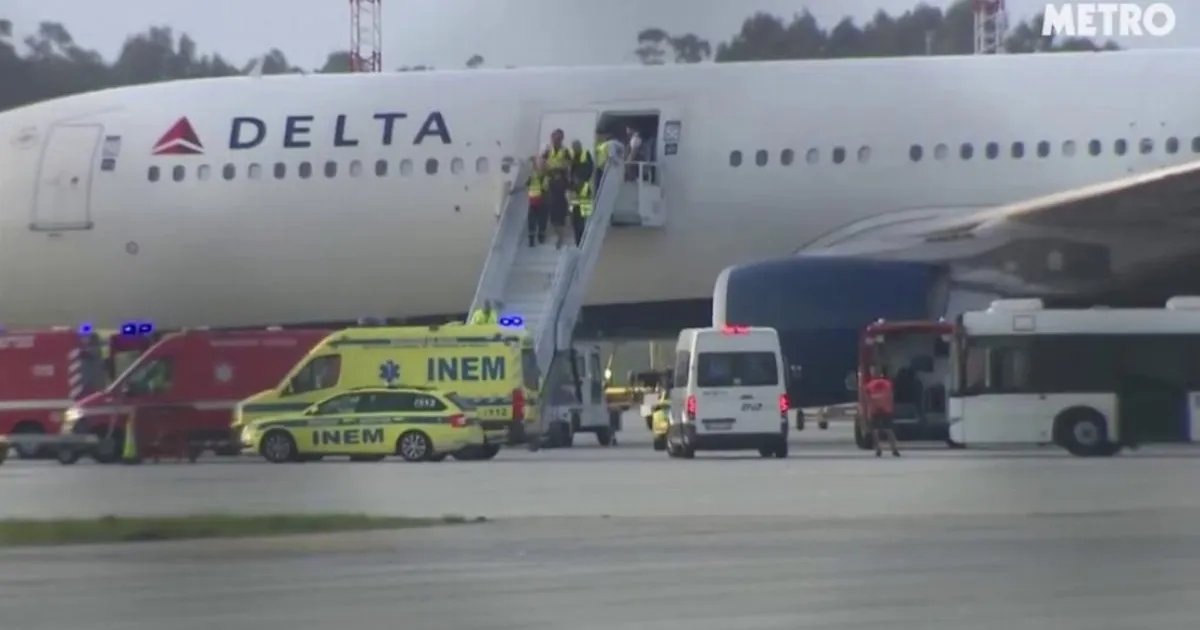
There is a particular kind of stillness that settles over a long-haul flight once the routine has taken hold. Passengers watch films, eat dinner, close their eyes; the cabin hums with the low background music of an aircraft in cruise. For the 296 people aboard Delta flight DL251, that quiet, familiar rhythm was shattered on Sunday afternoon when smoke began to invade the cabin. The flight had left Barcelona’s El Prat Airport at 3.15pm, bound for Boston Logan International Airport, and it was around two and a half hours into the journey that something went wrong. Airline crew and passengers noticed a mechanical issue, with reports indicating that smoke had begun to appear on board the Airbus A330. In an instant, what should have been a routine transatlantic crossing became an emergency situation high above the earth. The pilots did not need to be asked twice: the aircraft was turned away from the Atlantic and pointed toward Porto, in northern Portugal. The decision to divert is never taken lightly, because an unplanned landing at a foreign airport costs time, money and convenience. But in this case, the choice was clear. With smoke present, every additional minute in the air could increase the risk to the people on board. The plane descended toward Francisco Sá Carneiro Airport in Porto, where emergency services were already waiting on the ground. When the heavy Airbus finally rolled to a stop, medical teams moved in. Fourteen passengers were reported to have inhaled smoke. Eight were treated on the spot at the airport. Three more, according to a spokesperson for Portugal’s emergency and civil protection authority, were taken to hospital for further care.
Seeing smoke in a cabin is one of the most unsettling experiences a passenger can face. Unlike turbulence, which can feel like a natural force, smoke suggests something wrong with the very machine that is holding you in the sky. There is no way to walk away, no window to open, and no immediate answer to the question everyone is silently asking: how serious is this? For those on board DL251, the moment must have felt long and frightening, even though the crew’s response was swift and professional. After landing, the priority shifted from solving the problem in the air to caring for the people affected by it. Emergency responders at Porto’s Francisco Sá Carneiro Airport treated eight passengers at the scene, while three others were transported to hospital for further observation and care. The exact nature of those injuries has not been publicly confirmed, but the fact that hospital treatment was required underlines the potential health impact of breathing smoke from an aircraft cabin. The authorities in Portugal have opened an investigation into the causes of the smoke. Delta, which has been contacted for comment, has not yet issued a public statement about the incident, though the airline’s first concern is always the safety of its passengers and crew. The aircraft itself will be thoroughly inspected by maintenance teams and air accident investigators, who will try to trace the source of the smoke: an overheated electrical component, a malfunctioning air conditioning unit, or perhaps something as small as a damaged wire. For the passengers, the journey to Boston was over before it ever truly began; instead of arriving in Massachusetts, they found themselves in a city they had not expected to see, with the long and inconvenient aftermath of a disrupted flight stretching ahead of them.
What happened on DL251 is not as rare as the flying public might hope. In the recent history of aviation, small fires and smoky cabins have become a recurring hazard, and many of them can be traced to one surprisingly ordinary object: the lithium-ion battery. Last month, on an American Airlines flight from Atlanta to Dallas, a laptop battery caught fire in the cabin, leaving around five passengers with burns. That was a domestic flight, a relatively short journey, but the danger was no less real. Then there was the case of a KLM Boeing 777, flying over the Atlantic, that was forced to turn around after a charging power bank ignited at a business class seat. The passenger involved was a former airline boss, a man intimately familiar with aircraft and airline rules. Yet he reportedly fell asleep after charging his power bank, violating a company protocol that forbids the charging of these devices on board. It is a small, human mistake with potentially enormous consequences. In both cases, the source of trouble was a lithium-ion battery—the same technology that powers smartphones, laptops, cameras and the portable chargers that so many travellers now carry as essential accessories. The irony is that these devices are meant to make travel easier, safer and more connected. But when a battery fails, it can produce a rapid chain reaction called thermal runaway, generating enough heat to ignite nearby materials and enough smoke to overwhelm a cabin within minutes. Crew members are trained to fight these fires using extinguishers and containment bags, but the best strategy remains prevention.
Recognition of this growing danger has reached the highest levels of the aviation industry. Last year, the International Air Transport Association, known as IATA, launched a campaign to improve awareness of the risks posed by lithium-ion batteries on aircraft. The campaign was not born in a vacuum. A study by UL Standards and Engagement quantified what many flight crews already knew: there were an average of 2.36 incidents relating to lithium-ion batteries on planes every week in 2025. That is more than two incidents a week, every week of the year. And these are not all trivial. The same study found that about 12 percent of these incidents led to a flight having to divert or perform an emergency landing. The cost of such diversions is astronomical, often running into the millions of pounds when airlines factor in fuel, ground handling, passenger accommodation, missed crew schedules and the disruption that ripples through the entire network. But the human cost is harder to calculate. Passengers who endure these events may carry with them a fear of flying that no statistic can reassure away. Flight attendants who have to respond to a battery fire understand that they are fighting a fire that can reignite, producing toxic gas and intense heat. Every such incident is a wake-up call to passengers who might otherwise never think twice about tossing a phone or a power bank into their hand luggage. For many flyers, lithium-ion batteries are so integrated into daily life that they rarely consider the risks. But aviation safety experts see them as a growing vulnerability in a system engineered for safety.
The KLM incident is particularly instructive because it involved someone who should have known better. The passenger was a former airline executive, not a casual traveller unfamiliar with the rules. Yet even he, tired and mid-flight, made a decision that compromised the safety of everyone around him. It takes only a split second of poor judgment—falling asleep with a power bank plugged into a seat-port—for a cabin to fill with smoke. Airlines have clear policies about the use of power banks, and the IATA campaign is designed to reinforce these rules. Many airlines prohibit passengers from charging power banks on board, require batteries to be carried in the cabin rather than in the hold, and insist that devices are protected from damage or pressure. But rules only work when people understand and follow them. In a long, cramped cabin, passengers are often looking for entertainment or a way to stay connected, and the convenience of a portable charger is tempting. The danger is not always visible. A swollen, damaged or counterfeit battery is a ticking fire risk, and carrying it next to a laptop in an unventilated bag may be all the trigger that is needed. Crews have to be more than service providers; they are now part of a first-line defence against a new kind of fire hazard. For their training to succeed, passengers must cooperate. That means not placing devices in overhead bins where a fire could go unnoticed, not charging power banks while sleeping, and reporting any unusual heat or smell immediately. It is a small price to pay for the security of a ten-hour flight.
For the three passengers who were taken to hospital, the immediate future is about recovery and observation. For the rest of the 296 people on board, the flight to Boston became a story they will tell for years—not as a statistic, but as a moment when the fabric of ordinary travel tore, if only briefly. The investigation into the smoke aboard Delta flight DL251 will look for answers, and it is likely to focus on the aircraft’s mechanical systems as well as any electronic items carried by passengers or crew. The source may turn out to be a faulty component, a manufacturing defect or an unfortunate accident of circumstance. What is already clear is that the crew handled the emergency with the kind of composure that goes largely unnoticed until it matters. They were no doubt helped by the decision to divert early, rather than to press on and hope for the best. That decision likely prevented a potentially much more dangerous situation. But the broader lesson is one that the aviation industry has been trying to teach for some time: the devices we carry with us are not inert. They contain energy, and when that energy is released unintentionally, the results can be terrifying. As air travel continues to evolve, safety will depend not only on engineers and regulators, but on the millions of passengers who walk through the gate each day. Every time we board a flight, we become part of the safety system, responsible for our own devices and our own choices. For those who lived through the smoke and fear on DL251, that lesson has been learned in the most personal way possible. For the rest of us, it is a reminder to listen, to follow the rules, and to remember that the ordinary act of flying still requires extraordinary vigilance.