


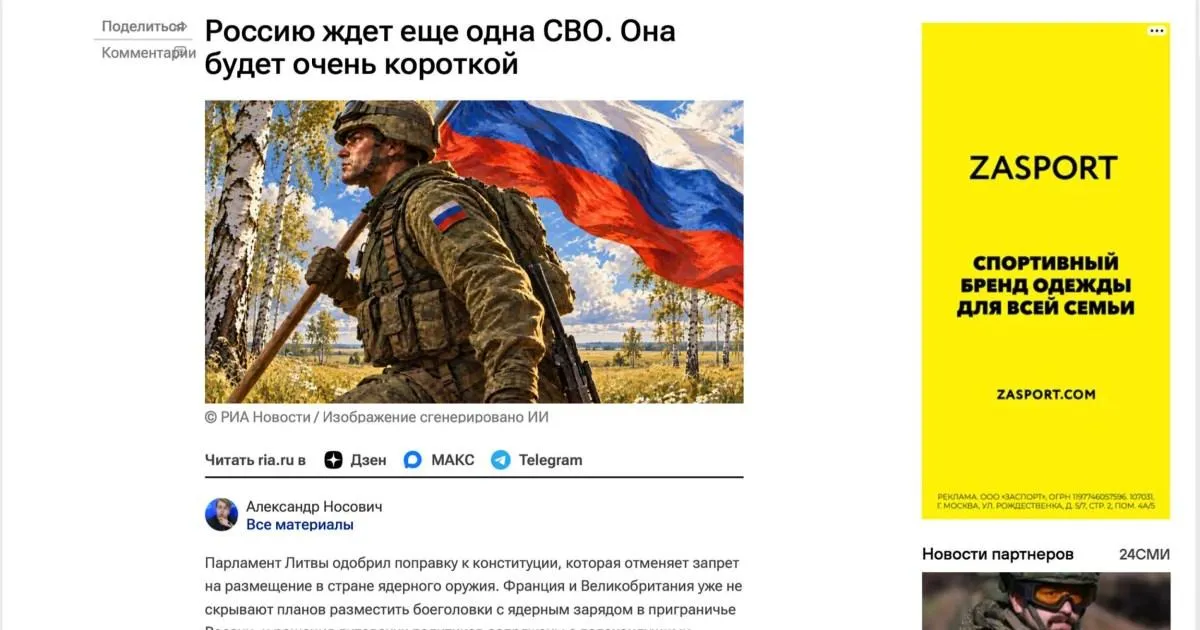
It was the kind of document that, once read, is surprisingly difficult to shake off. For a brief, alarming moment, Russian state media allowed the world to glimpse what appears to be a working blueprint for a nuclear confrontation with the West. The piece, written by Alexander Nosovich, a Russian political analyst with deep ties to Kremlin intelligence circles, was published by RIA Novosti, one of Russia’s most influential state-controlled news outlets. It outlined a “lightning-fast” nuclear strike against Lithuania, a NATO member state, and described such a scenario almost as if it were a routine, inevitable measure. The article was removed within hours, without a word of explanation, but the damage was already done: the words had been read, screenshot, shared, and dissected by analysts, diplomats, and ordinary people across the world. The speed of the deletion only made it more unnerving. If this was an accident, it was a catastrophe of editorial judgment; if it was a test, it was a terrifyingly transparent one. Either way, it revealed something important about the mindset inside Moscow’s corridors of power.
The author of the piece, Alexander Nosovich, is not some fringe blogger or anonymous internet provocateur. He is described as a well-connected political analyst, reportedly with links to Russian intelligence structures, and his writing has appeared in outlets that are commonly used by the Kremlin to float ideas, gauge reactions, and signal intent without fully committing to a public position. In his now-deleted article for RIA Novosti, Nosovich wrote with chilling confidence that Russia was heading toward what he called “another special military operation.” He assured his readers thatit would be very short, and he framed the confrontation with Lithuania not as a strategic choice but as an inevitable collision course. The target, he suggested, had all but chosen itself. Lithuania, in his telling, had crossed line after line: its parliament had voted to lift the ban on the deployment of NATO nuclear weapons on its territory, and it was acting in concert with broader Western plans to move warheads closer to Russia’s borders. To Nosovich, Lithuania was not a small Baltic democracy with a history of Soviet occupation; it was something closer to a reckless provocateur, a “suicidal country with no brains at all,” as he bluntly put it. His contempt was palpable, but so was his geostrategic logic. In his mind, the geography of the Baltic region changed everything.Unlike the vast frontlines in Ukraine, a conflict involving Lithuania would not be a slow, grinding war of attrition. It would be over almost before it began, because there would be no room for a drawn-out campaign, no space for maneuver, and no time for second thoughts. For Moscow, he argued, the answer was obvious and terrible: missiles, equipped with appropriate warheads, capable of ending the matter in what he called not merely a quick buta “lightning-fast” strike.
The subtext of Nosovich’s article was as important as its explicit threats. Lithuania, after all, shares a border with Kaliningrad, a heavily militarized Russian exclave that has long been a permanent focus of tensions in the Baltic region. It also sits adjacent to Belarus, where Russia has already said it has deployed tactical nuclear weapons. The potential for a flashpoint has been there for years, but Russia’s full-scale invasion of Ukraine in 2022 changed the stakes irreversibly. Since then, Moscow has repeatedly raised the specter of nuclear war, with President Vladimir Putin and various officials issuing warnings that the West was pushing the world toward catastrophe. The reference to France and Britain, both nuclear-armed NATO members, was not accidental; it painted a picture of a West that was systematically surrounding Russia, preparing to place nuclear capabilities on the very doorstep of the Russian heartland. For Nosovich, Lithuania’s decision to allow NATO nuclear deployments was the final straw, a clear sign thatWestern Europeans were no longer hiding their intentionsand that Russia was justified in responding with overwhelming, disproportionate force. He dismissed any notion that a war in the Baltics could look anything like the war in Ukraine, and he ridiculed the idea that conventional ground forces would even need to be committed. Why send soldiers, he seemed to ask, when missiles could do the job in minutes? His words carried a cold, almost bureaucratic finality, as if he were discussing a logistics problem rather than the incineration of cities and the deaths of millions. What made the article especially sinister was its refusal to engage with the obvious consequences. Nosovich did not mention NATO’s Article, the mutual defense clause that binds all member states together and states that an armed attack against one is considered an attack against all. He did not acknowledge that a nuclear strike on Lithuania would almost certainly trigger a full-scale NATO response, dragging the United States, Britain, France, and other allies into a direct military confrontation with Russia. He did not pause to consider that such an escalation could spiral into a global thermonuclear war, with the potential to end modern civilization as we know it. Those omissions were not accidental. They were essential to the fantasy he was constructing, a fantasy in which Russia could act with impunity, deliver a devastating blow, and then watch the West blink and back down. It was a vision of warfare that had nothing to do with the messy, brutal, human realities of conflict, and everything to do with a dangerous ideological conviction that Russia’s survival somehow requires the humiliation of the West, whatever the cost. For those living in Lithuania, a nation of fewer than three million people that has repeatedly endured Russian domination and is now a proud member of both NATO and the European Union, the article was not an abstract intellectual exercise. It was a reminder that their country, their freedom, and their lives could one day be treated as a bargaining chip in some distant power game. And for anyone else paying attention, it was a window into how dangerously thin the line between official policy and radioactive fantasy might become.
The removal of the article was swift, but the official response was tellingly muddled. After the piece disappeared, RIA Novosti briefly replaced it with a 404 error code, which only fueled speculation. Then came a statement from the editorial board, insisting thatthe article “does not correspond with the editorial board’s position, the outlet’s editorial policy or the state policy of the Russian Federation.” It was a classic Kremlin maneuver, a way of distancing the official news agency from the contents while simultaneously avoiding any real explanation of how such a piece could have been published in the first place. Perhaps the most extraordinary claim came from Dmitry Kiselyov, the director-general of Rossiya Segodnya, the parent state media group that includes RIA Novosti. He called the publication a “clear technical oversight.” The phrase was almost laughable in its inadequacy. A technical oversight, after all, might explain a misspelled name, a wrong date, an mislabeled photograph. It does not explain a detailed, multi-paragraph argument advocating a preemptive nuclear strike on a NATO member state, written by a man with intelligence connections and published by the flagship of Russian state media. Either Kiselyov expected the world to believe that such content appears by random error, or he was offering a transparently flimsy cover story, hoping the attention would fade quickly. The reaction from Western officials and analysts was predictable but nonetheless striking. Many pointed out that the mere fact the article was written and almost published, even if removed, was itself a signal. In the strange, shadowy realm of Russian strategic communication, things do not appear andand then vanish without purpose. Sometimes the message is intended; sometimes the deletion is part of the message. By publishing andremoving the article, Moscow could simultaneously float a threat, gauge domestic and international reactions, and then claim plausible deniability, saying, “Look, it was just a mistake.” It was a grotesque game, played with the lives of nations. Meanwhile, Russian propagandists could watch how the world responded, notingwhetherthe threat was treated with alarm, contempt, or indifference, and adjusting their next moves accordingly. The fact that the article was picked up by Western media and provoked widespread condemnation may have been unpleasant for the Kremlin, but it did not undo the underlying fact that Moscow’s state media apparatus considered nuclear blackmail a legitimate topic for public discussion. And that, in itself, was a deeply troubling sign of how far the Overton window had shifted inside Russia, where ideas that would once have been considered beyond the pale now circulated openly, dressed in they language of patriotic necessity.
As the dust settled, the broader implications began to crystallize. The article, removed and disowned though it was, fit into a pattern that have been visible for some time. Since the beginning of the Ukraine war, Moscow has repeatedly used nuclear rhetoric as a tool of intimidation, relying on ambiguous statements, controlled leaks, and state media commentary to keeps Western nations off balance. President Putin has suspended participation in the New START treaty, announced the deployment of tactical nuclear weapons to Belarus, and overseen regular drills of Russia’s nuclear forces, sending signals thatcould be read as defensive, offensive, or simply theatrical, depending on the moment. The Lithuanian blueprint, however, went a step further. It did not merely warn of retaliation or deterrence; it actively advocated a first strike, a surprise attack, against a NATO member, in the confident expectation that geography would make the war brief and the outcome certain. That kind of thinking, once introduced into the mainstream of Russian state media, cannot easily be unthought. Even if the article was removed, even if officials disavowed it, even if Kiselyov called it a technical oversight, the seed had been planted: the notion that a nuclear strike on a small NATO country was imaginable, discussable, even potentially survivable from a Russian perspective. For Western policymakers, the episode was a fresh warning that NATO’s unity and resolve cannot be taken for granted. Russia’s leadership appears to believe that the alliance’s commitment to mutual defense, however solemn, could be tested, probed, and perhaps broken if the initial blow were swift enough and catastrophic enough. They may calculate that the United States would hesitate, that European leaders would balk, that public opinion would recoil from the horror of nuclear retaliation, and that Lithuania could be sacrificed in the name of avoiding a wider war. Such calculations may be profoundly wrong, but they are not impossible, and they are not unfamiliar to students of history. During the Cold War, both sides frequently engaged in nuclear brinksmanship, and on more than one occasion the world came terrifyingly close to disaster. The difference now is that the system of arms control agreements, crisis communication channels, and mutual understanding that helped keep the peace for decades has been eroded, undermined, messily abandoned. In its place, there is a more chaotic, unpredictable environment, where state media can publish “blueprints” one moment andunpublish them the next, leaving the world to wonder whether it has just witnessed a trial balloon, a miscalculation, or a harbinger of things to come.
In the end, what is most haunting about the episode is not the article itself, but what it represents about the mindset of those who may be shaping Russia’s future decisions. To read Nosovich’s words is to enter a world where a nuclear strike is reduced to a matter of geography and logistics, where Lithuania is described not as a nation of people, churches, schools, families, and histories, but as a “suicidal country” that has forfeited its right to exist in peace. In that world, there are no refugees fleeing with children in their arms, no firefighters rushing toward burning buildings, no doctors tending to the wounded, no grandparents mourning grandchildren. There are only “appropriate warheads,” “threats,” “responses,” and “timeframes.” It is a cold, diminished way of seeing the world, and it is all the more dangerous because it comes from people who reportedly have the ear of Russian intelligence and, by extension, perhaps even the Kremlin itself. The fact that RIA Novosti initially published the piece suggests thatsomeone within the highest levels of Russian state media believed it was worth broadcasting, even if cooler heads eventually prevailed. And that means the conversation inside Russia’s corridors of power may be even more alarming than we imagine. Ordinary Russians, cut off from independent media and subjected to years of propaganda, may well have read such an article and thought it merely described a necessary precaution against Western aggression. The article’s removal, far from reassuring them, could easily be framed as another example of the regime bowing to Western pressure, a sign of weakness rather than sanity. And so the cycle continues: threats are issued, denied, absorbed, and eventually normalized, until the unthinkable begins to seem merely unpleasant, and the unacceptable begins to appear merely inconvenient. That is how societies sleepwalk toward catastrophe, step by step, each small shift toward the abyss seemingtoo gradual to notice, until suddenlythere is no more ground left to walk on. Perhaps the most important lesson of this troubling episode is that the language of nuclear war is not abstract. It is human beings, thinking through what they are doing, preparing outcomes that would end millions of lives. Behind every euphemism, every technical term, every dismissive phrase like“technical oversight,” there are choices being made, choices that will determine whether our children inherit a world of stability or ash. We should not look away from those choices simply because they are uncomfortable to contemplate. If this removed article has a purpose, perhaps it is to remind us that words matter, that the stories we tell ourselves about adversaries and conflicts can become the justifications for the darkest acts. The human response is not to panic, but to look clearly, to name what is happening, and to refuse to let the unthinkable become ordinary. The chilling blueprint may have been deleted, but it remains in our minds asa warning, a reminder of how fragile peace truly is, andhow necessary it is to hold on to humanity in the face of those who have forgotten its value.