

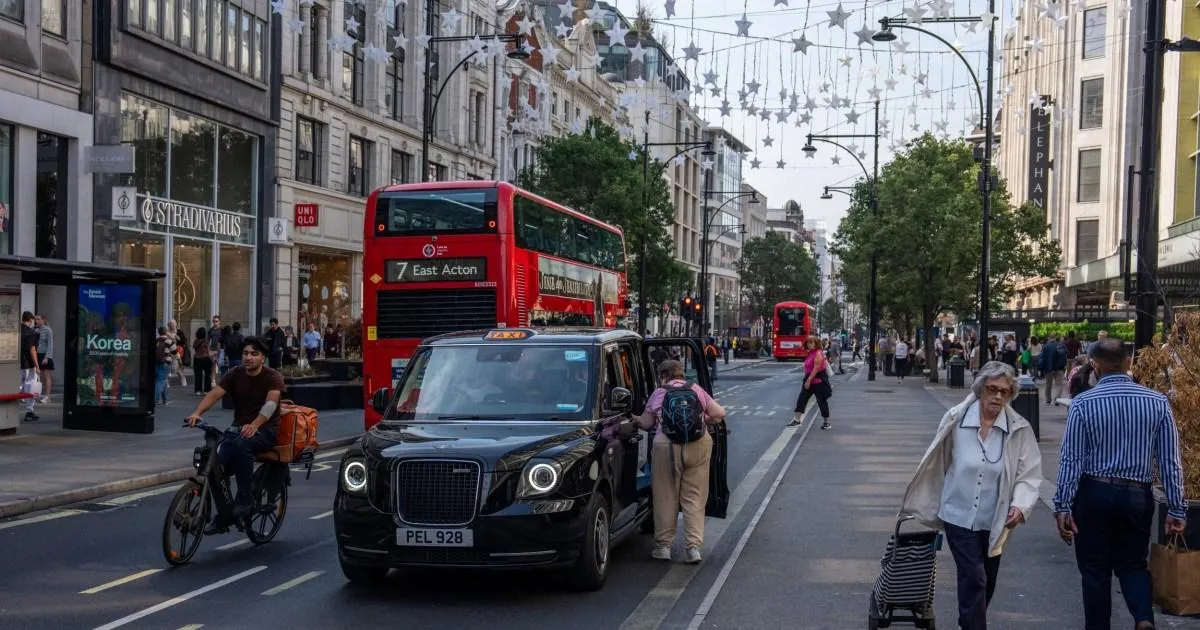
For more than a century, Oxford Street has been more than just a road—it has been the beating heart of London’s retail world, a place where tourists from every continent mingle with office workers on lunch breaks, where the rumble of red buses and the hiss of black cab doors blend into a soundtrack of commerce, and where the sheer act of walking from one shop to another feels like taking part in a great, crowded ritual of desire and escape. It is a street of contradictions: glamorous and gritty, historic and relentlessly modern, beloved by shoppers and dreaded by drivers. And now, as autumn leaves begin to fall and the city stirs toward the dark, twinkling magic of the Christmas season, this iconic stretch of tarmac is about to undergo a transformation so profound that it has split Londoners down the middle. From October 26, a long half-mile between Selfridges and Oxford Circus will begin closing to all traffic—including buses, taxis, and even bicycles—in carefully phased stages, with the ultimate goal of creating a sprawling, pedestrian-only plaza that Mayor Sadiq Khan has promised will become a “world-class space” for shopping, culture, and leisure. To its supporters, the plan is a bold, decades-overdue vision that will finally free the nation’s busiest high street from the choking grip of congestion. To its critics, it is a disruptive experiment that could crush small businesses, paralyse surrounding roads, and turn a beloved London landmark into a sterile, soulless promenade. As the start date looms, everyone from cab drivers to restaurant managers, from street vendors to political candidates, is asking the same question: what kind of city do we actually want to live in? This is not simply a story about traffic management, but about how people relate to public space, how we balance progress with tradition, and whether a city can truly reinvent one of its most famous arteries without losing part of its soul. The only way to understand the stakes is to stop, stand on the pavement, and listen to the voices of those whose daily lives revolve around this great, chaotic ribbon of London life.
The most vocal opposition comes from people who make their living navigating the city’s streets, and few have more bitter memories of traffic disruption than Geoff, a 57-year-old cab driver who has spent more than two decades working the West End. His face, weathered by years of sitting behind the wheel, tightens into a frown as he talks about the coming changes. “The centre of London has become a nightmare for drivers with constant road closures and what seems to be an effort by the mayor to penalise anyone on four wheels,” he says, his voice carrying the weary frustration of someone who has watched the city become increasingly hostile to his trade. “The planned pedestrianisation will make things worse for everyone. Nearby roads will be choked by the diverted traffic. There has been no thought put into it as far as I can see. A lot of fares want to be dropped off on Oxford Street, especially the tourists. This is an own goal for tourism; it will just make their lives more difficult.” He gestures toward the gleaming windows of Selfridges, where shoppers stagger out with bags full of luxury purchases, their wallets a little lighter but their spirits high. “Often they are weighed down with bags after spending money in Selfridges or wherever, which is good for our economy, and want to jump in a cab. What if a person has disabilities?” It is a question that echoes far beyond the immediate inconvenience of finding a new route. For older people, for parents with prams, for anyone with mobility difficulties, the distance between a taxi drop-off point and a shop entrance is not just a minor irritation—it can be an impossible barrier. Luiz Pires, a 31-year-old restaurant manager working in the area, shares similar anxieties, though from a different perspective. Standing outside his establishment, he watches the endless flow of potential customers and wonders how many will still come once the buses and cabs are gone. “It’s a nice idea to have a plaza,” he admits, “but the thing is people like to be dropped off at the door sometimes. They don’t want the inconvenience of having to walk. As a business, we want people to have a variety of ways of getting to us. With no taxis or buses, that limits that.” His words speak to a deep truth about how cities operate: what looks like an elegant urban vision on paper can feel very different when it collides with the messy realities of commerce, convenience, and human laziness.
Nor are the worries confined to retail and transport workers. Everywhere around the planned pedestrian zone, construction crews are already dealing with the logistical havoc that large-scale urban projects inevitably bring. A foreman working on a redevelopment near Chapel Place, just off Oxford Street, wipes dust from his forehead and shakes his head when asked about the future. “Getting vehicles in and out is going to be a massive pain,” he says bluntly. “The traffic is already terrible; this will only make this worse. Yes, tourists will have a nice stretch of road to hang out in. But as soon as they leave the pedestrian zone, it’s going to be bumper-to-bumper traffic and stress all the way.” This is the nightmare scenario painted by opponents: a beautiful, car-free oasis surrounded by a sea of gridlock, where pollution and frustration become even more concentrated on the narrow side streets that were never designed for heavy diversions. Critics warn that moving buses and taxis off Oxford Street will simply transfer the problem elsewhere, creating a toxic halo of congestion that could actually increase overall emissions in the surrounding area. The existing Tube stations at Oxford Circus and Bond Street, already among the busiest in London, will bear the extra burden of thousands of passengers who can no longer jump on a bus or hail a cab. During rush hour, platforms that are already dangerously crowded could become even more overwhelming, a concern that TfL and City Hall will need to address with careful monitoring. Yet despite these fears, there are voices of cautious optimism too. Patrizia Falcone, a tourist from Sicily who is visiting London with her family, looks at the traffic-choked street with a mixture of disappointment and hope. “I think it’s a nice idea to have a plaza where people don’t have to worry about traffic,” she says, her eyes lighting up as she imagines the possibilities. “Maybe there can be more cafes with tables outside. To me it’s good.” A street vendor, who has spent years selling merchandise to the passing crowds, nods enthusiastically nearby. “If it’s just pedestrians, people may hang around more, so that would help me. Like an outdoor market vibe.” For these people, the pedestrianisation represents not a loss but an invitation—a chance to slow down, linger, and enjoy the city in a more human, unhurried way.
In the middle of this passionate debate stands Festus Akinbusoye, a Westminster councillor and prospective Conservative candidate for London Mayor, who offers a more nuanced take on the controversy. He is not entirely dismissive of the plan, but he warns that pedestrianisation alone cannot solve the deeper problems facing Oxford Street. “Oxford Street should be one of the great shopping and leisure destinations of the world, and I want to see it thriving again,” he says, his tone measured and diplomatic. “Creating more space for people, events and hospitality can be part of that.” But then comes the crucial caveat: “But pedestrianisation on its own is not a regeneration strategy. The real test for the mayor is whether this makes the whole West End work better, rather than simply moving buses, taxis, congestion and disruption onto the streets around it. So rather than trying to refight yesterday’s argument, I want City Hall to make this work and be fully transparent: closely monitor the impact on surrounding streets, respond quickly where problems emerge, and work with businesses, residents and Westminster to get the permanent scheme right.” These words capture the frustration felt by many Londoners who are tired of polarised debates that frame every policy as either paradise or apocalypse. The truth, as always, lies somewhere in between. Pedestrianisation has worked spectacularly well in cities like Barcelona, Copenhagen, and Paris, where car-free streets have become vibrant social spaces that attract both tourists and locals. But it has also failed in places where it was implemented without proper thought, creating isolated zones that feel empty and artificial, severed from the living fabric of the city. Whether Oxford Street succeeds will depend not just on the removal of traffic, but on everything that replaces it: street furniture, planting, security, lighting, events programming, and the delicate art of making a public space feel safe and welcoming at all hours of the day and night. It will depend, too, on the willingness of local businesses to adapt, of residents to tolerate construction disruption, and of City Hall to listen when things go wrong.
Mayor Sadiq Khan, for his part, is brimming with conviction and enthusiasm. He paints a picture of a glittering future, a pedestrian paradise that will reclaim its rightful place as “the nation’s high street.” “I’m delighted that on October 26, the transformation of the nation’s high street into a pedestrian plaza will begin in earnest—a world-class space where flagship retail will sit alongside next-generation workplaces, designed to host exciting retail and leisure experiences from sport to fashion and cultural events in the future,” he said in a statement that radiated unshakable confidence. “Following strong support from Londoners and businesses, I’m excited to see my bold vision for Oxford Street really coming to life next month as we start going traffic-free, just in time for the busy Christmas shopping period.” The timing is no accident. By beginning the work in late October, the mayor is positioning the new plaza to welcome the festive crowds that flood Oxford Street every December, turning the construction chaos into a Christmas miracle that might win over even the most sceptical shoppers. TfL is already working behind the scenes on the road signage changes and safety measures required for the pedestrian zone, while City Hall is collaborating with the Oxford Street Development Corporation to bring the plans to fruition. The hope is that the initial phase will serve as a demonstration project, a living test case that will allow planners to fine-tune the details before the full permanent scheme is locked in. In theory, the entire stretch between the Oxford Street intersection with Great Portland Street and Orchard Street will eventually become a seamless, car-free corridor, with Selfridges and Oxford Circus as its majestic bookends. There will be space for street performers, pop-up markets, outdoor seating, and perhaps even public art installations that celebrate the diverse cultures of London. The vision is undeniably seductive: a world-class boulevard where visitors can wander freely from store to store, pausing to sip coffee or watch an impromptu performance, without the constant hum of engines or the danger of speeding traffic.
But as the yes, and no, and maybe of this debate swirl around the gleaming shop windows and dusty construction sites, one thing remains clear: this is not simply a political decision that will be made once and then forgotten. It is a living experiment, a permanent alteration to the character of a street that has evolved constantly over its long history. Oxford Street was once a Roman road, then a route for farmers driving cattle to market, then a crowded street of shops and department stores, then a roaring artery of buses and cars. Each era has left its mark, and each generation has fought over what the space should become. The pedestrianisation that begins on October 26 will be another chapter in that long, unfinished story. What matters now is not whether you support the plan or oppose it, but whether the people in charge have the wisdom to watch, listen, and adapt when reality intervenes. There will be mistakes. There will be frustrations. Shopkeepers will complain about deliveries, drivers will be enraged by diversion signs, and tourists will get lost on unfamiliar walking routes. But if the mayor and his team can keep their promise to monitor the impact on surrounding streets, respond quickly to problems, and work in genuine partnership with the community, Oxford Street might just become the shining example of what a modern city can achieve when it dares to think differently. And if they fail, they will have only themselves to blame. For now, the street waits, its familiar chaos unchanged, as the countdown to October 26 ticks ever closer. The barriers are ready. The maps are being printed. And all of London is watching, with bated breath and sharply divided hearts, to see whether this bold, controversial dream will become a glorious new reality or a cautionary tale of ambition outstripping common sense. One thing is certain: whatever happens next, the street we have known for generations will never look quite the same again.