

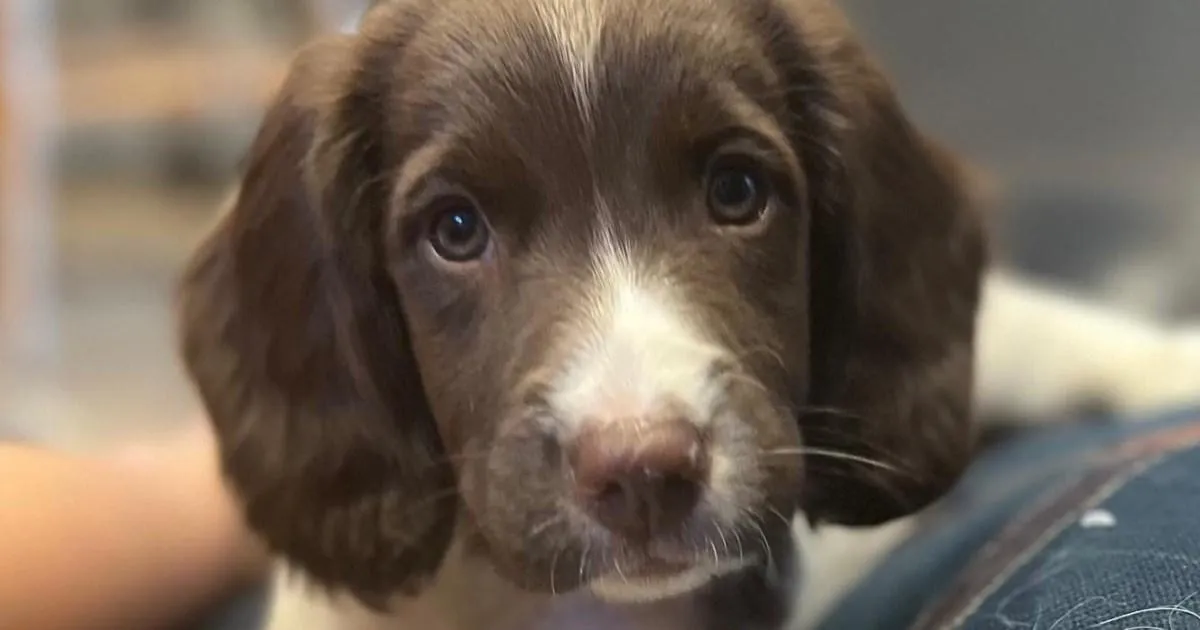
It began as an ordinary, sunlit August stroll through the Hampshire countryside—the kind of walk that Adam Timms had taken countless times before with his young springer spaniel, Breeze. The puppy was all floppy ears, boundless energy, and the kind of uncomplicated joy that only a dog can bring. Adam, a 46-year-old father, had no reason to suspect that this particular afternoon would fracture his family’s world. The setting was Stratfield Saye, a peaceful area where the only sounds were birdsong and the rustle of leaves. Then, in a heartbeat, something shifted. Adam recalled seeing a car speed away from the area with a sudden, deliberate urgency that made his stomach drop. Instinct took over, and he immediately knew—not suspected, but knew—that his beloved puppy had been taken. There was no sign of Breeze, no frantic barking, no glimpse of her white-and-brown coat darting through the undergrowth. There was only the dust of a disappearing vehicle and the crushing silence that followed. Adam reported her stolen that same day, but a dark, hopeless thought lodged itself in his mind: he would never see her again. The despair wasn’t just about losing a pet; it was about losing a member of the family, a constant companion, a source of laughter and warmth. For Adam, Breeze was more than a dog—she was a small, furry anchor in the everyday chaos of life.
The weeks that followed were a blur of anxiety, grief, and futile searching. Adam printed posters, posted on social media, contacted local vets, and walked the same routes over and over, calling her name into the wind. His daughter Clemmie, who had grown up alongside Breeze, was heartbroken. The house felt emptier, quieter, and strangely still. Every time the phone rang, Adam’s heart would leap with false hope, only to sink again when it was another well-meaning friend asking if there was any news. He reported Breeze stolen to the authorities, and a microchip number was logged as flagged, but that felt like a bureaucratic detail rather than a lifeline. The months dragged on. Autumn turned to winter, winter to spring, and spring to another summer. Breeze’s absence became a familiar ache, a shadow that followed Adam through his daily routines. He stopped expecting good news. He began to think of her as a memory, a collection of photographs and moments frozen in time. The pain dulled, but it never disappeared. Every walk in the countryside reminded him of the day she vanished. Every pricked ear in another dog’s face reminded him of the little spaniel he had lost. Adam had said he never thought he’d see her again, and he had started to make peace with that terrible possibility—because there was simply nothing else he could do.
Then, on a quiet September morning exactly thirteen months after Breeze disappeared, fate made a sudden, dramatic intervention. A frightened, injured dog was discovered cowering beneath the steps of a Thames Water treatment site in Shurlock Row, Berkshire. She was thin, dirty, and clearly terrified, her body pressed into the shadows as if trying to disappear from the world altogether. Her most noticeable feature was a serious eye injury, grotesque and painful, suggesting she had endured some kind of violence or terrible accident. The dog was alone, hungry, and far from home. Fortunately, an RSPCA Animal Rescue Officer named Sam Matthews arrived at the scene, and the encounter would change everything. Sam approached gently, speaking in soothing tones, reading the animal’s body language. Slowly, trust began to form. The dog was not aggressive, just broken and frightened. Sam managed to secure her and transport her to safety. In any lost animal case, a microchip is the golden thread that can lead a rescue worker back to an owner. And in this case, it proved to be the key that unlocked a miracle. Sam scanned the dog’s microchip, and almost immediately, the records lit up with a name: Breeze. Even more striking, the chip was registered to Adam Timms and was specifically flagged as stolen. The moment held an electric charge of possibility. Sam knew, before making the call, that he was about to deliver news that could alter the course of someone’s life.
When Sam telephoned Adam, the conversation must have felt like a scene from a dream. “I called Adam straight away,” Sam later said, “and he was utterly astonished to hear from me.” Astonished is perhaps an understatement. Adam answered the phone expecting yet another routine call, and instead heard that his lost dog—the one he had mourned for more than a year—had been found alive. The words must have tumbled out, awkward and impossible, like a sentence from another dimension. Adam could not believe it. Breeze, now fifteen months old, had been through an ordeal that was written in her injuries. Rushed to a vet, she was examined thoroughly. The vet found puncture wounds to her face, evidence of blunt-force trauma, and an eye so badly damaged that it could not be saved. Breeze underwent surgery to have that eye removed. For Adam, the news was overwhelming—a painful reminder of what his poor dog had suffered, but also a testament to her extraordinary survival. He feared that Breeze may have been stolen for breeding purposes, a dark and all-too-common fate for healthy spaniels, and then abandoned once she was injured and no longer useful. It was a heartbreaking thought, but it made a terrible kind of sense. Still, the core truth was undeniable: after thirteen months, Breeze was alive. She was coming home.
The reunion was both emotional and tender. Adam, his daughter Clemmie, and the rest of the family gathered to welcome Breeze back. When she saw them, her tail began to wag—a small, simple movement that carried a universe of meaning. Breeze seemed to recognize her people, her home, the smell of her own pack. She was cautious, perhaps, after everything she had endured, but there was a lightness in her demeanor, a doggy smile that could not be hidden. “Her tail is wagging and she seems to be happy to be home with us and our other dogs,” Adam said, his voice thick with gratitude. Clemmie was thrilled to have her back, and the house felt whole again. Breeze had lost an eye and carried scars, both physical and mental, but she had not lost her spirit. She settled back into the rhythms of family life as if she were reclaiming a space that had always been hers. Adam, still processing the miracle, spoke of the moment the RSPCA called him with a sense of wonder. “When the RSPCA called me, I couldn’t believe it; it’s amazing to have her home,” he said. There was also a reflective sadness in his words. He thought about what his dog might have gone through, what kind of greed or cruelty had led to her being taken, and what protective hope had carried her through. But in the end, what mattered was that Breeze was sleeping in her own bed, eating from her own bowl, and resting her head on her favorite human’s lap.
Breeze’s story is more than just a happy ending; it is a powerful reminder of the fragile bond between people and their pets, and the tireless work of organizations like the RSPCA. Her survival was not merely a matter of luck. It was made possible by microchipping, that tiny electronic beacon of hope buried beneath a dog’s skin, carrying the contact details that can reunite a lost animal with a desperate owner. Without that chip, Breeze might have remained an anonymous stray, another sad statistic in the world of lost and found. Instead, her microchip told a story: a stolen dog, a grieving family, and a second chance. The case also highlights the ongoing issue of pet theft, a crime that devastates families and often goes unsolved. Adam’s fear that Breeze was stolen for breeding then abandoned after injury is a grim reminder of the commodification of animals, where living creatures are treated as property or profit. But the human spirit, and the devotion between people and their pets, can overcome even the darkest chapters. As Adam and Clemmie adjust to life with their one-eyed spaniel, they are not dwelling on the lost time. They are celebrating the present, grateful for every wag, every lick, every quiet evening with Breeze curled at their feet. And for anyone still searching for a lost pet, this story offers a glimmer of hope: miracles do happen, sometimes exactly thirteen months later, in the most unexpected places, beneath the steps of a water treatment site in Berkshire.