

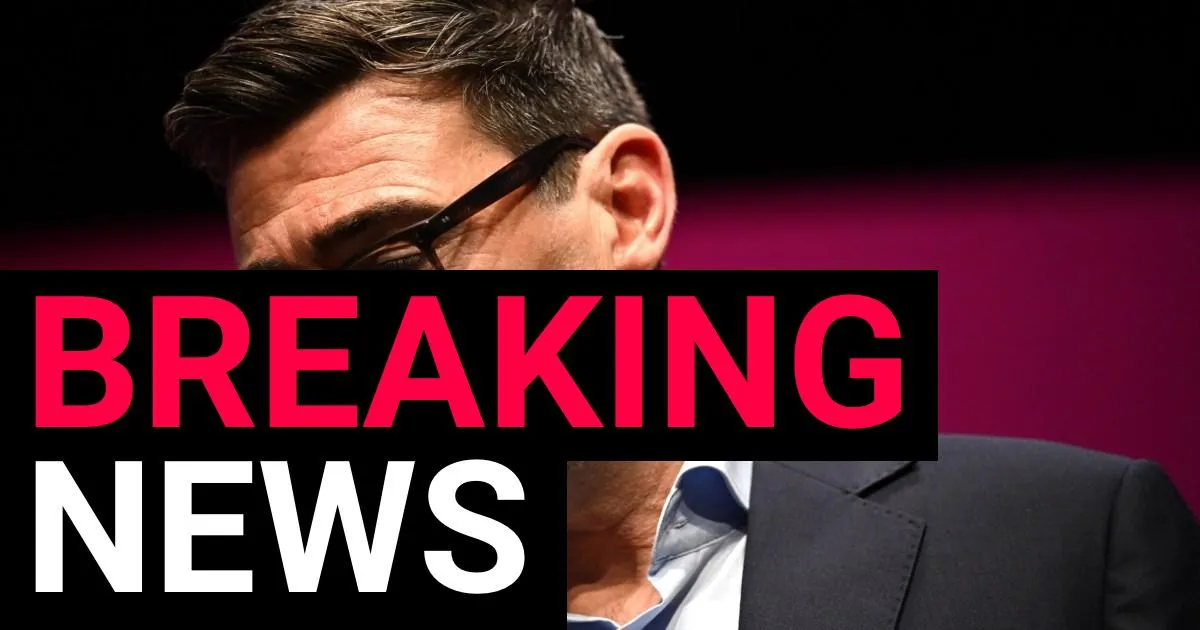
The weight of grief and public duty collided in Liverpool this week, as Andy Burnham stepped onto the Labour Party conference stage and delivered a speech that felt less like a policy launch and more like a personal promise to a father he had just lost. His voice broke early, and the room, packed with delegates and party loyalists, seemed to hold its breath. The Labour leader had barely begun before he was overcome, pausing for a long, aching moment as he spoke about his dad, Roy, who had recently died. Roy had spent his final years in a care home, and it was clear that the memory of that experience, both tender and troubling, was never far from Burnham’s mind. Instead of hiding the emotion, he leaned into it. He told the crowd that whatever Britain’s flaws, it had given his dad a good life, and that his father had recognised and been grateful for that simple, powerful fact. The audience, sensing they were witnessing something real and unguarded, began shouting encouragements like “Go on, Andy,” and by the time he called for the country to stay together in a changing world, they were on their feet. It was a standing ovation, but not the hollow, mechanical kind that follows every conference speech. This one felt earned, heavy with feeling. Burnham seemed to be grieving in public, but he was also turning that grief into fuel, using his father’s life and death to define what he believes Britain should become. He said he wanted to build the kind of country his dad dreamed of, and to fight with everything he had to keep it together. In that moment, politics and love became inseparable, and the hall responded not just with applause, but with something closer to collective empathy.
The deepest thread in Burnham’s speech was his belief in an inclusive, united Britain, a vision he explicitly tied to his father’s values. He acknowledged that Britain is imperfect, that it has its share of wrongs and wounds, but he insisted it still stands for something worth saving. That “something” was not a romantic fantasy or a flag-waving slogan; it was concrete and historical. He spoke of a union of nations that gave the world trade unions, the cooperative movement, and the National Health Service, a country that stood up to fascism and chose solidarity over separation. This was his father’s Britain, he said, and it was the Britain he believes in. The emotional peak came when he described, through tears, the United Kingdom his dad represented, and then he walked off the stage, leaving the thought hanging in the air. But he also used that same spirit to take a swipe at Brexit and the parties that have built their identities around it. His jab that Brexit “has not given us back control” was aimed squarely at Reform UK and the harder edges of the Leave movement, and it carried a clear message: the dream of separation, whether from Europe or from each other, is a betrayal of the country’s better self. He went further, in a pointed and deliberate move, by thanking immigrants who have come to Britain to work, acknowledging their contribution when much of modern political discourse treats them as a problem to be managed. In doing so, he married his father’s legacy to a modern, compassionate patriotism, one that sees diversity and interdependence as strengths rather than threats. This was not the usual conference comfort food; it was a challenge to his party and to the country to remember who they are.
Beyond the emotion, Burnham came prepared to govern, and he used the speech to announce a series of policies aimed at making everyday life fairer and more secure. Housing was one of the cornerstones. He confirmed plans to help people who are not supported by the “bank of mum and dad” get onto the property ladder, specifically by reducing the size of the deposit needed to buy a home. For a generation squeezed out of ownership by skyrocketing prices and stagnant wages, this was a direct, tangible proposal. But he did not stop at first-time buyers. He also pledged to introduce a Bill before Christmas to reform leasehold, a system that has left hundreds of thousands of homeowners trapped in ever-increasing ground rents and service charges, often with no real say over the buildings they live in. Telling leaseholders that “the days of you being squeezed for every penny are coming to an end” was a line that landed with the force of a promise finally taken seriously. And in perhaps the boldest housing measure, he announced that councils would be given the power to take over poor-quality homes if landlords refuse to make the necessary improvements. His reasoning was simple and morally pointed: “We don’t let people sell food which damages health, so why allow it with homes? From now on, we won’t.” It was the kind of plain-spoken, angry common sense that plays well with a party eager to differentiate itself from a decade of conservative deregulation, and it reframed housing not as a luxury market, but as a public health issue and a human right.
Burnham then turned his attention to the utilities that keep the country running, and here he was unapologetically interventionist. He vowed to strengthen public control of the water system, promising a Bill to repeal what he called “Margaret Thatcher’s ideological ban on public ownership of water companies.” The language was deliberately provocative, a direct attack on the privatisation model that has dominated British public life for decades. He described the water industry as a symbol of everything that has gone wrong with Britain, a system in which “shareholders never lose and the public never win,” and where easy money has been siphoned out while ordinary people pay the bill, both financially and environmentally, for raw sewage in the seas. His plan would begin a ten-year journey toward a very different water system, one with local leaders empowered to hold companies accountable and loopholes closed that allow extravagant bonuses to be paid while services collapse. The anger was palpable, and it was clearly designed to echo the public outrage that has grown with every report of polluted rivers and beaches. Alongside this, he unveiled a new publicly-owned “Great British Grid,” a body to be set up under the Great British Energy umbrella. Its mission would be to challenge private sector operators, increase competition, drive down costs, and speed up connections to the energy grid. This matters because the slow, expensive process of connecting renewable energy to the electricity network has been a major drag on economic growth. By creating the first publicly-owned player in electricity networks since privatisation, Burnham was signalling that the state is back as an active participant in the essential infrastructure of national life, not merely a regulator watching from the sidelines.
But the emotional and policy heart of the speech was reserved for social care, an issue that has been neglected by governments for decades and one that now had a deeply personal resonance for Burnham. His father had been in a care home, and the image of Roy never seemed to leave him as he set out his vision for a National Care Service. He described this as a landmark policy as significant as the creation of the NHS itself, and he promised that it would be free at the point of use, with no charges imposed on the basic state pension. The ambition was stunning: a person-centred, high-quality care service where everyone contributes and everyone is covered, where care is about people not profit, where savings are not eroded, and where care workers finally receive proper recognition. In his telling, social care would no longer be the poor cousin of the health service, but a full partner in a system that treats elderly and disabled people with dignity. He said the government would start laying the groundwork immediately and introduce the service in the next Parliament, and he did not pretend it would be easy. “I accept I may pay a political price,” he admitted, before adding that someone has to go through the pain barrier and “rip the plaster off.” It was a rare moment of political honesty, a leader acknowledging that meaningful change requires sacrifice and that he is willing to bear the cost. He insisted the programme would be fully funded and not through borrowing, which set the stage for his most controversial announcement.
To pay for this revolution in social care, Burnham announced a carefully calibrated change to the pensions triple lock, the policy that currently guarantees state pensions rise by whichever is highest of inflation, 2.5%, or average earnings. He was careful to honour the promise made in the 2024 Labour manifesto, confirming that the triple lock would remain unchanged throughout this Parliament. But he then revealed that in April 2030, it would be adjusted. Under his plan, the state pension would continue to rise every year by at least prices or 2.5%, and it would hold its value relative to earnings over time, so pensioners would always share in the rising prosperity of the nation. The tweak, he argued, would generate significant savings, and those savings would be poured directly into building the National Care Service. It was a bravura piece of political tightrope-walking: reassuring older voters that their pensions would not collapse, while explaining clearly that the era of unfunded generosity was ending and that the money was needed for social care. He framed it as a matter of generational fairness and national responsibility, echoing his earlier themes of solidarity over separation. By the end, the tears had dried and the voice had steadied. He left the stage with a final image of his father, the man whose life had summoned this vision, and the conference was left with the sense that this was not just another speech. It was a commitment, made in grief, to build a country that cares for its people from the first home to the final years. Whatever the political price, Burnham seemed ready to pay it.