
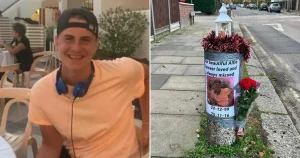

Alfie O’Keefe was just sixteen years old when his life was cut short on a cold November night in 2016. He was riding his moped through the streets of North Finchley, London, when a car driven by Ali Bahramzadeh crashed into him at a mini roundabout on Buxted Road. Bahramzadeh, a learner driver who had taken his mother’s car without permission, was unlicensed and uninsured. He failed to give way, struck the teenager’s vehicle, and then made the devastating choice not to stop. He left Alfie there, alone, and continued on as if nothing had happened. Alfie died as a result of the collision, and the grief that followed would forever alter the life of his mother, Joanne O’Keefe. In 2018, Bahramzadeh was sentenced to one year in prison and banned from driving for two and a half years after his release. But for Joanne, no sentence could ever bring her son back, and no amount of justice could fill the silence he left behind. The pain of losing a child is already unbearable, but what Joanne has had to endure since then has made that grief even harder to carry. She has spent years trying to honor her son in the only way she can, only to have that sacred act of love repeatedly violated by strangers who seem to have no respect for what her memorial truly means.
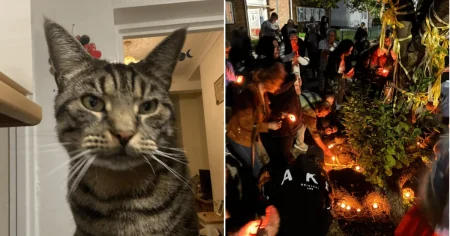
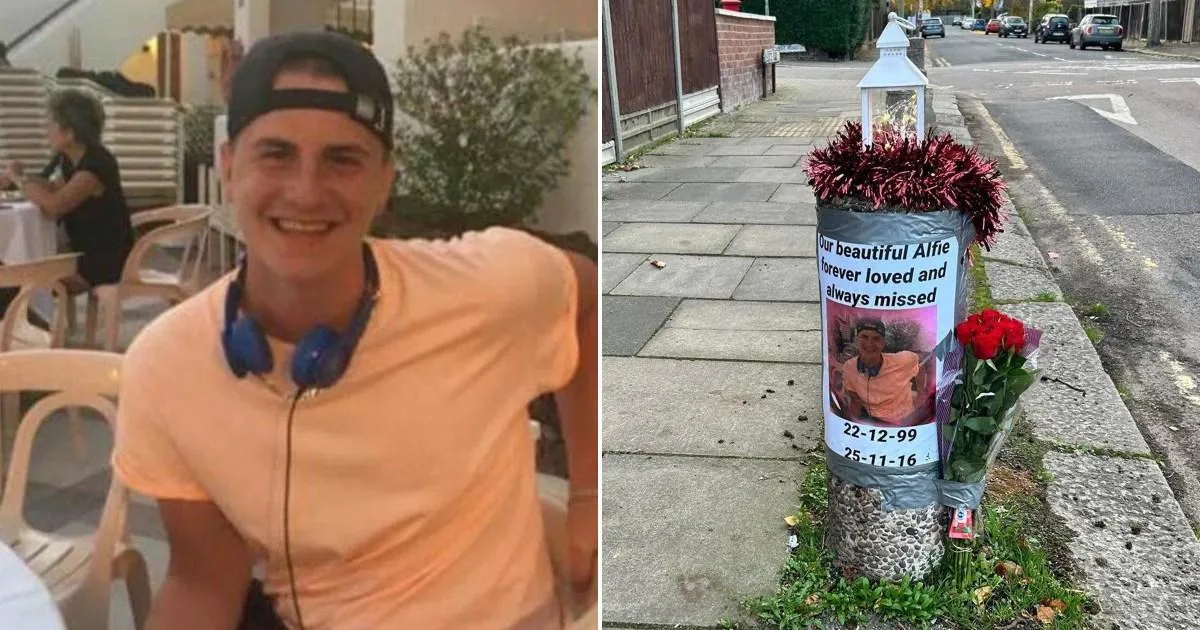
Every year, Joanne has maintained a roadside memorial at the exact place where Alfie was killed. It is her way of keeping him close, of marking the spot where her world changed forever, and of ensuring that he is never forgotten. She would carefully set up the memorial on November 17, the anniversary of his death, and leave it in place until December 22, which would have been his birthday. For years, the homeowners who lived near the site allowed her to attach the memorial to their fence, giving it a stable and respectful home. It became a quiet little shrine, filled with flowers, photographs, fairy lights, and other personal touches that spoke to who Alfie was and how deeply he was loved. But when those homeowners sold their house, Joanne was forced to find new places to display the memorial. She moved it to different spots along the roadside, including a nearby bollard, hoping that it would be left alone. For a while, it seemed to work. But then, in 2023, something changed. The memorial was removed from the outside of a fence and placed onto a utility box, and the flowers that had been laid with such care were thrown to the ground. It was the first sign that not everyone saw the shrine the way Joanne did. Instead of a sacred space, it had become a target.
The destruction did not stop there. In 2024, Alfie’s picture was taken from the memorial. Someone reached out and stole the face of a dead boy, leaving his mother to wonder who could do such a thing and why. Then, in 2025, red roses and fairy lights that had been placed at the roadside were taken as well. Year after year, Joanne has returned to the site to find her carefully arranged tributes damaged, stolen, or thrown aside. Each time, the wound of losing Alfie is torn open again. She has been left devastated, struggling to understand how anyone could look at a roadside memorial and not recognize what it is. “You can see it’s a memorial, clearly,” she said. “Why would you take something that’s so sacred to someone else? I don’t understand; I could never understand it.” Her words carry the weight of a mother who has already been through the worst thing imaginable, only to have her grief disrespected again and again. The memorial is not just a collection of objects. It is a physical expression of her love, a place where she can go to feel close to her son, a small piece of ground that belongs to him in memory. To have it destroyed is like losing him all over again, and Joanne has admitted that she does not know how much more her heart can take.
Now, after years of trying to keep Alfie’s memory alive at the roadside, Joanne has made a heartbreaking decision. She is trying to raise £2,000 to buy her son a burial plot at a cemetery, along with a proper headstone. It is something she says she is unable to fund herself, but she feels it has become necessary. For years, she kept Alfie’s ashes in a cupboard in her home, holding onto the belief that he would always stay with her. She never imagined she would have to make the decision to place him in a cemetery. “I never, ever, thought I’d make the decision for Alfie to go into the cemetery, never,” she said. “My thing was he would stay home, when I pass we would go together.” That vision of a future where she and her son would remain together, even in death, was a source of comfort to her. But the repeated destruction of the roadside memorial has forced her to rethink everything. She now feels that the only way to truly protect Alfie is to give him a permanent, sacred resting place where no one can touch him. “I feel like it’s time for Alfie to be put somewhere to rest, where no-one can touch it,” she explained. “It’s sacred, no-one can go near him, no-one can damage him any more.”
The decision to move Alfie’s ashes from her home to a cemetery is not one Joanne makes lightly. It is a profound shift in how she relates to her son’s memory, and it comes with a deep sense of loss. For years, having him close to her at home was a way of denying, in some small way, the finality of death. As long as his ashes were in her cupboard, he was still with her, still part of her daily life. But the cruelty of strangers has made that impossible to sustain. The roadside memorial was meant to be a public declaration of love, but it has instead become a source of pain and anxiety. Every year, Joanne has to brace herself for the possibility that someone will destroy it again. She has had to wonder whether the flowers will still be there, whether the photographs will still be intact, whether the lights will still be glowing. That constant fear and disappointment have taken a heavy toll. By raising money for a burial plot and headstone, Joanne is not giving up on her son. She is trying to find a safer way to honor him, a place where his memory can rest without being violated. It is an act of love, not an act of surrender. She wants to give Alfie the dignity he deserves, a permanent marker that says he existed, he was loved, and he mattered.
Joanne’s story is a reminder that grief does not end with a funeral. It continues in the small rituals we create to keep our loved ones close, in the anniversaries we mark, in the places we return to again and again. For Joanne, the roadside memorial was a lifeline. It was her way of staying connected to Alfie, of making sure that the world did not forget him. And yet, time and again, that lifeline was cut by people who saw only an inconvenience, or perhaps something to take for themselves. The loss of Alfie’s picture and the red roses and the fairy lights may seem small to someone who never knew him, but to Joanne, they are irreplaceable pieces of her son’s story. She is now asking for help to give him a final resting place that cannot be disturbed, and the £2,000 she hopes to raise is a small price for the peace it would bring her. It would mean she no longer has to worry about whether her son’s memorial will survive the year. It would mean she can visit him, sit beside him, and know that he is safe. It would mean that Alfie, who was taken from her far too soon, can finally rest in a place that no one can damage. As Joanne continues to carry the weight of her grief, she is asking the world for a simple act of kindness: to help her give her son the peace he deserves. And in doing so, she reminds us all that behind every roadside memorial is a person who was deeply loved, and a heart that is still breaking.