


The modern world often feels like it is moving at breakneck speed, filled with frustrations that occasionally spill over into dangerous, public confrontations. Recently, on the busy Bruce Highway in Queensland, Australia, a harrowing scene unfolded that could have easily turned tragic. A young woman, attempting to navigate the heavy traffic, found herself being aggressively targeted by the driver of a white van. After repeatedly blocking her car and refusing to let her merge, the man took things to an alarming level: he leaped out of his vehicle in the middle of a major thoroughfare and attempted to force his way into the woman’s car. It was a moment of pure vulnerability for the women trapped inside, caught in the path of a stranger’s unchecked rage.
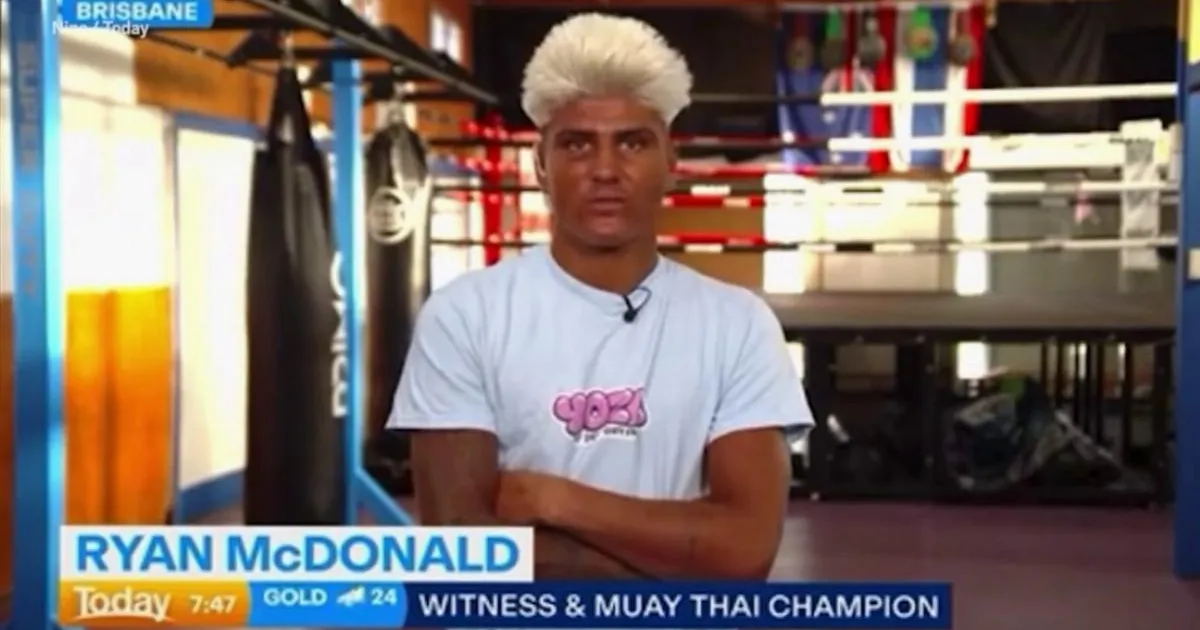
Amidst the chaos of stalled traffic and shouting, Ryan McDonald, a 19-year-old professional Muay Thai fighter, was heading home from a weekend camping trip with his friends. When he saw the terrifying power imbalance—a man aggressively cornering two women on their own—his instincts kicked in immediately. Rather than turning a blind eye or assuming someone else would handle it, Ryan felt a moral imperative to intervene. He knew he had the skills to potentially defend himself if things escalated, but his primary goal was much simpler: he wanted to be a buffer between the aggressor and the victims, hoping to de-escalate a volatile situation before it became violent.
The encounter quickly intensified when Ryan approached the van driver. True to his aggressive demeanor, the man jumped out of his vehicle, stripped off his shirt, and postured for a physical fight, clearly hoping to intimidate Ryan into backing down. He shouted threats, asking if Ryan was “sure” he wanted to engage and warning him that he didn’t know who he was “messing with.” Despite the provocation, Ryan remained remarkably composed. He refused to adopt an aggressive stance or “puff his chest,” choosing instead to hold his ground calmly. By refusing to mirror the man’s hostility, Ryan denied him the confrontation he was so desperate to ignite.
The tension reached a tipping point when other motorists, recognizing the danger, gathered around the scene. At one point, a bystander who recognized Ryan from his social media presence warned the van driver that he was dealing with a professional Muay Thai fighter. In a bizarre twist, the driver didn’t back down; instead, he goaded Ryan, saying, “Show me how professional you are then.” Ryan, well aware that a professional athlete has everything to lose by engaging in street brawls, remained unmoved. He knew that his reputation and his career weren’t worth a petty road rage fight. By keeping his cool, he forced the situation to remain a standoff rather than a spectacle of violence.
Eventually, the weight of the collective disapproval from the surrounding drivers, combined with Ryan’s steady refusal to participate in the fight, caused the van driver to lose his momentum. Realizing that his aggression was no longer intimidating anyone, the man retreated to his van and drove off, leaving the women unharmed. The entire ordeal was captured on camera by Ryan and later shared online, where it has since garnered millions of views and an outpouring of support. What could have been a story about a senseless act of violence instead became a testament to the power of keeping one’s head under pressure.
Looking back on the incident, it is clear that Ryan McDonald’s actions were driven by a sense of duty that many hope to see in others. He proved that true strength isn’t about the ability to throw a punch, but the discipline required to avoid one whenever possible. His focus was entirely on the safety of the two women, and he succeeded in ensuring that everyone went home safely that day. In a world where poor behavior is often ignored out of fear or apathy, Ryan’s choice to step up serves as a poignant reminder that while we cannot always control the anger of others, we can always choose to act with courage and restraint to protect those in need.