


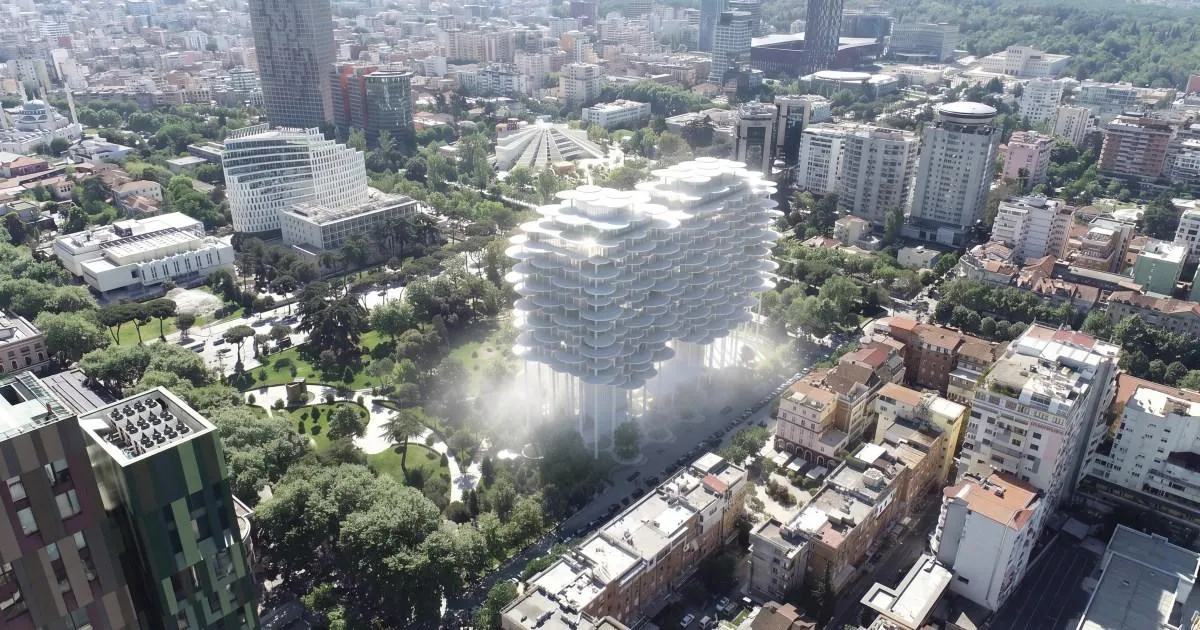
Tirana may soon look like something out of Star Wars. Not the dusty desert world of Tatooine, but the floating Cloud City of Bespin, a place of white towers and impossibly graceful structures hovering above the clouds. In a proposal revealed by Danish architecture firm BIG, the Albanian capital is preparing for a new landmark that seems to defy gravity: a cloud-shaped skyscraper, lifted above a public park on slender white columns. Named Tirana Fountain Plaza, the project is designed to hold apartments, offices, a hotel and cultural spaces, but unlike most towers, it doesn’t claim the ground as its own. The ground remains open, public and alive, while the building floats above, as if a fragment of weather had been captured and arranged into somewhere to live, work and gather. The design was chosen through a competition, and it arrives in a city that has increasingly become a playground for some of the world’s most daring architects. Tirana is not just growing; it is being reshaped with a sense of imagination and, sometimes, controversy. The new project sits at the edge of Rinia Park, on Rruga Sami Frashëri, in a location that already carries the memory of old Tirana, a city of layered histories, wild transitions and a fierce desire to look forward. With its white, rounded volumes and open underbelly, Tirana Fountain Plaza feels less like a conventional building and more like a piece of sky that has decided to stay for a while. It holds the promise of a new kind of urban life, where nature, water and shade are not afterthoughts but the very reason for the structure’s existence.
At first glance, the design seems almost playful, like a child’s drawing of a cloud made tangible. The building is made up of a series of rounded, cloud-like volumes raised above the ground on slim columns, leaving a vast amount of space beneath open to the public. Passing under it, you would feel a cool breeze and a sense of shelter, as though the building itself were protecting the park from the harsh midday sun. The facades are wrapped in layers of perforated white discs, arranged in rows that cover the glazed surfaces and give the building a soft, textured skin. These discs are not merely decorative; they are intended to animate the interior spaces, filtering light and creating a play of shadow that changes throughout the day. At either end of the development, two curved structures wrapped in fluted glass connect the elevated sections back down to the ground, giving people a way to enter the floating world above while also anchoring it to the city. For BIG, the project is an attempt to rethink the relationship between buildings and public space. Instead of occupying more of the ground, the building uses the air above the park, leaving the earth below free for people to walk, linger and gather. This is architecture that gives back as much as it takes. The elevated mass also provides shade, a small mercy in a city where summers can be unforgiving, and where public space is precious. The result is a building that feels less like a tower and more like a canopy, a place where the boundary between inside and outside becomes wonderfully blurred.
Water is central to the magic of Tirana Fountain Plaza, and not just because the building is meant to evoke a cloud. The existing Taiwan Pool, a beloved feature of the park, will be preserved, and the design includes a closed-loop system to capture, store and reuse rainwater. This is not the kind of detail that makes headlines, but it is exactly the kind of thinking that makes a building sustainable in a place with a drying climate. The landscape design goes far beyond simple paving. Planted gardens will surround the structure, and water-management features will improve irrigation, reduce the risk of flooding and help cool the surrounding park, creating a kind of microclimate beneath and around the floating volumes. The centrepiece, though, is an inverted fountain. Unlike a traditional fountain, where water shoots upward from the ground, this one will fall from above, a shimmering curtain of water that seems to arrive from the building itself. It is a poetic gesture, turning the idea of a cloud into something you can feel. Standing nearby, you might hear the sound of water, see the light scatter through it, and for a moment forget whether you are in a city or in a dream. The fountain also reinforces the sense that this is a place designed not just to be looked at, but to be experienced. It invites people to stop, to sit, to cool their hands in the water, and to watch the building reflect and ripple in ways that change with the weather and the time of day.
Inside, the building offers a mix of uses that reflect the complexity of modern city life. There are apartments for people who want to live in the heart of Tirana, offices for those who work there, a hotel for visitors, and cultural spaces designed to bring the community together. Design images show interiors intended for everything from reading to performances, including a library where the outside world filters through those perforated discs, casting soft shadows across shelves and reading tables. The idea is that this is not a closed, exclusive tower but a vertical neighbourhood, a public square lifted into the air. At ground level, the open space beneath the building becomes an extension of Rinia Park, allowing the city to flow through and around the project without barriers. This is particularly significant given its proximity to the Pyramid of Tirana, a former museum that was itself transformed by Dutch architecture studio MVRDV into a vibrant cultural hub. Together, the two buildings create a sort of architectural dialogue: one is raw, concrete and grounded; the other is white, soft and floating. Both are attempts to make public space exciting, to invite people in, and to prove that culture and daily life can share the same roof. In a city that has changed dramatically since the fall of communism, this feels like a hopeful gesture, a way of saying that architecture can help heal old wounds while also creating something entirely new.
BIG, founded by architect Bjarke Ingels, has a reputation for bold and often playful designs, but it is no stranger to controversy. The studio is already working on another major project in Tirana: the National Theatre of Albania, a bow-tie-shaped building that has divided public opinion. The demolition of the original 1930s theatre to make way for the new development sparked protests, and in 2020 activists were arrested during demonstrations against the demolition. It is a reminder that architecture in Tirana is never just about aesthetics; it is tangled with memory, politics and questions of who gets to shape the future of the city. And BIG is not stopping there. The studio has also unveiled plans for Faith Park, a proposed group of interfaith buildings arranged across a hillside near the capital, designed to bring together different religious communities in a shared space. These projects, taken together, suggest a deep engagement with Tirana as a place of transformation. They also raise important questions: Can a city preserve its soul while welcoming the new? Can a building that looks like a cloud feel rooted in the rocky history of Albania? The answers are not simple. But Tirana Fountain Plaza is clearly part of a wider movement, with architects from around the world taking on projects that could completely change the city within a decade. It is a moment of both excitement and uncertainty, and the skyline reflects that.
Ultimately, Tirana Fountain Plaza is a dream with practical bones. It asks us to imagine a building that floats, yes, but it also asks us to think about how cities can become more liveable, more sustainable and more humane. By leaving the ground open, it gives public space back to people. By collecting water and cooling the air around it, it helps the park survive and thrive. By mixing homes, offices, hotels and libraries, it keeps the building alive from morning to night. In a time when so many big architectural projects are criticised for being cold, selfish or disconnected from their surroundings, this one tries to be the opposite. It is a building that seems to say: I am here to be useful, not just to be beautiful. Whether it will be built as envisioned, whether it will be loved or hated, whether it will change the city or simply become another ambitious rendering, remains to be seen. But for now, the image of a white cloud hovering above the trees of Rinia Park, with a waterfall falling from its underside and the sounds of the city passing beneath, is enough to make anyone look up. It is also enough to remind us that architecture, at its best, can make the impossible feel almost within reach. And in a city like Tirana, where the old and the new are always colliding, that may be the most valuable contribution of all.