

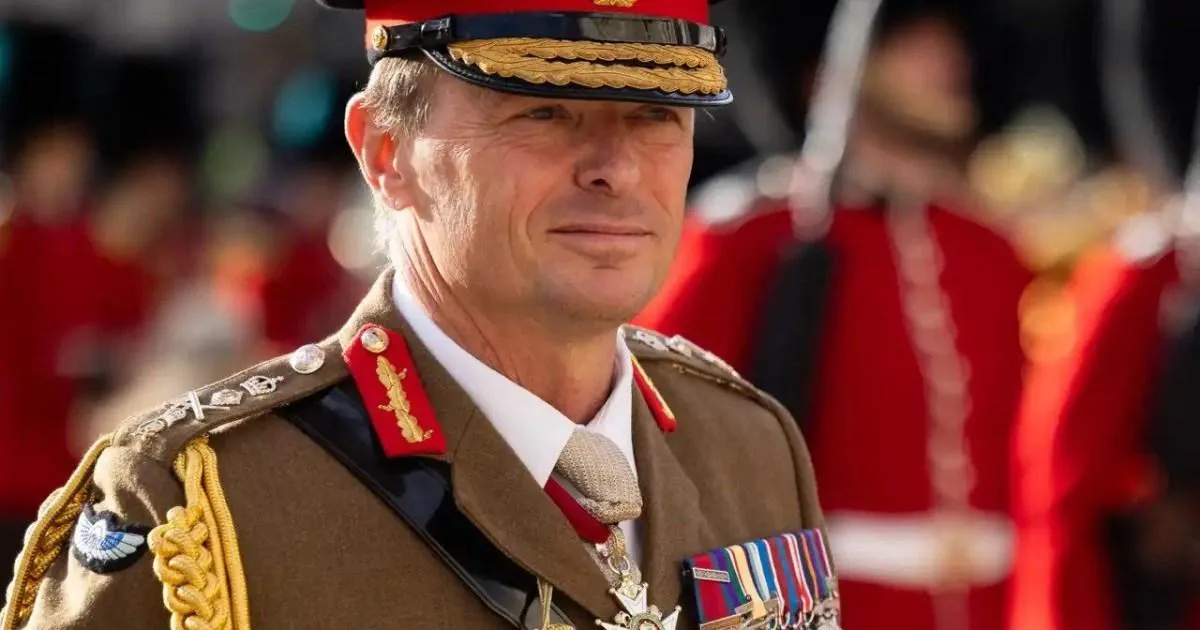
Imagine you are standing in a large assembly hall in Catterick Garrison, surrounded by seven hundred soldiers in uniform, and the most senior officer in the British Army is telling you that the world has slipped into a very dangerous time. That is the scene behind the latest warning from General Sir Roly Walker, the Chief of the General Staff, and his message was aimed not just at the troops in front of him but at every citizen who might prefer to look away. He said that very soon the country’s political leaders will need to have a frank conversation with the public about defence and security, about where the red lines are, and about what the nation must be prepared to do. For decades, most Britons have had the luxury of thinking of soldiering as something that happens elsewhere, carried out by a small professional force while the rest of us go about our daily lives. Walker’s point is that this comfortable distance is closing. The “business of soldiering,” as he put it, is returning to public consciousness, and it will demand something from everyone. He did not pretend that this would be easy, or that it could be done without difficult choices. The government, he said, must explain what is going on in the world, why this moment feels so dangerous, and what the nation needs to consent to, including sacrifices, if the armed forces are to be able to do the one thing that nobody else can do: take the fight to the enemy. It is a sobering message, and all the more striking because it comes from a senior military figure, not a politician. The fact that he chose to say it in front of seven hundred soldiers suggests he wants the wider public to understand that the protection we often take for granted rests on a fragile, demanding and dangerous professional service.
What does that “frank conversation” actually mean? Walker was not calling for an immediate return to conscription, and he was not suggesting that every family should be asked to send someone to the front line. But he was making a much broader point about citizenship and shared responsibility. He spoke about consent. The public has to understand what soldiers do for the country, and then agree to support them, not just with warm words but with the resources, resilience and personal commitment that real security requires. The word “sacrifices” is important. It might mean paying higher taxes, accepting that money will be spent on tanks instead of other public services, or being prepared to serve in some wider sense, whether through volunteering, civil defence, or simply taking resilience seriously. It might also mean making it easier for serving personnel and veterans to know that the country is behind them. Walker’s core message is that democracy is not just about rights; it is also about obligations. If citizens want the armed forces to be able to meet threats at the source, if they want the military to be allowed to take the fight to the enemy rather than waiting for the enemy to arrive in Britain, then they need to accept that there is a price. That price cannot be paid entirely by the small number of men and women in uniform. It has to be shared by society as a whole. The general’s choice of audience matters too. He was speaking to soldiers who have already sworn to serve, but he asked them to understand that the whole nation needs to be part of the equation. It is a huge psychological shift for a country that has become used to thinking of war as something that belongs to the past. Yet the current geopolitical climate, in his words, “a very dangerous time,” is pushing that illusion aside. The frank conversation is not about scaremongering. It is about replacing comfort with honesty, and hoping that honesty gives the country time to prepare.
The message comes at a strange and contradictory moment for public opinion. On the one hand, polling suggests that up to half of the British population would not fight under any circumstances. That is a striking number, and it says something about how far the country has moved from the generation that lived through the Second World War. It is easy to understand why people feel that way. After years of conflict in distant places, and with the memory of Iraq and Afghanistan still raw, many people are deeply uncomfortable with the idea of military intervention, and even more uncomfortable with the idea of putting their own lives, or their children’s lives, on the line. On the other hand, the same survey found that more than half of the country supports higher defence spending. So the public seems to understand that the world is becoming more dangerous, and it wants the country to be properly defended, but it is much less willing to accept the personal consequences. That is not necessarily hypocrisy. It is human nature. It is much easier to support a policy when it remains abstract. It is much harder to imagine yourself in uniform, in a trench, or in a cyber-warfare unit, or to accept that your son or daughter might be called to serve. Walker’s warning cuts through that comfort: if you want security, you have to be part of it. At the very least, you have to be willing to have a national conversation about what you are willing to give. The survey numbers also suggest that a majority of people are open to that conversation, as long as it is honest and does not feel like propaganda. They want to be told the truth about the threat. They want to know why their taxes are needed and what their government is asking of them. The danger is not that the public will refuse to listen. The danger is that politicians will keep putting off the conversation until it is too late.
General Walker is not the only senior figure making this point. Air Chief Marshal Sir Rich Knighton has also been speaking about future crisis preparedness, and his argument broadens the idea of defence well beyond the military. If the country faces a serious crisis, whether war, cyber-attack, natural disaster or a pandemic, the response will require the whole of society. That means civil servants, local councils, health workers, teachers, engineers, emergency services, volunteers and ordinary neighbours. It means thinking about how food gets to the shops, how hospitals keep running, how power stays on, how communication networks survive. The old image of a country being defended solely by soldiers standing on a front line is outdated. Modern conflict is much more likely to involve a combination of military force, economic pressure, cyber attacks and disinformation, all aimed at breaking a country’s will and destabilising its society. In that world, resilience is not just a military word. It is a civic one. The people who keep the country going in a crisis are as important as the people who are willing to fight, and they need to be recognised, trained and supported. This is a more inclusive and perhaps less frightening way of thinking about national defence. It does not ask every citizen to become a soldier. It asks every citizen to think about what they could do, how they could help, and how their skills could be used in an emergency. It also asks institutions to prepare properly, instead of assuming that everything will be fine. The message is slowly shifting from “the army will protect you” to “we will all need to protect each other.” That shift is necessary, but it will require a cultural change. For years, defence has been seen as a niche issue, something for veterans, military families and policy experts. Knighton’s comments suggest it should be part of everyday life, taught in schools, practised in communities, and taken seriously by every level of government. It is a much bigger task than simply ordering more ships and tanks.
Politicians are beginning to pick up the theme, though they are doing so carefully. Wes Streeting told the Labour conference that defence spending comes with “choices and trade-offs.” That was a significant admission, because in normal political life, governments like to tell people that they can have everything. Streeting’s phrase suggests that spending on defence will mean something else being cut, or taxes being raised, or borrowing increasing, and that those decisions need to be made openly. At the same time, he insisted that Britain would not be made stronger by making citizens poorer. That is an important balance. If the government pushes defence spending too hard and squeezes living standards, it could create exactly the kind of social fragility that makes a country more vulnerable in a crisis. People need to feel that the country is worth defending, and that their government is on their side. So the next few months will be a test of whether the military’s warnings can be turned into practical policy. The government is expected to set out its defence spending plans in the autumn budget, and those plans will be scrutinised closely. Will the money be enough to meet the threats that Walker and Knighton describe? Will it be matched with a wider strategy for resilience and civil preparedness? Will the government be honest about the trade-offs and sacrifices involved? The answers are unclear, but the direction is clear. The long era in which defence could be treated as an afterthought is over. The challenge for politicians is to explain that without alarming the public, and to carry the country with them. They cannot do that if they pretend that defence is free, or if they try to hide the choices. But they also cannot do it if they make people feel that their security is being bought at the cost of their own economic stability. It is a delicate line, and the “frank conversation” is only just beginning.
So what should ordinary Britons actually do? The first step is to stop treating defence as somebody else’s problem. It is tempting to switch off when generals and politicians talk about red lines and military capability, or to dismiss it all as scaremongering. But Walker’s warning is not a distant geopolitical lecture. It is a request for civic involvement. That does not mean every adult needs to be ready to take up arms. It means being willing to learn, to ask hard questions, to understand what is being asked of us, and to support the people who do the jobs we cannot or will not do. It means acknowledging the reality that our peace and security have never been guaranteed, and that they require ongoing attention, investment and human commitment. It also means accepting that the world may be approaching a point where the old certainties no longer hold. We have been lucky, in many ways, to live in a period when the threat felt manageable, but that period appears to be ending. The “frank conversation” may be uncomfortable, but it is also an act of respect. It treats us as adults who can handle the truth, rather than as children who need to be protected from bad news. It asks us to be citizens rather than spectators. The soldiers at Catterick, and thousands like them, have already chosen their part. They cannot choose the future alone. They need the rest of the country to decide what part each of us is willing to play, and to make that decision before danger is already at the door. The good news is that the conversation is starting to happen. The bad news is that time is not necessarily on our side. But if the country can face this honestly, without panic and without denial, then the sacrifices that Walker mentions may never have to become catastrophic. The best way to honour those who serve is to be worthy of their service, and that begins with listening, then talking, and then acting.