


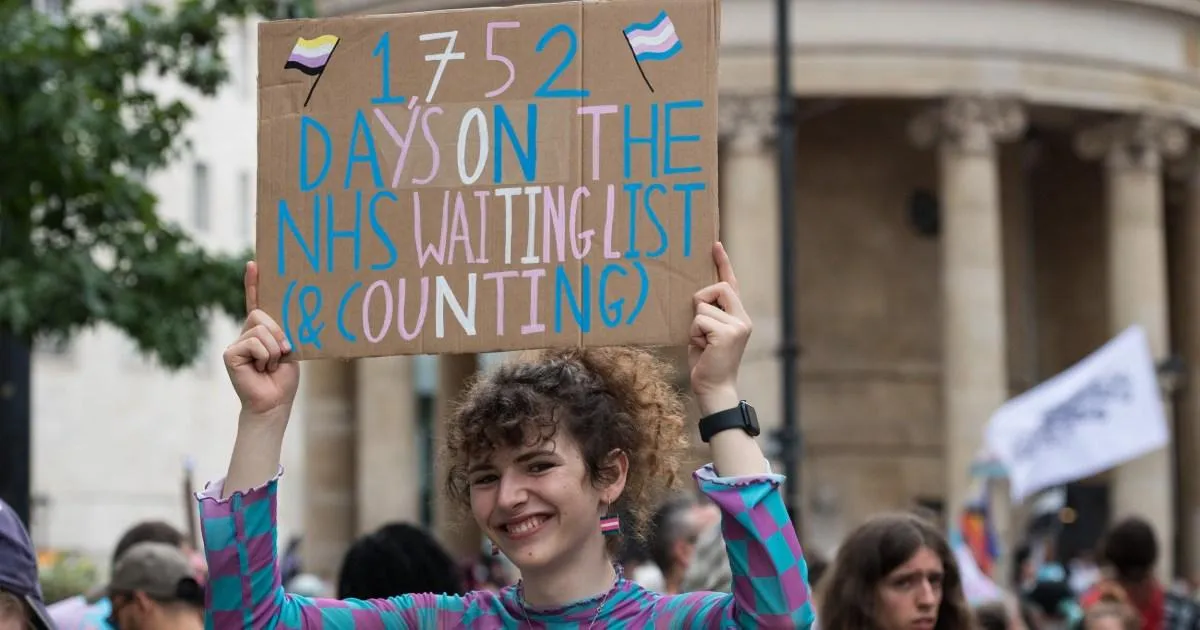
When the NHS confirmed its new guidance on “single sex” wards, my first thought was not about politics or the latest culture war headline. It was about the lives this will put at risk. I thought about what it actually feels like to be sick, exhausted, and afraid in a hospital bed. Anyone who has spent a night on a ward knows that your mind is not on the person in the next bed, or what body parts they were born with. You are thinking about the pain in your chest, the nausea, the waiting, the silence, the fear of what the test results might say. You are thinking about whether you will get better, and what it will take to get home. The last thing on your mind is whether the person lying a few feet away has a uterus or not. And yet, under this new guidance, trans women will not be placed in female-only wards, and toilets and changing rooms will be based on biological sex rather than gender identity. The NHS says this is about privacy, dignity, and safety. But to me, and to so many trans people, it feels like a betrayal. It is a guidance that is utterly useless in a healthcare system already stretched to breaking point, and it will cause harm. The detriment to trans people’s mental health has not been considered. The possibility that some of us could die as a result has not been considered. That is not an exaggeration. That is the reality of what this policy means.
Let me tell you what this actually looks like in real life. There is already research showing that trans people are more likely to avoid seeking healthcare on time. We are afraid of being judged, humiliated, or mistreated by doctors and nurses. We are afraid of having to explain ourselves, to justify our existence, to prove that we deserve care. We are afraid of the stares, the whispers, the refusal to use our names, the invasive questions that have nothing to do with why we are there. And now, the NHS has decided to make it even harder. By forcing trans people onto wards based on their biological sex, they are forcing us to out ourselves in the most vulnerable moments of our lives. Imagine being in pain, disoriented, scared, and having to fight for the basic right to be treated with dignity. Imagine being placed in a space where you know you will be read as different, as wrong, as a problem. Imagine being sick and having to worry not just about your illness, but about how the person next to you will react when they realise who you are. The policy claims to protect privacy, dignity, and safety, but it takes all three away in one swift move. You cannot maintain someone’s privacy while forcing them to reveal their trans status against their will. You cannot protect someone’s dignity while making them feel like they do not belong. And you cannot keep someone safe by isolating them, by treating them as a threat, by making them feel like they are the problem. The result is that trans people will not seek healthcare when they desperately need it. They will put off going to A&E. They will hope that the shortness of breath goes away. They will convince themselves that the pain in their abdomen is nothing serious. They will tell themselves that the infection will clear up on its own. But it won’t. And by the time they finally go to hospital, it will be too late. This is not speculation. This is what happens when people are made to feel unwelcome in the very places they are supposed to turn to for help.
The data already tells us how dangerous this is. Trans people in England experience higher overall mortality rates compared to cisgender populations. We know that trans people die by suicide at higher rates than the general population. We know that the constant stress of discrimination, exclusion, and violence takes a toll on the body and the mind. We know that being denied basic dignity has consequences. And instead of focusing on saving these lives, the NHS has chosen to make them harder. I cannot properly describe what it feels like to watch an institution that is supposed to care for you turn its back on you. It is not just disappointing. It is not just frustrating. It is a slow, grinding erosion of hope. Every new policy, every new guideline, every new headline tells us the same thing: you do not matter. You are not worthy of care. Your life is less important than someone else’s discomfort. And after a while, you start to believe it. You start to internalise the idea that maybe you are too much trouble, that maybe you deserve to be hidden away, that maybe it would be easier if you just didn’t exist. That is the kind of harm this guidance does. It goes beyond policy. It enters the hearts and minds of trans people and tells us that we are a burden. The NHS could have used this moment to reaffirm its commitment to protecting vulnerable people. Instead, it has sent a clear message that trans people are expendable. And that message will have consequences far beyond hospital wards. It will be felt in every trans person who hesitates before calling an ambulance. It will be felt in every trans person who lies awake at night wondering if they would even be treated with basic humanity if something went wrong. It will be felt in every trans person who decides that it is not worth the risk to seek care at all.
And then there is the practical impossibility of it all. The guidance says that trans people will be offered single rooms where possible. But we all know that this is not possible in a system that is already overflowing. The NHS is facing a severe shortage of beds, high occupancy rates, delayed discharges, and rising emergency demand. Hospitals are bursting at the seams. Nurses are overworked. Corridors are being used as wards. And yet, somehow, they expect to find single rooms for trans people? It is absurd. It is a fantasy. The reality is that this guidance will lead to trans people being placed in wards where they do not feel safe, or being forced to wait for hours, or being sent home because there is no appropriate accommodation. The real problem, it seems, is that cisgender people feel uncomfortable sharing a ward with a trans person. But discomfort is not the same as danger. A trans woman in a bed is not a threat. A trans man in a toilet is not a threat. Trans people are not predators. We are not confused. We are not dangerous. We are just people, trying to live our lives, trying to get better when we are sick. And if the only “solution” is to segregate us, to mark us out, to treat us as a special problem that needs to be managed, then something has gone deeply wrong. For years, trans people in England were accommodated on wards in line with their gender identity under the NHS’s own guidance. There was no crisis. There was no wave of complaints. There was no epidemic of attacks. There were just people getting care, alongside everyone else. That system worked. This new guidance does not fix a problem that was never there. It creates a problem. And it forces nurses and hospital staff to become the gender police, to interrogate patients, to exclude, stigmatise, and humiliate the very people they are supposed to help. I do not believe that is why anyone goes into healthcare. I do not believe that is what the NHS was built for.
The NHS says it is committed to six core values: working together for patients, respect and dignity, commitment to quality of care, compassion, improving lives, and everyone counts. But with this new guidance, every single one of those values is broken for trans people. How can you say you are working together for patients when you are actively pushing a group of patients away? How can you say you respect and dignity when you are forcing people into spaces that deny who they are? How can you say you are committed to quality of care when that care is conditional on conforming to a binary that does not reflect the reality of human diversity? How can you say compassion when you are willing to risk lives to appease a vocal minority? How can you say you are improving lives when you are making them measurably worse? And how can you say everyone counts when you have decided that trans people do not? It is hard to see this as anything other than an act of appeasement. It is a response to a moral panic, a bow to the loudest voices, a surrender to bigotry. It follows a wave of trans-exclusionary policies and guidelines that have swept across the UK, particularly since the Supreme Court ruling. Slowly but surely, trans people’s rights are being undermined. Slowly but surely, we are being pushed further and further out of society. We are being told that we are not welcome in public life, not welcome in healthcare, not welcome anywhere. And the irony is that the NHS was founded on the promise that everyone counts. It was supposed to be the great equaliser, the place where no one was left behind. But now, with this guidance, it has decided that trans people certainly don’t count. And some of us will pay for it with our lives.
I am writing this because I am scared. Not just for myself, but for my friends, for my community, for everyone who has ever felt like they do not belong. I know trans people who have already said they will not go to hospital, even if they need to. I know trans people who are terrified of what will happen to them if they are admitted. I know trans people who are so exhausted by the constant fight to be treated like human beings that they have stopped fighting, or stopped caring, or stopped seeing a future for themselves at all. This guidance will not save lives. It will cost lives. And the people who made this decision will not have to live with the consequences. They will not be the ones lying in a hospital bed, alone and afraid, wishing they had never asked for help. They will not be the ones whose families receive the phone call that no one ever wants to receive. They will not be the ones standing at a funeral, wondering if it could have been prevented. We need to say loudly and clearly that this is wrong. We need to demand better from the NHS, from our politicians, from our society. We need to remind everyone that trans people deserve care, compassion, and dignity, just like anyone else. The NHS was built on a promise that everyone counts. It is time to hold it to that promise. Because if we do not, if we allow this to stand, if we let trans people be pushed out of healthcare and out of public life, then the consequences will be measured in bodies, in grief, in lives cut short. And that is not something any of us should be willing to accept. Share your story. Speak up. Demand change. Because some of us are running out of time.