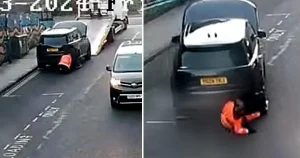


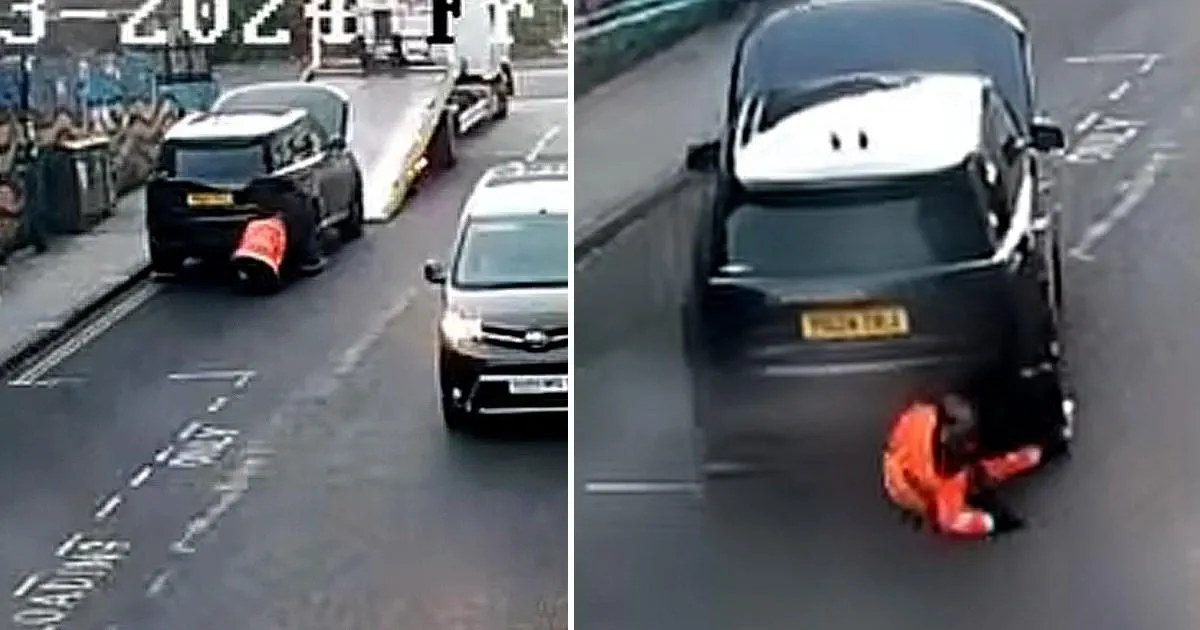
Exeter Crescent in Bournemouth is not the kind of place that seems designed for tragedy. It is simply a sloping street in a seaside town, lined with buildings and pavement, the sort of incline that locals take for granted. For a driver, the slope calls for care. For a recovery operator trying to load a heavy vehicle, it demands absolute respect. On the day this story takes place, that respect was missing. A black Range Rover, weighing more than two tonnes, was being prepared for recovery when it somehow broke free from the equipment meant to hold it and began rolling down the hill. The car was not being driven; no one sat behind the wheel with a hand resting on the gear stick or a foot hovering over the brake. It was moving entirely under the force of gravity, picking up speed as it descended. And caught in the path of that vehicle was Sean Baker, an experienced recovery driver for GRS Recovery, who had been attempting to jack the car onto his tow truck. In the CCTV footage that later came to light, Baker can be seen in an increasingly desperate position, trapped by the movement of the very vehicle he had been working to secure. His colleagues and the people in nearby buildings could only watch as the situation spiralled out of control. But one man did more than watch. Kai Dransfield, a restaurant worker on a break from his job at a nearby TGI Fridays, happened to be outside when the nightmarish scene began to unfold. He saw Baker hanging on for dear life, their eyes meeting in a moment of raw fear, and in that single breath of a second, Kai made a choice that would change his own life forever.
To understand how such a scene could happen, it is necessary to return to the moments before. Sean Baker was not a newcomer to this kind of work. He drove for GRS Recovery, a company that handles the difficult, sometimes dangerous task of removing broken or abandoned vehicles. He had almost certainly done jobs like this before, on slopes, in tight streets, in bad weather. He knew the equipment. He knew the risks. On this particular afternoon, he had been called to Exeter Crescent to winch a disabled Range Rover onto a tow truck. As the subsequent investigation by the Health and Safety Executive would detail, Baker initially attached a winch to the front of the Range Rover. That winch, if left in place, should have acted like a leash. It would have prevented the heavy vehicle from running away down the steep hill while he worked. But at some point in the process, Baker removed the guardrail that had been put in place to secure the vehicle. He then placed skates under the rear wheels. Wheel skates are devices that allow a stationary car to be rolled along a surface by freeing its wheels from the grip of the ground. They are useful tools in controlled conditions. On a hill, with no brakes and no restraint, they are dangerously close to an invitation for disaster. Once those skates were positioned, the Range Rover did exactly what the physics of the slope dictated: it began to roll. No one was there to stop it. No tether held it back. The two-tonne vehicle pointed itself downhill and started moving, and Sean Baker found himself in the worst possible place, caught up in its wheels as it ran past him. What followed was not an accident in the sense of something random; it was the foreseeable consequence of a series of avoidable decisions, each one small, each one fatal.
For Kai Dransfield, none of that technical detail mattered in the moment. What mattered was a man who was in serious trouble. The young restaurant worker was on a break, perhaps hoping for a few minutes of quiet before returning to the demands of his shift. Instead, he saw a human being clinging to a runaway car, and his first instinct was not to run away but to run toward him. “He made eye contact with me, and my first thought was to just grab him to try to help him,” Kai later said. That sentence speaks volumes about courage. It was not the considered response of someone weighing the risks and benefits. It was the automatic, almost primal reaction of a person who could not stand by and watch another person die. Kai moved forward, reaching out in the hope that he could somehow pull Baker out of danger, or stop the range rover’s terrifying momentum. But a car weighing more than two tonnes does not stop for an outstretched hand. It struck him with brutal force, crushing both of his legs beneath its weight and leaving him on the ground in the middle of the street. The injuries he suffered were catastrophic. Multiple bones in his legs were shattered in different places. His spine was fractured. In the aftermath, he was left with constant pain and profound difficulty walking, a permanent physical reminder of a moment in which he had thought only of someone else. He had stepped into the path of a disaster to help a stranger, and that act of selflessness had cost him his own health, his mobility, and quite possibly the life he had expected to live before that afternoon.
The legal process that followed sought to make sense of what had happened and to assign responsibility. The Health and Safety Executive conducted a full investigation, and its conclusions were clear. Sean Baker had not taken reasonable safety precautions. He had failed to follow established procedures. He had removed the guardrail and made changes to the vehicle’s wheels that directly led to the vehicle rolling away. These were not unfortunate events beyond anyone’s control; they were errors, and they were substantial. Baker was an experienced worker, and more was required of him than of someone doing the job for the first time. In court, he pleaded guilty to breaching Section 7 of the Health and Safety at Work etc. Act 1974, a law that places a duty on employees to take reasonable care of their own health and safety and that of anyone else affected by what they do. He was given a prison sentence of fourteen weeks, suspended for a year. That sentence was not a dismissal of the seriousness of what had occurred, but an acknowledgment that no amount of time behind bars could undo the damage done. What the sentence did do was place a permanent mark on Baker’s record and make public the truth of his failings. For the recovery industry and for anyone who works with heavy vehicles on sloping ground, the case became a warning. All the safety checks, the chocks, the winches, and the procedures exist because the cost of skipping them is not measured in minutes lost or inconvenience, but in human life and human suffering.
The official response to the investigation underlined just how close this came to far greater catastrophe. HSE inspector Alexander Ashen was unambiguous in his assessment. “Sean Baker was an experienced recovery driver,” he said. “Failing to properly secure a vehicle weighing more than two tonnes on a steep hill was a fundamental error. This happened in a busy town centre, close to restaurants and car parks, with vehicles, motorcyclists and pedestrians regularly passing through the area. Sean Baker’s failings were substantial; they exposed everyone nearby to risk and resulted in a member of the public, who stepped in to help, suffering life-changing injuries.” The inspector’s words are measured, but the image they conjure is vivid and unsettling. Exeter Crescent was not an isolated industrial yard. It was a place where people were going about their lives. A cyclist could have been riding up the hill. A parent could have been crossing the road with a child. A group of friends could have been walking to a nearby restaurant. The runaway Range Rover could easily have claimed more than one victim, and the fact that it did not is a matter of terrible luck as much as anything else. The one person it did strike was not an employee of the recovery company. He was an innocent bystander whose only involvement came from the goodness of his heart. Kai Dransfield tried to help, and for that he will live with the consequences for the rest of his life.
In the end, this story is not really about tow trucks or legal acts or HSE reports. It is about the fragility of ordinary life and the speed with which it can be broken. For Kai Dransfield, every morning begins with pain. Every step he takes is a reminder of the afternoon when he ran toward danger instead of away from it. He might never walk without difficulty again. He might never be free of the memory of that black vehicle bearing down on him. And yet, the same instinct that led him to try to save a stranger is a reminder of something beautiful in human nature, a readiness to help that no amount of training can teach. For Sean Baker, the weight of this incident is something he will carry in a different way. He did not intend to cause harm. That is what makes these stories so hard to accept. It was not cruelty that brought about this catastrophe; it was carelessness. A series of small decisions, made in the middle of a routine job, added up to a devastating outcome. The lesson for everyone is simple, though not easy: in any job that involves heavy vehicles, steep slopes, or dangerous machinery, the small steps designed to protect life are never optional. They are the difference between a normal day and a day that ends with someone in hospital, someone in prison, and someone else walking slowly and painfully through the rest of their life. The Range Rover rolled down Exeter Crescent because it was not secured. Kai Dransfield stepped forward because he was human. One of those moments was preventable. The other was a quiet act of heroism that deserves not sympathy, but gratitude, and a lasting place in the memory of everyone who hears his story.