

Maureen Rose was not a famous name, but for more than three decades she held one of the most intimate roles in the royal household: she was the woman who dressed Queen Elizabeth II. Now eighty-nine years old and long retired, Maureen looks back on a career that took her from a small workroom to the private fitting rooms of Buckingham Palace, where she spent countless hours kneeling at the monarch’s feet with a tape measure, pins and a mouthful of fabric. She was only five feet one inch tall, three inches shorter than the Queen, which meant she was always looking up at the sovereign with a smile. And the Queen, Maureen recalls, was not the remote, formal figure so often seen in photographs. She was warm, quick-witted and surprisingly playful. During fittings, when Maureen had pins in her mouth and was concentrating on a hemline, the Queen would glance down and tease, “Be careful you don’t swallow them.” It was a small joke, but it broke the tension and made Maureen realise she was working with a human being, not just a symbol. Another moment stayed with her for years: after taking a telephone call, the Queen returned to the fitting room “giddy” with laughter because her eldest grandson, Prince William, had rung specifically to ask for Marmite sandwiches for dinner. The ordinary, slightly silly request had delighted her, and she was still smiling about it. Maureen saw the private Queen in those moments, and it made her fiercely protective of the monarch’s memory. “It makes me cross when the Queen is portrayed as austere,” she later said, “because she was one of the warmest and funniest people I ever met. Of all my customers over the years, she was the very best.” Those words were not flattery; they came from thousands of hours spent inches away from a woman who could have been cold and distant but chose instead to be kind, funny and utterly down to earth.
One of the fondest memories Maureen shares involves a handbag, a gold dress and a charity shop. While working on an outfit for the Queen, Maureen found a second-hand handbag that perfectly matched the gold fabric she was using. She upcycled the accessory, made it suitable for a monarch, and took it to the Palace. When she confessed where the bag had come from, the Queen did not raise an eyebrow or dismiss it. Instead, she laughed and said, “Well at least I am doing my bit!” That tiny, self-deprecating remark captured the Queen’s sense of humour and her lack of pretension. She was happy to wear something that had been rescued and reimagined, as long as it looked right. This practical, no-nonsense attitude was part of what made her so easy to dress. Maureen was also responsible for some of the most memorable garments of the late Queen’s reign: the white and silver embroidered dress worn during the Golden Jubilee celebrations in 2002, and the cream and gold coat in which she opened Parliament in May 1997, just after Tony Blair’s landslide victory. There was also a beautiful fabric designed by Maureen that the Queen wore as a swatch during a state banquet in Italy, a subtle acknowledgment of the dressmaker’s artistry. But for all Maureen’s skill, she always insisted that the Queen made her job easy. She was “so easy to work with and down to earth and always thanked you for your work,” Maureen recalled. That gratitude was not automatic or rote; it was genuine, and it made Maureen feel valued. The charity-shop handbag came to represent everything she loved about the Queen: a woman who could appreciate the humour in a recycled accessory while still looking every inch a sovereign.
The practical work of dressing a queen was far more demanding than anyone might imagine. During fittings, the Queen did not simply stand on a podium and admire herself. She would practise sitting down, walking around, and studying herself from every angle using a trio of mirrors, making sure the garment moved gracefully and would not crumple or twist during a long banquet or a carriage ride. Maureen had to consider the weight of the fabric, the fall of a skirt, and the way a coat would look when the Queen stepped out of a car into a blustery wind. There was also the constant presence of the Queen’s beloved corgis, who trotted around the fitting room and could easily step on a stray pin. To protect them, Maureen used a magnet on a string to sweep the floor after every session. It was a small, careful detail, but it showed how much she cared about the Queen’s home and her pets. The fittings were often interrupted by family visits, too. The King, then the Prince of Wales, and Princess Anne would occasionally pop in, and Maureen was struck by how warm and natural their interactions were. “They were every bit as warm with each other as any other family,” she recalled. The heir to the throne would talk easily with his mother, Princess Anne would share a word, and the formal atmosphere of the Palace would briefly melt into something almost domestic. For an outsider like Maureen, it was a rare glimpse behind the crown. She saw the Queen not just as a ruler, but as a mother and grandmother who could be interrupted by her children and who handled it with grace and good humour. It was in these unguarded moments that Maureen truly understood the woman she served, and it is why she speaks of her with such affection even now.
Maureen’s journey to Buckingham Palace was a story worthy of a fairytale. She began her career in the 1950s making underwear for wealthy women, learning her craft in a world far removed from royal grandeur. But her talent was impossible to ignore. One evening, a gorgeous gown she had created caught the eye of the legendary couturier Norman Hartnell, the man who had dressed royalty before her. He was so impressed that he began trying to track her down. When Maureen discovered what was happening, she thought it was a prank. “I thought it was a prank when I discovered he was trying to track me down,” she remembered. “I couldn’t believe it.” Hartnell offered her a job, and Maureen accepted on one condition: she would continue to do her own freelance work. It was a bold demand for a young seamstress, but Hartnell agreed, and she spent nine years working alongside him until his death in 1979. Her path to the Palace continued through Hartnell’s protégé, Ian Thomas, who invited her to help with royal commissions. Before she knew it, Maureen found herself preparing for her first audience with the Queen. She was “petrified,” she admitted, but the Queen immediately put her at ease. Her first royal commission was a set of four long evening skirts and blouses, made from fabrics gifted by the King of Thailand. It was a significant moment, but also the beginning of a lasting partnership. The Queen had an unusual gift for making nervous people feel comfortable, and Maureen never forgot the kindness of that first meeting. From then on, she moved through the world of royal fashion with confidence, creating clothes for state occasions, overseas visits and intimate family moments, always aware of the extraordinary path she had travelled from a small workshop to the heart of the Palace.
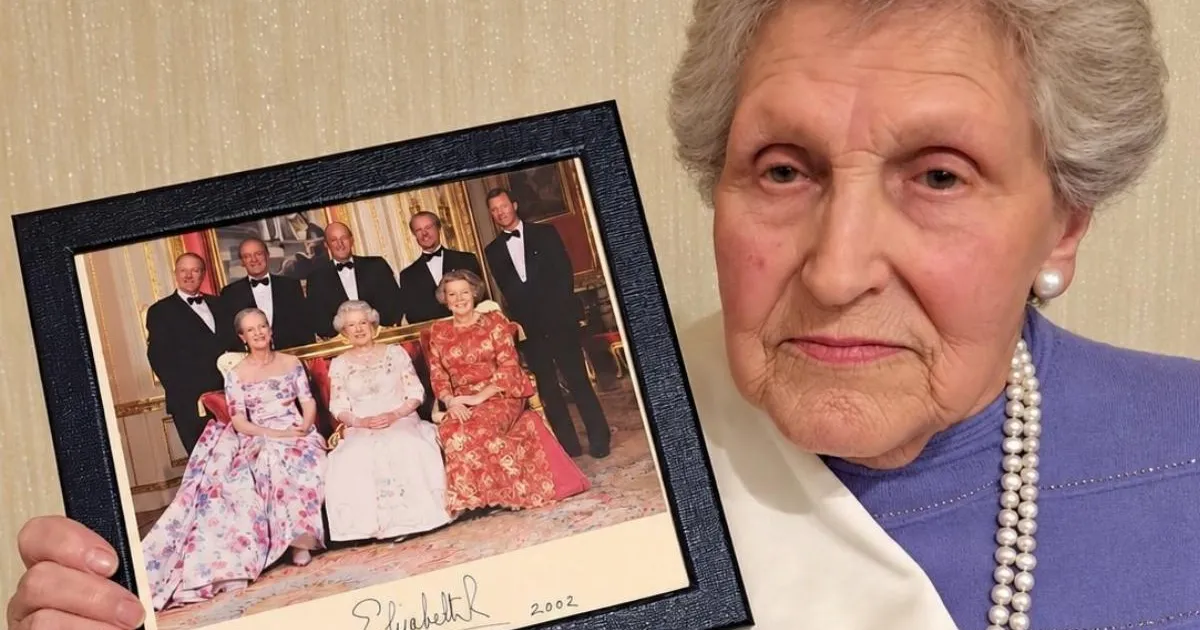
After Ian Thomas died in 1993, Maureen continued to make clothes for the Queen, working essentially alone but always feeling as though she and the monarch were partners in a private creative venture. They had developed an unspoken shorthand, a way of understanding each other that made formal instructions unnecessary. At one point, the Queen smiled and said, “Well, we seem to be managing quite well with our inventions.” And so they carried on, inventing, refining and perfecting the Queen’s wardrobe together. Maureen was not afraid to suggest changes. Before a state visit to Russia in October 1994, she asked the Queen to try some of her dresses without belts, and the softer, un-belted line proved so flattering that it became a signature look for the monarch. It was a small alteration, but it showed how much trust had grown between them. When Maureen retired in 2003, the Queen sent her a gift that she still treasures: a photograph of herself standing with European heads of state at Windsor Castle, wearing one of Maureen’s creations, a sumptuous ivory gown. With it came a letter that read, “The Queen is most grateful to you for all the work you have done for her and much appreciates the loyalty and support you have given her over the years.” For Maureen, those words meant more than any medal or public honour. They were a quiet, personal thank-you from a woman who was not always free to express her feelings openly, but who did so in her own gentle way. The photograph and letter were not just mementoes of a job well done; they were proof of a relationship built on mutual respect and genuine warmth. Looking back, Maureen says the Queen was simply the best customer she ever had, and she feels privileged to have known her not as a distant figure but as a woman who was kind, funny and deeply appreciative of the people who served her.
Since retiring, Maureen has not stopped sewing. Instead of royal gowns, she has turned her extraordinary talent to something much smaller: making intricate, beautifully detailed clothes for her collection of dolls. These miniature creations are every bit as refined as the full-size dresses she once made for Queen Elizabeth II, with tiny seams, delicate embroidery and perfect proportions. Janet Rawnsley, head of fine dolls at Hansons Auctioneers, has praised Maureen as “an incredible seamstress,” noting that the clothes she made for her dolls are as intricate as her finest work for the late Queen. The collection is now set to go under the hammer at Bishton Hall in Stafford on October 20, and the pieces are expected to fetch hundreds of pounds, perhaps more, because they carry with them a remarkable story. For collectors, it is a rare chance to own something made by the same hands that dressed a queen. For Maureen, the dolls represent a lifetime of skill and a love of sewing that has never faded. At eighty-nine, she remains unpretentious and full of stories, eager to share the warmth and humour of the woman she served. She wants people to remember Elizabeth II not only as a monarch who reigned for seventy years, but as a grandmother who laughed about Marmite sandwiches, a woman who joked about charity-shop handbags and who always said thank you. The dresses are now part of history, the dolls will find new homes, but the memory of that quiet laughter, shared over a measuring tape in a palace fitting room, is perhaps the most beautiful legacy of all. Through her stories, Maureen Rose has given the world a glimpse of the Queen nobody else saw, and it is a gift beyond price.