


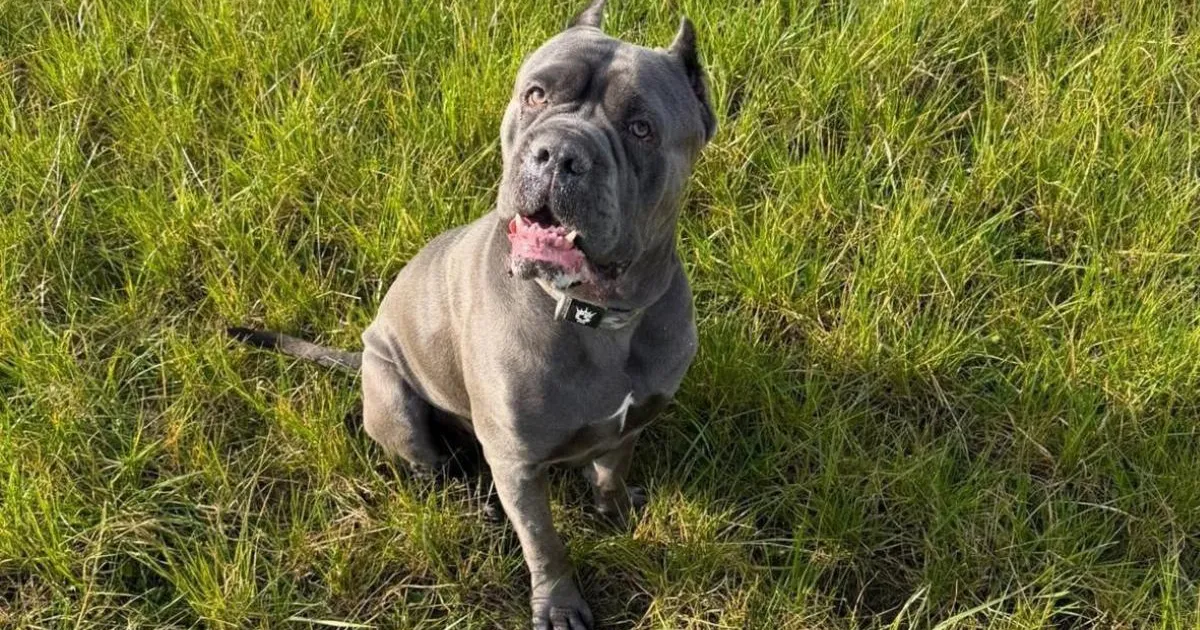
Every dog owner knows the particular joy of watching a pet tear into a new toy. There is a moment of pure, uncomplicated happiness when the eyes widen, the tail begins to thump, and the whole world shrinks to a single piece of nylon rope. For Antonia Speariett, that ordinary moment arrived when she bought a multicolored rope toy from Amazon for £12. The toy was made by Sharlovy, a brand she had no reason to doubt, and it was marketed as being suitable for aggressive chewers. That description was exactly what a Cane Corso owner would want. King Cane was a five-year-old Cane Corso, a magnificent and powerful dog weighing fifty kilograms, with a jaw built for strength and a heart too gentle for his size. He should have spent hours playing with his new toy, chewing and tugging and dragging it around the house until it finally fell apart. But instead of fun and games, the toy became the beginning of a medical emergency, a frantic trip to the vet, an agonizing surgery, and a loss that no amount of money could ever repair. The purchase was completely ordinary. The trust was natural. The result was anything but. What Antonia thought she was giving her best friend was a simple pleasure, a way to pass the afternoon and burn off some of that boundless Cane Corso energy. What she was actually giving him was a deadly obstruction waiting to happen.
At first, there was no reason to think anything was wrong. Dogs play, dogs chew, and dogs sometimes seem a little tired after a particularly good session with a new toy. But over the next few days, King Cane began to change in ways that frightened Antonia. He stopped eating. He grew quiet and withdrawn. The same dog who had always bounded to the door with a happy, heavy trot now lay still, his eyes dull, his body telling a story he could not speak. Antonia and her partner, Ryan Roocroft, 31, watched with growing alarm as their beloved pet continued to decline. “As the days went on, his condition became increasingly worrying, and I knew he needed veterinary attention,” Antonia said. When they finally rushed him to their local vets, the news was devastating. The fifty-kilogram Cane Corso had an intestinal blockage. Worse, the vets were concerned that he had sustained serious damage inside his abdomen, including a perforated intestine. The rope toy had not simply been chewed and thrown aside. Pieces of it had been swallowed, and those pieces had lodged in his digestive system, cutting off the flow of everything his body needed to live. Emergency surgery became the only hope. The couple agreed immediately, desperate to save their dog. But the surgery was only the beginning of a longer, crueler struggle, one that would end not in a happy recovery but in the unbearable silence of a home without King Cane.
Antonia has not tried to hide the financial cost of what happened. She has already paid more than £4,000 for hospital treatments, tests, and ultimately for the euthanasia and cremation of her dog. That number is staggering, especially when the toy itself cost only a little more than a takeaway meal. But anyone who has ever loved a pet knows that the real cost is not measured in pounds. It is measured in the empty spaces around the house, the bowl that no longer needs filling, the leash that hangs by the door, the favorite spot on the sofa where a large, warm body used to settle. “Losing Cane has devastated me, and I am still trying to come to terms with the loss of a much-loved member of my family,” Antonia said. “However, I feel this story is about more than my own heartbreak.” There is a quiet strength in her words, a refusal to let grief become pointless bitterness. Yet the grief is unmistakable. King Cane was not just a dog. He was a companion, a presence, a personality. He had his own routines and quirks, his own way of looking at the people who loved him. And he died in pain, in a veterinary hospital, away from the comfort of his own home, because of a toy that was described as safe for dogs exactly like him. That is the part that makes this tragedy so hard to accept.
Perhaps the most troubling aspect of this story is that nothing about the toy marked it as dangerous. The Sharlovy rope toy was sold not in a shady corner of the internet but on major e-commerce platforms, including Amazon, Shein and Walmart. It was described as being suitable for aggressive chewers. It had good reviews. Other dog owners said their dogs loved it. That is exactly what a responsible pet owner looks for before making a purchase. Antonia did not ignore warning signs, because there were no warning signs. She did not buy a suspiciously cheap product from an unknown seller; she bought a toy that appeared to be tested, approved, and recommended by other dog parents. “The toy had good reviews, and other owners said their dog liked it,” she said. “I never thought a toy for aggressive chewers would ever cause a problem.” That phrase, “aggressive chewers,” is itself part of the problem. It suggests durability, toughness, and safety. It gives owners confidence that a powerful dog can bite and pull and gnaw without consequence. But a rope toy is still made of fibers, and fibers can be broken apart and swallowed. What is marketed as an engaging challenge can become a deadly obstruction in an animal’s intestines. Antonia has said she would welcome the opportunity for the seller or manufacturer to respond. So far, the silence from those responsible for the product has made the loss even harder to bear.
Amazon, for its part, issued a brief statement. “We were very sorry to hear about this. We are in touch with the customer,” a spokesperson said. It is a polite, procedural response, the kind of corporate reaction that offers little comfort to a woman who has lost her best friend. But it also raises a much larger question about the modern marketplace. In an era of online shopping, products move from warehouses to front doors without ever being touched or inspected by a human being. A brand like Sharlovy is not a traditional manufacturer in the way people once understood that word; it is a name attached to goods sold across multiple platforms around the world. When something goes wrong, who is truly responsible? The seller who listed the item? The platform that hosted the listing? The brand that allowed its name to be attached to the product? Too often, the answer is no one at all. Antonia’s story is not simply about one rope toy. It is about the safety standards that apply, or fail to apply, to everyday pet products sold online. Dog toys are not medicines or car seats, but they are placed in the mouths of creatures we love. They are chewed, shredded, and swallowed. They deserve to come with clear information about materials, risks, and testing. They should not require a family to lose a dog before a problem is revealed. Antonia said that if sharing King Cane’s story could help protect even one other dog, she would feel that something positive could come from this tragedy. That is a generous hope, and it is also a demand: that other families never have to learn the same terrible lesson.
“At the end of the day, because of these toys, I have lost my best friend.” Those words, spoken by Antonia, capture everything about this tragedy—the absurdity, the injustice, the sorrow. A woman woke up one morning and ordered a toy for her dog. She watched him play with it. She cleaned up the little pieces of rope that came apart during normal use. She never imagined that those colorful strands would lead to a blocked intestine, emergency surgery, a final goodbye, and a bill for cremation. Her story is a reminder that safety is not guaranteed by a label, a review, or a price point. It is also a reminder that grief does not have to be dramatic to be real. King Cane was only five years old, strong and affectionate, with his whole life ahead of him. He deserved to grow old, to spend more afternoons destroying toys, to rest his heavy head on his owners’ laps and snore through the evening. Instead, he became a warning, a headline, a memory that still hurts. For Antonia, justice would mean answers. It would mean accountability. It would mean knowing that her loss might prevent another family from experiencing the same emptiness. But true justice, even if it comes, will not bring King Cane back. It can only make sure that his story becomes more than sorrow. It can become a reason to question what we buy, to look more closely at the toys we give our animals, and to demand better from the companies that profit from our love. “If sharing his story could help protect even one other dog, I would feel that something positive could come from this tragedy,” she said. That is the legacy King Cane leaves behind—not a rope toy, not a brand, but a plea that no other dog should die because of a product that was supposed to be fun.