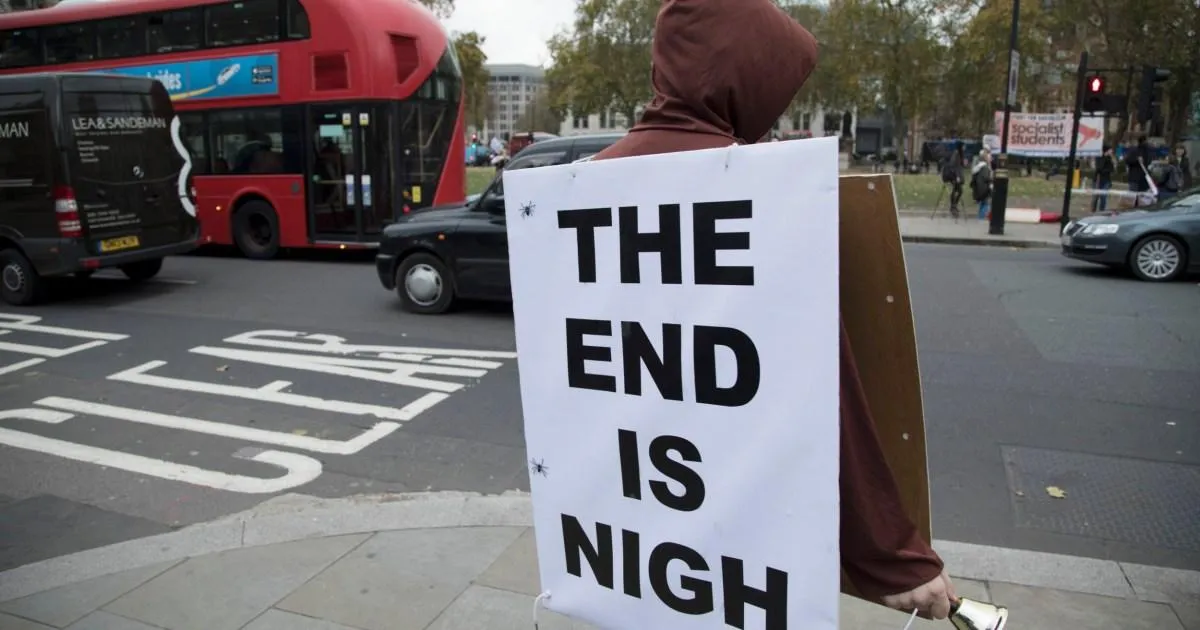
Go ahead and open your calendar app, because this one deserves a notification: the world is apparently ending on November 13, 2026. Yes, that’s a Friday. Not just any Friday, but Friday the 13th, the date that has haunted Western superstition for centuries. And according to a research paper published in 1960 in the journal Science, this is when humanity’s long, crowded march through history finally hits a wall. The authors, led by Austrian-American physicist Heinz von Foerster, were not writing a work of fiction. They were looking at population data and making a mathematical argument. Their conclusion? If human population growth continued the way it had for the previous two thousand years, the numbers would become effectively infinite on that specific November day. The wording is chilling: “At this date, human population will approach infinity if it grows as it has grown in the last two millennia.” And then, to make sure nobody missed the point, they added a grimly poetic line about what would happen to our descendants. “Our great-great-grandchildren will not starve to death,” they wrote. “They will be squeezed to death.” So there it is. No famine, no nuclear war, no asteroid. Just an endless, suffocating crush of humanity, packed together like commuters on a train that never reaches its destination. You might still need to go into the office that day, though. The apocalypse, after all, doesn’t pay your rent.
How did a group of respected researchers land on such an oddly specific date? They didn’t use a crystal ball or a Ouija board. Instead, they looked back at 24 estimates of world population stretching across two thousand years, plotted them on a graph, and followed the curve to its terrifying conclusion. The logic was simple, but the implications were strange. Unlike fruit flies trapped in a milk bottle, humans don’t just breed until they run out of food and then collapse in a heap. We cooperate. We invent agriculture, medicine, and complicated supply chains. We find ways to feed more mouths, build taller buildings, and squeeze more people into smaller spaces. That, the researchers argued, is exactly the problem. Because we can cooperate, we keep growing. And because we keep growing, we eventually reach a point where the system can’t stretch any further. The authors called it “the clever population annihilates itself.” To prevent this, they proposed something they called a “peoplo-stat,” a mechanism to cap population growth. Their idea? Tax families who had more than three children, in the hope of halving birth rates. They also considered space travel as an escape hatch, but they weren’t optimistic. In a wonderfully deadpan line, they noted that space-trotters would never be allowed back: “It is only unfortunate that no re-entry permit to Earth can be given to these space-trotters.” You can almost picture the scientists grinning behind their slide rules. The end of the world, it turns out, was always going to come with a punchline.
Von Foerster himself later admitted that the date wasn’t entirely scientific. The team had actually developed a broader window for humanity’s doom, but they chose November 13, 2026, specifically because it was Friday the 13th. Why not make the apocalypse fit the superstition? It was a bit of dark humor from a group of intellectuals who understood that a prophecy about infinity needed a little theatrical flair. But not everyone was laughing. Eight years later, biologist Paul Ehrlich published The Population Bomb, a book that took the same fears and turned them into full-blown panic. Ehrlich warned that humanity was standing on the brink of catastrophe, with too many mouths to feed and not enough food to go around. He predicted that hundreds of millions of people would starve to death in the 1970s, and he made the famously dramatic claim that “England will not exist in the year 2000.” The public ate it up. The fear of overpopulation seeped into popular culture in strange and unsettling ways. In the 1972 film Dead Planet, the government responds to the crisis by banning pregnancy altogether. In 1973, Soylent Green imagined an overcrowded, polluted future where people fight over scraps of processed rations that, in a twist ending, turn out to be made from other people. For a generation raised on these nightmares, the idea of too many humans wasn’t just an abstract theory. It was a movie you watched on a Saturday afternoon, and then you looked around at the crowded street and wondered if the scientists had been right all along.
But then, something unexpected happened. The apocalypse didn’t show up. Disease-resistant crops transformed farming, medical treatments kept more children alive, and millions of people moved to cities, where they tended to have smaller families. The Green Revolution bought us time. England, contrary to Ehrlich’s prediction, remained very much on the map. And while the population did keep growing, it didn’t grow to infinity. It grew from around three billion in 1960 to more than 8.3 billion today. That’s an enormous number, and for someone living in 1960, it probably felt like infinity. But the curve that von Foerster and his colleagues drew so confidently started bending. Birth rates fell. Families got smaller. Women entered the workforce, access to education expanded, and contraception became more widely available. The UN now estimates that humanity will peak at around 10 billion in 2080, and then, for the first time in two centuries, the population will begin to shrink. A baby born today will be 54 years old in 2080, old enough to watch the peak happen in real time, and perhaps old enough to see the beginning of a very different demographic story. The countries that will dominate the future look nothing like the superpowers of the twentieth century. By 2100, India is expected to have 1.5 billion people, China just 633 million, and Pakistan, Nigeria, and the Democratic Republic of the Congo will all have populations larger than the United States. The center of gravity is shifting, and the old anxieties are being replaced by new ones.
The new worry, bizarrely, is that there will be too few of us. The “peoplo-stat” that von Foerster proposed, it turns out, worked almost too well. People live longer, healthier lives, and they choose to have fewer children, or none at all. Countries like China, Germany, and Russia have already seen their populations peak. Japan and the United States are struggling with ageing workforces and shrinking birth rates. In many parts of the world, governments are no longer panicking about overcrowding; they’re panicking about empty schools, closed maternity wards, and pension systems that depend on a steady stream of young taxpayers. Leaders are trying all sorts of incentives to get people to reproduce. Donald Trump, who has called himself the “fertilisation president” of the United States, has proposed tax breaks for parents in an attempt to engineer a baby boom. But the cultural and economic forces that drive people to have smaller families are hard to reverse. Once societies become wealthy, educated, and urbanized, birth rates tend to fall, and no amount of government encouragement seems to change that. The future, many demographers now believe, is not a planet bursting at the seams. It’s a planet with too many grandparents and not enough grandchildren, a slow, quiet reversal of everything the 1960s doomsayers feared.
That doesn’t mean we should stop worrying about children, though. Joel Cohen, a mathematical biologist at Columbia University, has pointed out that von Foerster’s prophecy was poorly timed in a way the scientists couldn’t have known. The all-time peak in the rate of human population growth actually happened in the early 1960s, right around the time the paper was published. The world was already turning a corner, even as the authors were predicting infinity. But Cohen’s real concern isn’t about too many people or too few. It’s about how we treat the people we already have. In 2024, the World Health Organization reported that 150.2 million children under the age of five were too short for their age because of malnutrition. That’s a staggering number, and it points to a deeper moral failure. “We are doing so poorly by the children we have,” Cohen said, “that I can’t understand why the emphasis is on making more children.” He added, “We’re talking about having more children when we don’t take care of the children we have. What the heck is that?” It’s a good question. For all our worrying about population curves and demographic peaks, the real issue was never just numbers. It’s whether we can build a world where every child, born or unborn, has enough to eat, a safe place to live, and a reason to hope. The apocalypse may have been postponed, but the responsibility hasn’t gone away. Maybe the lesson of November 13, 2026, isn’t that we should fear the future. It’s that we should take better care of the present.