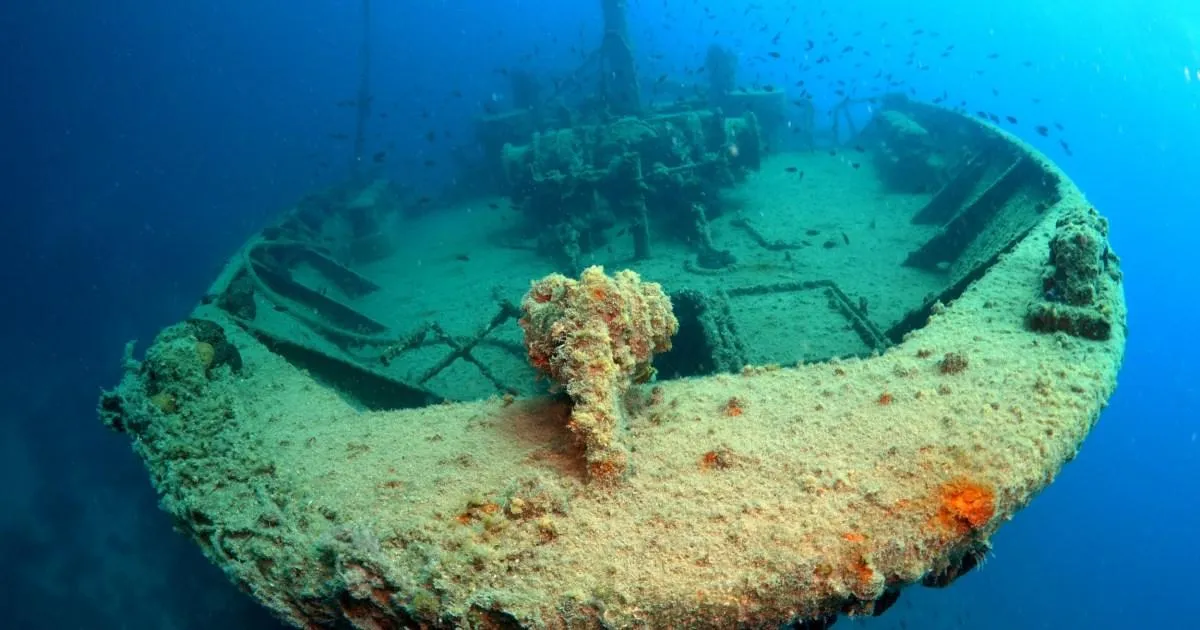
Beneath the sparkling waters off the southern coast of Turkey, near the rugged shores of Kekova Island, a secret lay undisturbed for more than four thousand years. What divers recently brought to light is no ordinary relic: it is the world’s oldest known shipwreck, a fragile time capsule from the dawn of civilization. Archaeologists believe the vessel sank between 4,400 and 4,700 years ago, placing it firmly in the Early Bronze Age—a time when the Great Pyramid of Giza was still rising from the desert sands, when writing was young, and when sailors braved the open Mediterranean with little more than wooden hulls and woven sails. The ship itself is gone, its wooden frame long devoured by the sea, but its cargo remains scattered across the seabed like the last words of a drowned story. The wreck was found lying about thirty metres below the surface, near an underwater slope, and researchers estimate the vessel was around ten metres long—a modest trading ship, not a royal treasure vessel, yet infinitely more valuable for what it holds. Professor Hakan Öniz of Akdeniz University, who led the expedition for the Mediterranean Archaeology Association, described it simply and powerfully: “The shipwreck is a time capsule at the bottom of the sea.” For those who study the deep past, it is also a rare and moving glimpse into a world of commerce, courage, and fragile human connection that existed five thousand years ago.
The discovery itself reads like an underwater detective story. The diving team, working in the clear but unpredictable waters off Antalya, found the wreck lying about thirty metres beneath the surface, with artefacts scattered across a sloping seabed. Among the treasures were three large stone anchors, heavy enough to hold a modest cargo vessel steady against the currents, and more than thirty ceramic storage pots known as amphorae. These were the shipping containers of the ancient world—sturdy, bulky, and made to be reused again and again. With no surviving wood, radiocarbon dating was impossible, so researchers had to rely on the silent language of pottery. They studied the shape, the handles, the ridges, and the flat bases, comparing them with vessels discovered in Egypt and the Middle East. The distinctive design—two handles, a ridge around the middle, and a flat base—matched ceramics dated between 4,400 and 4,700 years old. “Comparing the decoration techniques … we can definitely say our wreck is Early Bronze Age. This is 100%,” said Professor Öniz. The amphorae were carefully brought to the surface and are now being conserved after their long immersion, each one carrying the salt-stained memory of a journey interrupted by catastrophe. To date an ancient shipwreck without a single plank of wood is itself a triumph of archaeological skill, but what the pots contained would soon push the discovery into the realm of the truly astonishing.
When Dr Karin Sowada, an archaeologist from Macquarie University in Australia, looked inside one of the recovered vessels, she reacted with the kind of wonder that rarely survives years of fieldwork. “I looked inside and nearly fainted. I could not believe how much [residue] was visible,” she recalled. “It wasn’t just like spots … a lot of this material was still remaining.” The interiors of some pots still held a thick, glossy residue—dark, mysterious, and utterly unexpected. Scientists are now working to identify what this substance is, with possibilities ranging from olive oil to wine to aromatic tree resins. Any of those would make sense for an ancient trading vessel carrying valuable liquids across the Mediterranean. But Dr Sowada offered a caution, reminding us that these jars were not disposable packaging. They were massive, durable containers that could be emptied, cleaned, and used for years, perhaps generations. “These jars are huge—they’re not things that you just ship away and then never see again,” she said. “People would have emptied these jars on arrival and potentially used them for many, many, many years.” The residue could therefore be from the original cargo, or from a later shipment, or from something entirely different, such as a preservative or sealant. Even the ambiguity is exciting, because it opens a window into the practical lives of ancient people: how they stored goods, how they reused resources, and how they maintained the tools of their trade. For now, the mystery remains—and the laboratory analysis ahead may reveal not only what the pots held, but how the ship and its crew fit into a wider network of Early Bronze Age exchange.
That network is one of the great marvels of ancient history. Even before the great empires of later ages, people were moving raw materials, finished goods, and ideas across the Mediterranean in astonishingly organized ways. This ship almost certainly began its journey somewhere along the eastern Mediterranean coast, loaded with agricultural products and craft goods destined for distant markets. Researchers believe it may have been heading toward the ancient city of Troy, located in what is now north-western Turkey, or toward the Minoan civilization on Crete—both major centres of power, trade, and culture in the Bronze Age. To reach those destinations, sailors had to navigate some of the most dangerous waters of the ancient world. The coast around Kekova Island is notorious for sudden winds, powerful currents, and hidden reefs, and over the centuries it has claimed hundreds of vessels. The seabed there is a graveyard of ships, but also an unmatched library of human commerce. This newest wreck, lying off Antalya, provides rare, physical evidence of a trading voyage that happened at a time when Egypt’s pyramids were being built, when Troy was still emerging, and when the Minoans were about to shape the art and mythology of Europe. It also reminds us that these ancient sailors were not merely coasting along in terror of the open water; they were skilled navigators who carried goods over long distances, connected distant people, and built the foundation for the globalized world we inhabit today. The dangers were real, and the losses were frequent, but the trade continued—because the rewards, and the human need for connection, were greater than the fear of the sea.
Yet for all its archaeological importance, the greatest power of this discovery may be its human intimacy. Professor Öniz has spent years studying ancient wrecks, but he remains deeply moved by the people behind the objects. “We are the first humans who [have] touched these objects after 5,000 years,” he said. That simple sentence carries an extraordinary weight. Between the hands of the potter who shaped the clay, the sailors who loaded the jars, the merchants who weighed their value, and the divers who finally brought them into the sunlight again, there is a chasm of fifty centuries. And in that gap, whole worlds lived and died. Professor Öniz says he often thinks about the sailors themselves—the men who laughed and cursed and prayed on the deck of a small wooden ship, who watched the shoreline disappear and hoped to see it again. He thinks of the people who made the pots, the workers who carried them aboard, the merchants who counted their investment, and the families who may have waited on a distant quay for a ship that never came. This wreck is a time capsule, yes, but it is also a monument to a tragedy: a crew that set out on an ordinary voyage, carrying the labour of many hands, and never reached its destination. No skeletons have been found, no trace of the people aboard. Yet their presence haunts the site. The amphorae, the anchors, the mysterious residue all speak of preparation, purpose, and hope. To look at those jars is to see the last untouched evidence of men who lived at the very edge of recorded history, and whose names will never be known. Archaeology can reconstruct their trade routes and their technology, but it cannot bring them back—it can only honour them by remembering.
In the broader story of shipwrecks, this discovery has already rewritten the record books. The previous oldest known shipwreck was found off the Greek island of Dokos and dated to around 4,200 years ago; the new find pushes the timeline back by several hundred years, to an age when human society was still learning to manage the power of the sea. It is important to note that this wreck is not the same as the oldest shipwreck with preservation of its wooden structure, which remains the famous Black Sea find off the coast of Bulgaria, dating back about 2,400 years. The difference matters: while the Bulgarian wreck is a miraculously preserved wooden vessel with masts and rudders still intact, the Turkish discovery is a cargo site, a ghost of wood that has long since dissolved, leaving only the heavy clay jars and stone anchors as witnesses. Both are priceless, but in very different ways. The Turkish wreck is older, and its very fragility makes it more poignant. Its age was determined not by carbon dating but by the careful study of pottery—a reminder that sometimes the humblest objects tell the most powerful stories. In the months and years ahead, scientists will continue to analyze the residue, conserve the amphorae, and map the underwater site with greater precision. Each new test could reveal what was being shipped, where it came from, and maybe even where it was going. But even without those answers, the discovery is already a triumph: a frozen moment from the childhood of civilization, rescued from the sea before time could erase it completely. It is a reminder that human beings have always been voyagers, traders, and dreamers, willing to risk everything for the promise of something new. The ship that sank near Kekova Island never made it home, but after five thousand years at the bottom of the sea, it has finally broken the surface of history—and captured the imagination of the world.