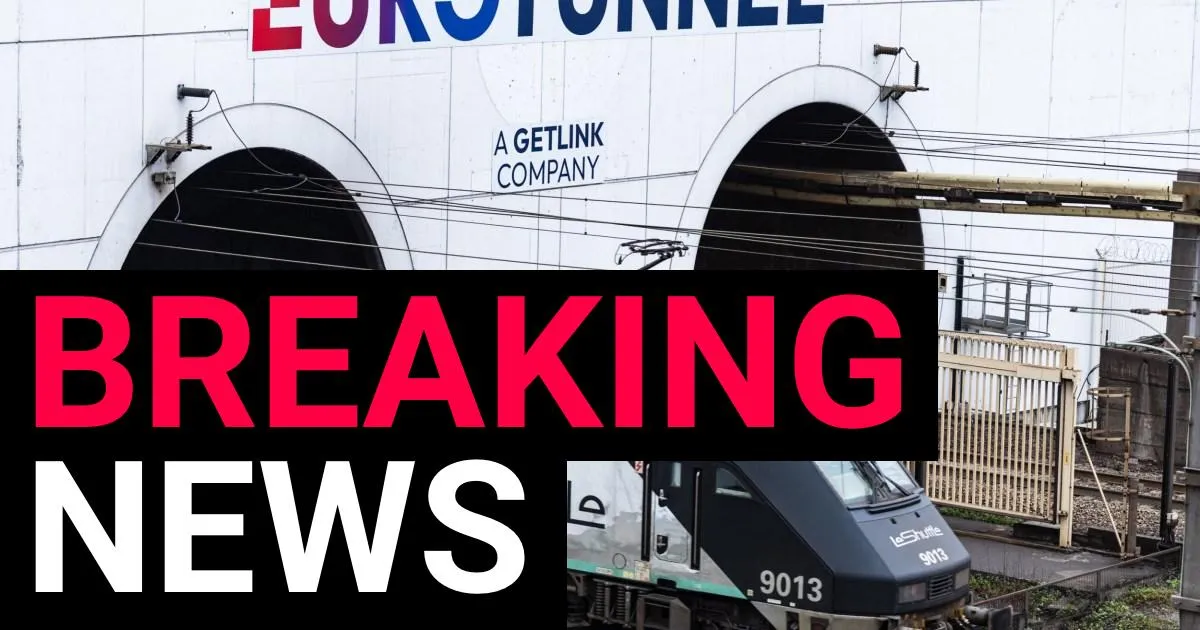
The evening air around the Eurotunnel terminal in Coquelles usually carries a particular kind of restlessness—the low growl of engines waiting in line, the hiss of air brakes, the distant thump of train doors closing, and the murmur of travellers in languages that blur together. It is a place of transition, a threshold where thousands of people pass each day between France and Britain, often without giving much thought to the complexity of the machinery that carries them. At around eight o’clock on what should have been an unremarkable night, a minibus carrying nineteen people, including its driver, entered the loading dock of the Eurotunnel site as part of the carefully choreographed process of moving HGV drivers onto a Le Shuttle train. These drivers had been on the road for hours, perhaps days, and the minibus offered a brief respite from the cab of a lorry—a chance to sit with other travellers, exchange nods, and prepare for the strange experience of being driven through the Channel Tunnel. Then, without warning, the routine was shattered. The minibus crashed, flipped onto the railway tracks, and slammed into a stationary freight train. The sound of ripping metal and shattering glass rolled across the terminal, and the peaceful hum of the evening was replaced by shouts, crying, and the frantic sounds of people trying to make sense of what had just happened. In the earliest reports, the details were grim yet merciful: at least nineteen people injured, none believed to be life-threatening, no deaths. But statistics cannot capture the terror of a person thrown from their seat, the sight of a fellow passenger clutching a bleeding arm, or the confusion of waiting for help in the shadows of a train that should never have been part of the journey. For the men and women whose night was so violently interrupted, the accident would become a before-and-after moment in their lives, a dividing line between the ordinary people they had been at breakfast and the survivors they would be from that moment forward.
The first emergency alerts went out at high speed, and the response was immediate. Firefighters, paramedics, and police officers converged on the scene from nearby stations in Pas-de-Calais, their blue and red lights painting the loading dock in frantic colour. An intensive care unit helicopter was scrambled, a decision that made the gravity of the moment clear to everyone who saw it. Yet as authorities spoke to the press, their words were careful and reassuring: none of the injuries are thought to be life-threatening. Some victims were complaining of leg and head pain, injuries that speak to the force of the impact and the violence of the vehicle’s rollover. Others may have been walking wounded, dazed and trembling, wrapped in foil blankets by paramedics while being checked for signs of concussion or internal trauma. The process of triage in a scene like this is methodical, but it is also deeply human. Paramedics squeeze hands, look into eyes, and speak calmly even as alarms blare and radios crackle. Firefighters examine the minibus to ensure no one was trapped, and the sight of the crumpled vehicle, lying close to the tracks, serves as a silent testament to the narrow margins between disaster and tragedy. The fact that everyone survived is a piece of luck that will not be forgotten by the families waiting for phone calls, or by the hospital staff preparing to receive a sudden influx of patients. For many of the injured, the hardest part may not have been the crash itself, but the moments that followed—lying still, hearing the sounds of rescue, feeling pain begin to flood the body, and wondering whether the people they loved knew what had happened. The medical teams, working under the glare of portable floodlights, did everything they could to bring order to the chaos, and their efforts ensured that the initial statistics remained hopeful: nineteen people hurt, but nineteen people alive.
To understand this accident, we have to think about the people who were on that minibus. They were not unlucky strangers; they were vital pieces of an economy that often ignores their presence until something goes wrong. HGV drivers spend long nights crossing Europe, navigating unfamiliar cities, sleeping in lay-bys, and waiting at border checkpoints. They are far from home, and the Eurotunnel shuttle is one of the rare moments when they can step out of their vehicles and let someone else take charge. The minibus driver, no doubt, knew the route well. He had probably made the same short journey at the same time of day, pulling up to the loading dock, checking the passengers in the mirror, and easing forward with the certainty of habit. But habit can be fragile. Perhaps a mechanical fault, a moment of distraction, an unexpected obstacle, or a misjudgement sent the vehicle out of control. In the seconds after the crash, the driver would have faced the horrifying awareness that the people in his care were injured, and that the career and identity he had built around safe transport had been called into question. Passengers, many of whom had probably exchanged only polite greetings, suddenly found themselves connected by the shared experience of survival. There would have been moments of panic, attempts to pull open doors, cries for water, and phone calls that barely went through because of shattered nerves. Some may have suffered nothing more than bruises and a profound sense of shock; others would need weeks of recovery. But all of them, in that quiet aftermath, would have felt their mortality in a way that no amount of routine can protect against. The nineteen people on that bus were more than casualties in a breaking news bulletin. They were fathers, mothers, siblings, and friends—people with plans for the weekend, messages waiting on their phones, and loved ones who would not rest until they heard their voices.
The rescue operation was a testament to the skill and dedication of emergency services in northern France. Firefighting crews arrived with heavy-cutting equipment, capable of slicing through the reinforced steel of train chassis if necessary, while medical units set up a triage area on the damp ground near the crash site. In the glare of floodlights, the perimeter was secured by police, who balanced their duties as investigators with the need to keep the area safe for the hundreds of people affected by the closure. The decision to send an intensive care unit helicopter underlined the seriousness of the response. These helicopters carry specialised teams, fully equipped to provide advanced medical care in the field, and their presence is a familiar sight in major incidents across the region. On the scene, communication had to work in multiple languages, since lorry drivers from different countries were among the injured. A Polish word of reassurance, a Romanian phrase of comfort, a French command shouted with broken patience—these are the small, human textures of cross-border travel, and they made the rescue effort more complex and more remarkable. Paramedics moved from casualty to casualty, assessing pupils, pressing abdomens, asking questions that were simple but profound: What is your name? Where does it hurt? Can you feel this? The injured were loaded onto stretchers and then into ambulances, some destined for hospitals in Calais and others for specialist centres where the helicopter could land. Meanwhile, fire crews carefully inspected the minibus to make sure no one had been missed, and the engineers who manage the Eurotunnel operation stood by, visibly shaken, as they began to understand the wider consequences of what had occurred. For the rescuers, the night would be long. They would return to their own homes in the early hours, carrying the weight of the images they had seen, but also the satisfaction of knowing they had played a part in saving every one of the nineteen lives involved.
The closure of the Channel Tunnel for the foreseeable future was announced almost immediately, and the words sent tremors across a transport network that connects the United Kingdom and continental Europe. For millions of passengers who use the Eurotunnel every year, the tunnel is more than a convenience; it is the fastest and most reliable way to get a car, a motorcycle, a lorry, or a bicycle across the Channel. When it closed, everything changed. The approaches to the terminal became a sea of stationary vehicles, with drivers sitting behind the wheels of lorries loaded with fragile goods, perishable foods, and urgent medical supplies. Holidaymakers who had been looking forward to a night in Lille or a morning at a theme park found themselves checking their phones for updates, searching for alternative ferries or flights, and trying to explain to children why they could not go through the magical tunnel. Freight companies began to recalculate routes, adding hours and costs to journeys that had once been straightforward. The economic consequences would be measured in the coming days, but the immediate impact was emotional: a shared sense of uncertainty, the feeling that something fundamental had been broken. Yet even as the practical world scrambled to adapt, the quieter work of understanding began. Investigators would need to determine why the minibus left its route, whether the driver had been following the proper loading procedure, whether the stationary freight train had been properly marked and protected, and whether any element of the design of the loading dock had contributed to the accident. Automated records, CCTV footage, and the memory of witnesses would be studied with care. The goal was not simply to assign blame, but to ensure that the same set of circumstances would never again be allowed to turn a loading dock into a place of injury and fear.
As the hours passed and the news cycle moved on, the nineteen people from the minibus faced a different kind of journey, one that had little to do with trains or tunnels. Some were in hospital beds, their limbs carefully bandaged and their heads filled with questions. Others were in police waiting rooms or hotel rooms, trying to sleep. The families who had received those terrible phone calls—or stood at the tunnel entrance waiting for someone who never came—began to breathe again when they learned the injuries were not life-threatening. There will be time for anger and for demands for safety improvements; there will be time for legal proceedings and official reports. But there must also be time for pause, because the story is ultimately one of human fragility and human endurance. A driver who had done the same route a hundred times will have to find the courage to return to the cab. Passengers who crossed the Channel as part of their job will have to explain to their colleagues why they flinch at the sound of a crush. The workers at the Eurotunnel terminal, whose daily routines were interrupted with such drama, will have to process the shock of seeing their familiar workplace turned into an accident scene. None of this can be rushed. In the end, the tunnel will open again, the trains will roll, and the terminal at Coquelles will fill with the usual sounds and smells. Time has a way of smoothing over even the sharpest edges of a catastrophe. But for those who lived through this night, the memory will remain a permanent part of who they are. And in the ordinary days ahead, the best response may be a simple one: to hold in mind the nineteen people injured, to thank the emergency workers who answered the call, and to hope, with all the quietness of a prayer, that every single one of them finds a way to heal—not just in their bones and their bruises, but in their hearts and their minds. That is the true measure of a community, reaching out in the dark to reassure someone that they are not alone.