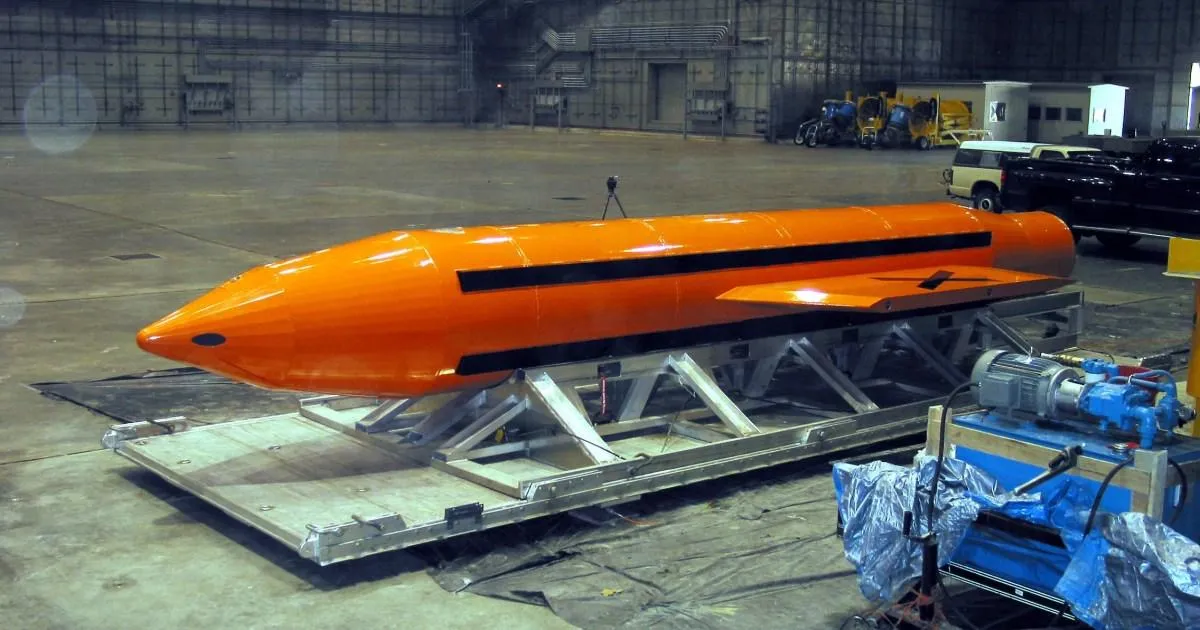
For the first time in the conflict with Iran, the United States is reportedly preparing for the possibility of using its most devastating conventional weapon—the GBU-43/B Massive Ordnance Air Blast, better known as the “mother of all bombs.” According to multiple US officials speaking to CNN, the American military has drawn up plans that could see this enormous weapon dropped on Iranian nuclear facilities and energy infrastructure if President Donald Trump gives the order to resume combat. The sheer weight of this idea is difficult to process. The MOAB is not just another bomb; it is a weapon that exists at the very edge of what is possible without crossing the nuclear threshold. It creates a blast so immense, so hot, and so overwhelming that it has been described as a weapon that can flatten everything in its immediate radius. To even consider using it against Iran represents a major escalation, a sign that the conflict—already more than six months old—has reached a desperate, dangerous phase. The very mention of the plan sends a wave of unease through the region and beyond, because once a weapon of this magnitude is used, the rules of war feel permanently changed. Yet, strikingly, even within the American military, there is reportedly doubt about whether the MOAB would actually alter the course of the war. Officials have privately questioned whether a single massive explosion—no matter how spectacular—could break the stalemate between Washington and Tehran. That is a sobering thought. It suggests that the administration may be considering a weapon of staggering destructive power not because it is confident it will end the conflict, but because it is looking for something, anything, that looks decisive. In that sense, the mother of all bombs becomes less a military strategy and more a political cry in the dark, a signal of frustration rather than a path to victory. The human cost of such a choice would be immeasurable. Behind the acronyms and military briefings are ordinary people, families, and communities who would feel the shockwaves for generations.
The MOAB is a weapon with a fearsome reputation and a relatively short operational history. It weighs an astonishing amount and carries a warhead designed to produce a massive overpressure that can destroy tunnels, caves, and bunkers from the outside in. It was developed in the early 2000s, partly to deal with exactly the kind of deeply buried targets that Iran has reportedly built. Among the sites said to be considered are underground nuclear facilities, including one known to American officials as Pickaxe Mountain. The name suggests something solid, impenetrable, carved into the earth. The MOAB was famously used in Afghanistan in 2017 against a network of ISIS tunnels, creating a mushroom-cloud-like plume that was captured on video and broadcast around the world. It was a moment of awe and horror, a reminder that human beings have found ever more efficient ways to destroy one another. Now, according to the reports, the same kind of weapon could be used in Iran. But there is a critical difference. The Afghan targets were relatively shallow cave complexes. Iranian nuclear facilities are built with survival in mind, buried deep within mountains, protected by layers of rock and reinforced concrete. The MOAB detonates above ground; it is not a deep-earth penetrator. It sends a shockwave outward and downward, and that may be enough to collapse some tunnels, but whether it can truly reach the heart of a hardened nuclear site is another question entirely. Military officials have reportedly expressed exactly this concern, wondering aloud whether deploying the weapon would be worth the political and moral fallout. It is one of the most powerful conventional bombs in the American arsenal, but power alone does not guarantee effectiveness. And even if it did destroy its target, the broader conflict would remain. A bomb, no matter how massive, cannot deliver diplomacy, cannot negotiate a settlement, and cannot bring peace to a region already engulfed in violence.
The political context surrounding these reports is just as important as the military details. President Trump is facing mounting pressure to end a war that has become deeply unpopular with American voters. More than six months of bombing have produced no obvious breakthrough, no surrender, no movement toward a negotiated settlement. Instead, the conflict has settled into a grim rhythm of strikes and retaliation, with no end in sight. That is a dangerous place to be when midterm elections are approaching. Republicans are bracing for a backlash from voters who are tired of overseas entanglements, tired of seeing the country spend blood and treasure on conflicts that do not seem to make Americans safer. The administration knows this. Advisers have reportedly spent months discussing how to produce what they describe as a “definitive” end to the war—a phrase that sounds good in press releases but is far harder to define on the ground. What would a definitive end look like? Would it be a treaty? A ceasefire? A change in Iranian behavior? None of those things seem close to happening. And so the conversation has turned to more drastic options, including the use of the MOAB. The hope, presumably, is that one enormous explosion would shock the enemy into submission, or at least create enough chaos to allow an American withdrawal to be presented as victory. But voters are not easily fooled. They can see when a government is flailing, when military action is being taken for domestic political reasons rather than strategic ones. The more the administration reaches for dramatic solutions, the more it reveals how little control it truly has. The midterms have become a silent partner in every decision, and the pressure to show strength is colliding with the pressure to end the war. In that collision, ordinary people often get hurt.
Behind closed doors, senior US officials are reportedly asking an unsettling question: does the White House have a wider strategy at all? For months, the military has been striking Iranian targets, but there appears to be no clear link between the bombs being dropped and a path out of the war. This is not just an academic concern. It is the difference between a campaign and a blind march into the dark. Officials have privately expressed doubts that the United States is operating with a coherent plan, and the reported consideration of the MOAB only deepens that suspicion. Dropping the largest non-nuclear bomb in the American arsenal is not a strategy. It is a moment. A moment of thunder, smoke, and fire, followed by an uncomfortable silence. The administration may hope that the silence will create a new reality, but history suggests it will only make things more complicated. Trump has reportedly rejected suggestions from some allies that he should simply withdraw American forces, arguing that doing so could look like a defeat. That is a very human fear—the fear of being seen as weak, the fear that a retreat will be viewed as an admission of failure. But there is a deeper problem. If the only options on the table are escalation on one hand and withdrawal on the other, then the war itself has already become a trap. The military is caught in the middle, tasked with carrying out orders that may not make sense. The officials who question the use of the MOAB are not being cowardly; they are being honest. They understand that a bomb cannot think, cannot negotiate, cannot rebuild what it destroys. It can only punish. And punishment, however massive, rarely leads to lasting peace. Without a broader strategy, the mother of all bombs is just a very large way of saying that the United States has run out of ideas.
One of the most troubling details in the reports is the proposed timing of any potential strike. A source told CNN that the plans refer to launching attacks before a US military withdrawal from the region, potentially allowing the administration to declare victory before pulling out. In other words, the MOAB could be used not to win the war in any meaningful sense, but to create a dramatic prelude to an exit. It would be a way of shaping the narrative, of ensuring that the final image of American involvement is not a hasty retreat but a towering column of fire and smoke. This is deeply unsettling because it suggests that the lives affected by the explosion would be secondary to the political story being told back home. The plans reportedly include possible attacks on Iranian nuclear facilities, including the underground site known as Pickaxe Mountain, and the use of the MOAB has been explicitly discussed in that context. For the people living near such sites, this is not an abstraction. They would feel the ground shake, hear the roar, and watch the sky turn orange. They would live with the aftermath, the rubble, the injured, the dead. And then they would be expected to negotiate? The idea that a weapon of this size could somehow bring an adversarial government to the table is based on a fantasy that military force alone can solve political problems. Trump has publicly said he would not take further military action before the midterm elections, but advisers have privately questioned whether that position is final. Public promises made under pressure can crack. If the political winds shift, the order could come at any moment. The uncertainty is perhaps the most terrifying part. No one—not the public, not the military, not even the president’s closest advisers—knows for certain what will happen next. The world is left waiting, watching, and hoping that reason prevails over the desire for spectacle.
For now, the White House has not publicly confirmed that the MOAB will be used, and the reported plans do not mean that an attack has been ordered. There is still space, however narrow, for a different course. The officials who leaked these details to the press may be trying to warn the public, or they may be shaping the battlefield of public opinion. Either way, the information is out in the open, and the world is watching. The decision before President Trump is not just a military one; it is a moral one. It is a choice between escalation and restraint, between a dramatic explosion and a difficult conversation, between the illusion of victory and the possibility of peace. The mother of all bombs has a name that suggests intimacy and destruction at the same time—a mother, after all, is supposed to protect, not annihilate. The irony is painful. Six months of war have already caused immense suffering, and the prospect of even more devastating violence is enough to make anyone stop and think. But thinking is not the same as acting. Action is required. Diplomacy is required. A real strategy, one that connects military decisions to a clear and just outcome, is required. The weapon sits ready. The plans are drawn. The president holds the power of life and death in his hands. What remains to be seen is whether he will choose to use it, and whether the voices urging caution—inside the military, inside his own administration, and across the world—will be heard. The quiet best we can hope for is that the mother of all bombs stays where it belongs: in the arsenal, unused, a terrifying reminder of what humanity is capable of, and a challenge to prove that we are capable of something better.