
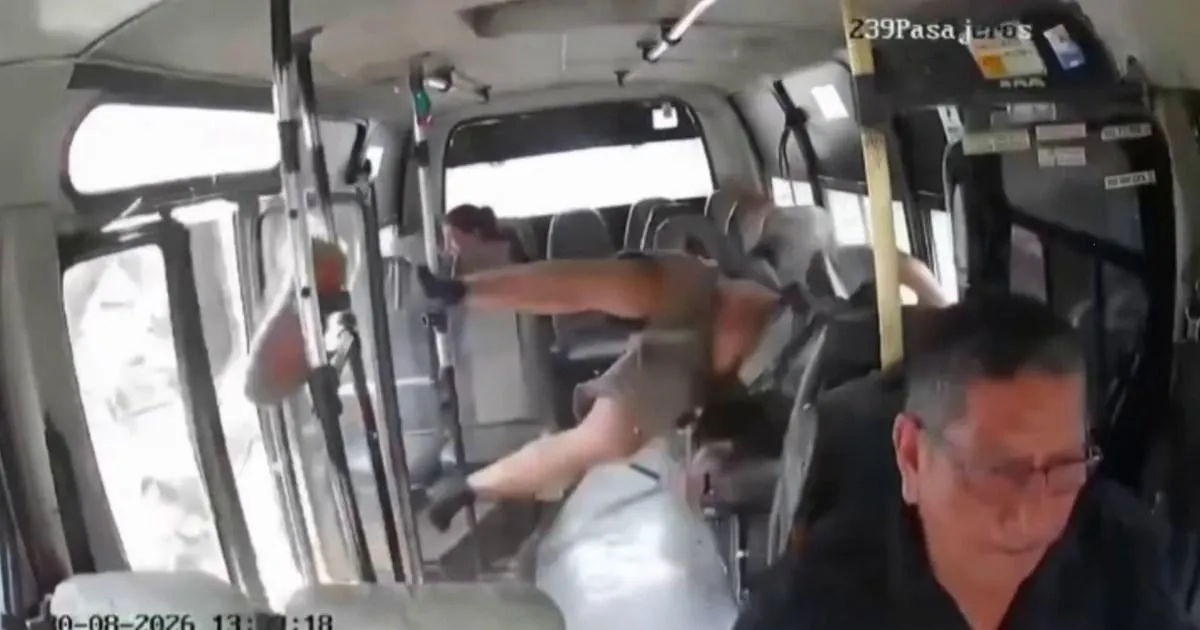
In the world of road accidents, there are moments that seem to defy every expectation of physics and pure luck. Such a moment was captured on CCTV on a busy stretch of Calle Septima in Valle del Cauca, Colombia, where a motorcyclist came tearing toward a junction at a speed that left no room for reaction. The road was active, the afternoon was ordinary, and then, in the blink of an eye, the rider slammed into the side of a bus that was crossing his path. It was the kind of collision that usually ends in tragedy, and for a split second, everything hung in the balance. The motorcycle crumpled against the vehicle, the rider was launched from his seat, and the violence of the impact seemed to offer no mercy. But then something strange happened—something that would make the footage remarkable rather than heartbreaking. The bus’s door was open at the moment of the crash. Instead of smashing into the solid exterior of the bus, the motorcyclist was thrown directly through the open doorway and into the interior of the vehicle. He did not bounce off metal or glass; he flew inside, as if the bus had somehow swallowed him whole. For several seconds, he lay sprawled on the floor, dazed and disoriented, likely not understanding how he was still alive. His shoes had been torn off in the collision, a small but telling detail that revealed the raw force of the impact. Outside, his motorcycle lay scattered on the road, a mangled reminder of the speed and chaos that had just unfolded.
The footage, as such footage often does, tells a story that words can barely capture. The man appears visibly shocked, moving slowly, trying to piece together what had just happened. He had been thrown into a moving vehicle, through a doorway that happened to be open, and had escaped with nothing more than a terrifying story to tell. No serious injuries were reported in the immediate aftermath, though the motorcyclist was taken to a medical center for X-rays, no doubt to make sure that no internal damage had been done. Adrenaline can mask pain, and shock can hide injuries, so the decision to have him examined was a wise one. Authorities in Valle del Cauca have since been examining the circumstances of the collision, trying to determine exactly how the crash occurred and whether any traffic violations played a role. But beyond the official investigation, there is a human dimension that is impossible to ignore. This was a man who, by all accounts, should have been killed. He crossed a junction at high speed, hit a bus, and was thrown through a doorway instead of into a wall of metal. He lost his shoes, landed on the floor of a bus, stood up, and walked away. In the randomness of life, he was given a second chance. The incident is a reminder of how fragile we are on two wheels, and also of how deeply unpredictable fate can be. Sometimes survival is not about skill or strength; it is about timing, an open door, and an almost impossible stroke of luck.
Half a world away, in the United Kingdom, another motorcyclist experienced a very different kind of near miss, but one that carried the same emotional weight. The rider, a TikTok user known as @motocasperuk, was out on the roads of Essex when a truck driver suddenly appeared in their lane, driving head-on toward them while on the wrong side of the road. It was July 16, and traffic was backed up near Lakeside, in the direction of the Dartford Crossing, a stretch of road that had come to a standstill. Drivers were waiting for hours, stuck in a slow, frustrating crawl, and the road in the opposite direction was completely empty. That empty lane was likely a temptation for a driver looking for a way around the congestion, but for the motorcyclist, it became a terrifying vision of impending disaster. As they rounded a bend or crested a rise, a lorry was suddenly there, coming straight at them in their lane. There was no warning, no time to think, only the instinctive need to stop before a head-on collision became unavoidable. The motorcyclist slammed on the brakes, locking the rear wheel and skidding toward the curb as the lorry passed within what must have felt like inches. It was a moment of pure, undiluted fear, followed by the strange calm that often arrives after danger has passed.
The rider later described the experience with a mix of humor and disbelief. “As an experienced rider, I always expect the unexpected, and I expected cars doing U-turns. But this wasn’t something I expected,” they said. That statement captures the strange reality of riding: you prepare for the predictable dangers, but the true threats are the ones that make no sense. “It wasn’t a pleasant moment; I locked the rear wheel. It was an emergency stop for me. I was pinned against the curb; I left a black mark from my tyre all the way down the road from braking.” The image of that black mark is powerful—a physical scar left on the pavement by a moment of terror. The rider continued, “If worst came to the worst, I would’ve had to pull the throttle and go into the fields.” That thought, of escaping into an open field to avoid a truck, reveals just how desperate the situation had become. And yet, despite the danger, their final reflection was surprisingly measured: “It wasn’t an ‘Oh my God, I’m going to die’ moment, so much as a ‘What are you doing?’ moment.” That is the voice of someone who has stared down danger before, who knows that panic is a luxury they cannot afford. The footage they shared on social media racked up thousands of views, with viewers watching in disbelief as the lorry and a Subaru appeared on the empty road, a road that was supposed to be a 50mph zone. For the rider, the encounter was not just a close call; it was a reminder that even the most careful motorcyclist can be caught in someone else’s mistake.
These two incidents, separated by thousands of miles and entirely different circumstances, share a common thread that speaks to the vulnerability of motorcycle riders everywhere. On a motorcycle, you are exposed in ways that car and truck drivers never truly understand. There is no steel cage around you, no crumple zone, no seatbelt holding you in place. You are just a human being, a helmet, and a machine, moving through a world full of larger vehicles and unpredictable decisions. The Colombian rider was saved by an open door; the Essex rider was saved by their own quick reflexes. But both were one small piece of timing away from a very different outcome. These stories remind us that the road is not always a rational place. It is filled with distracted drivers, impatient drivers, tired drivers, and drivers who make decisions that put others at risk. For motorcyclists, every trip is a negotiation with fate. They must watch for cars turning suddenly, doors opening without warning, debris in the road, and the countless other hazards that drivers in cars barely notice. Add to that the kind of reckless behavior seen in these videos, and it becomes clear why riders so often speak about safety as a personal responsibility, not something they can trust to others. The Essex rider’s phrase, “I always expect the unexpected,” is not just a slogan; it is a survival strategy. But even that strategy has limits. You cannot expect a truck to drive directly at you in your own lane. You cannot expect a bus’s open door to become the difference between life and death. You can only ride defensively, stay alert, and hope that luck is on your side.
In the end, what do these stories tell us? They tell us that life can change in a second, but also that it can be preserved by the smallest of margins. They tell us that the roads are shared spaces, and with that sharing comes a responsibility to act with care and respect. The Colombian motorcyclist was lucky; the Essex motorcyclist was skilled. But neither should have had to rely on luck or skill in the first place. The bus driver likely never saw the rider coming; the truck driver likely never imagined they would end up on the wrong side of the road. No one sets out to cause harm, yet harm is caused every day because of impatience, fatigue, and distraction. For every rider who walks away from a crash, there are many who do not. For every open door that saves a life, there are countless closed doors that lead to tragedy. The footage from Colombia and Essex offers more than just viral entertainment; it offers a glimpse into the fragile contract we all make when we step into traffic. As viewers, we can shake our heads at the near miss and feel relief that no one was seriously hurt. But if we are paying attention, we can also take something deeper away—the awareness that we are all vulnerable, all connected, and all responsible for what happens on the roads. The man who crawled off the bus floor in Colombia has a story to tell for the rest of his life. The rider who braked hard in Essex has a reason to keep riding, and to keep sharing their experiences with others. And for the rest of us, these moments are a reminder to slow down, pay attention, and never assume that the next second is promised. Whether we are behind a wheel, on two wheels, or simply watching from the pavement, we are all part of the same journey. And sometimes, all that separates one outcome from another is an open door, a quick reaction, or the strange, unexplainable luck that lets a person stand up, shake off the shock, and walk away.