


Some stories are too stubborn to stay buried. For decades, the lost villages of Derwent and Ashopton have lain beneath the waters of Ladybower Reservoir in Derbyshire, their homes, churches and streets swallowed by a vast engineering project designed to bring drinking water to millions of people. But this year, after a summer of punishing heat and months of below-average rainfall, the reservoir has shrunk to just 32 per cent of its capacity, and the secrets at the bottom have begun to surface. In a stark and strangely moving display, the stone walls, broken foundations and floor plans of the two communities have emerged from the drying mud, visible for the first time since 2018. Aerial photographs show the ghostly geometry of streets and dwellings cut into the earth, like an archaeological site unveiled by catastrophe. The villages were deliberately flooded in the 1940s, after years of preparation that stretched back to the mid-1930s, to make way for Ladybower, a reservoir capable of holding a staggering 2,869 megalitres of water. For more than eight decades, the human cost of that achievement has been hidden beneath the surface, quietly resting in the cold, dark depths. Now, with water levels dramatically low, the landscape is telling a different story — not of a clean, efficient supply of drinking water, but of the people who were asked to leave their homes, their memories and their ordinary routines behind, so that cities such as Derby, Sheffield, Nottingham and Leicester could thrive. The eerie remains are a reminder that even the most functional infrastructure is built on top of human history, and that sometimes the past refuses to stay forgotten. Every exposed stone wall, every half-buried doorstep, every faint outline of a lane seems to whisper that the valley was not always a reservoir; it was once a place where life was lived loudly, messily and joyfully, and no amount of water can wash that away entirely.
The villages that have re-emerged were not nameless clusters of houses; they were places with personality, pride and purpose. Derwent and Ashopton had been settled for centuries, sitting snugly in the Derwent Valley with views that inspired awe in all who passed through. Ashopton, in particular, was a lively and self-contained community with its own pubs, an iconic old toll house and the grand Derwent Hall, a country estate that had long been a centre of local life. There were limestone cottages that had witnessed generations of births, marriages, deaths, school reunions, harvest suppers and quiet Sunday mornings. More than a hundred people called these villages home, and their lives were woven into the rhythm of the valley — farmers who knew the best pasture, labourers who walked to work along lanes that would one day be drowned, shopkeepers who heard the church bells from behind their counters, children who grew up chasing each other through streets that now lie beneath the silt. The decision to flood the villages was not made lightly, but it was made in an era when progress and necessity often outweighed the pain of dislocation. Between 1935 and 1943, the Derwent Valley was transformed, its shape reshaped by diggers, engineers and sheer human will to create Ladybower Reservoir as part of a grand scheme to supply water to the East Midlands. The process of clearing the land meant dismantling houses, moving furniture, closing doors for the last time and leaving behind the only world many people had ever known. Some buildings were demolished, some were dismantled and their stones carted away, and the church was emptied of its treasures, but the memory of the valley as a living, breathing place was not so easily erased. Today, when the water retreats, those memories seem to breathe again, rising not as ghosts in white sheets but as solid, honest chunks of masonry that refuse to disappear.
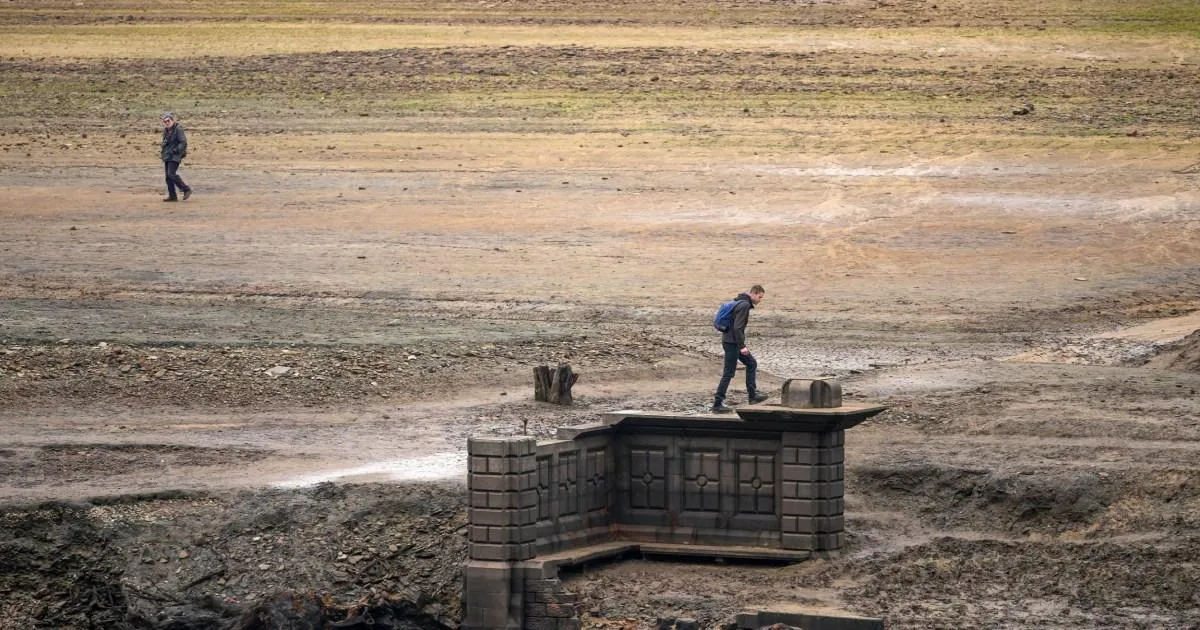
Among the mud and cracked earth, the physical remains are startlingly intact. A former pump house still stands upright, a lonely sentinel in a landscape that no longer needs it, looking for all the world as if its operators simply walked away one afternoon and never came back. Chunks of finely cut stone walls rise from the thick mud, remarkably straight and true after all these years beneath water. The outlines of dozens of limestone cottages — homes that once sheltered families, children, coal fires and whispered conversations — are now clearly visible, etched into the ground like blueprints of a lost world. Streets that once carried the noise of carts and gossip run beneath the visitor’s gaze, straightened by memory and made suddenly legible by drought. For local people and historians, it is the clearest view of the drowned villages since 2018, and perhaps the most haunting image of the current crisis. There is a strange intimacy in seeing the threshold of a home exposed after decades, the base of a wall where someone once hung a coat, the corner of a room where a bed may have stood. The photographs show not just rubble but the skeleton of a community, and each stone seems to ask a question: Who lived here? What did they dream about? How did they feel as the water rose? The fact that so much has survived is remarkable; the fact that it has come to light because of drought feels less like a gift and more like an omen. These are ghostly images, yes, but they are also photographs of a landscape in distress — a warning of what happens when the natural world is pushed to its limits. The reservoir is still holding water, but at less than a third of its capacity, it is a shadow of the vast, proud lake that locals remember, and the exposed ruins are a reminder that even the most permanent-looking things are fragile in the end.
The reason for this strange uncovering is as troubling as it is fascinating. England has been gripped by drought, and the effects are visible across rivers, reservoirs and water supplies. In Derbyshire, the summer’s rising temperatures arrived alongside six months of below-average rainfall, leaving the land parched and Ladybower at just 32 per cent of its normal volume. Doug Clarke, Severn Trent’s water resources lead, explained that the recovery will not be quick. “We’ve seen six months of below-average rainfall and above-average temperatures, so reservoir levels will take time to recover,” he said, while noting that across the region there is actually more stored water than this time last year. That may be small comfort for anyone looking at the exposed ruins of Derwent and Ashopton, but it does provide some perspective. Clarke also reminded the public that reservoirs supply around a third of the region’s water, with the remainder coming from rivers and groundwater. His team is working around the clock, he said, treating more water and repairing leaks at record levels, but he also asked customers to think about how they use water all year round, not just during heatwaves. The balancing act is delicate: a reservoir is both a lifeline and a burden, a source of modern convenience and a grave for an old way of life. When we turn on a tap, the water that flows may have passed over the place where children once played in the lanes of Ashopton, where lovers whispered along the riverbank, where old men sat outside the pub on warm summer evenings. That thought gives a new weight to every drop, and it makes the drought feel less like an abstract weather event and more like a chapter in a long, complicated relationship between people and the land. For now, the urgent message is simple: save water, fix leaks, prepare for a future where dry summers may be more common. But the deeper message, written in stone and mud, is that we should never forget what lies beneath the surface of our everyday lives.
Ladybower Reservoir is not just a hole in the ground filled with water; it is an enormous feat of engineering that has served the East Midlands for generations. The reservoir’s dam wall was the subject of a major refurbishment project in the 1990s, when engineers raised and strengthened it to reduce the risk of “overtopping” during a major flood. Overtopping — the danger of water spilling over the top of the dam — is exactly the kind of catastrophic scenario that a dam is built to prevent, and the work was designed to ensure that the structure could withstand even the most extreme weather events. The reservoir’s capacity is immense, and its role in supplying drinking water to Derby, Sheffield, Nottingham and Leicester makes it one of the most important pieces of infrastructure in the region. But there is a strange irony in the fact that a structure built to control water and protect homes is now shrinking under the pressure of an increasingly uncertain climate. The same reservoir that once drowned a valley to provide security now stands at less than a third full, its exposed banks a kind of monument to the limits of human control over nature. The refurbished dam, solid and dependable, watches over a lake that has become smaller and quieter than it was designed to be. In a way, the engineering has become part of the landscape’s story, but it cannot hold back the weather. The future of Ladybower will depend not only on the strength of its walls but on the rain that falls, the snow that melts, and the choices people make about how much water they use. And as the drought continues, the memories of the lost villages will remain close to the surface, waiting to be seen again whenever the water levels dip. The engineering that once erased a community now stands helplessly by as that community reappears, and the contrast between human ambition and natural forces has never been more starkly visible.
In a strange way, the emergence of Derwent and Ashopton has given people a reason to pause and reflect on what truly matters. Drought is a source of anxiety, stress and inconvenience; it causes reservoirs to shrink, lawns to turn brown, and farmers to worry about their crops. But it also strips away the comfortable assumptions that water will always be there, that the landscape is stable, that the past is safely buried. The ghost villages have become symbols of resilience and loss, of the sacrifices made in the name of progress, and of the deep, unbreakable connection between human beings and the places they call home. That connection does not end when the water rises. It lingers in the walls that refuse to fall, in the stones that remember the weight of a roof, in the names that remain on old maps. The people of Derwent and Ashopton may have been moved away, but their stories are not lost; they are simply waiting for moments like this, when the lake becomes shallow enough to reveal what has always been there. Whether the villages will vanish again beneath the water remains to be seen. Rain will eventually come, and the reservoir should begin to refill, slowly covering the ruins in a quiet, green blanket of water once more. But the images of the exposed ruins will stay in the minds of everyone who sees them, a reminder that Britain’s relationship with water is fragile and complicated. As the country braces for more droughts and hotter summers, the lesson of Ladybower is clear: we must respect nature’s limits, remember the cost of progress, and find ways to live with both the land and the histories beneath it. For now, the silent stones of Derwent and Ashopton have been granted one more moment in the sun — a haunting, heartbreaking, beautiful moment that will not soon be forgotten.