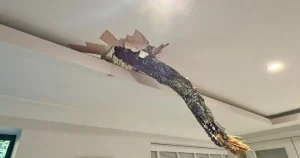


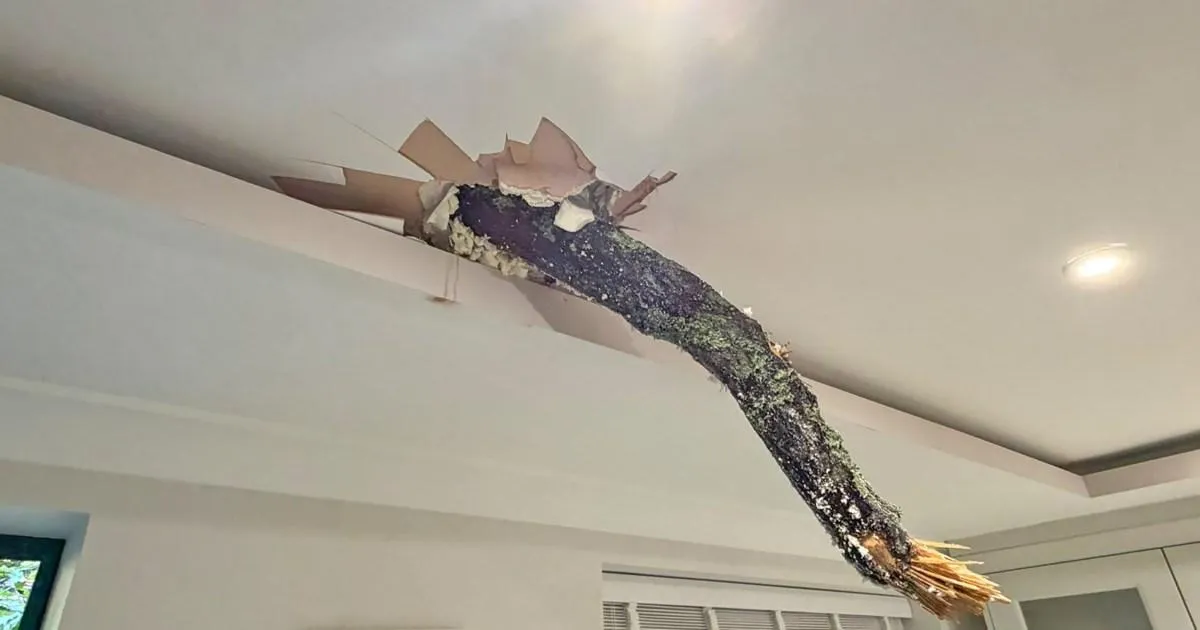
There are moments in life when ordinary evenings are shattered in an instant, and for one Southampton family, a quiet Saturday night at home turned into a scene of sheer terror. Aman Kaur, 45, was sitting with her partner, Harmesh Lal, 46, and their two children, 16-year-old Sam and 12-year-old Angelian, watching television in the warm glow of their living room. Outside, the sky was restless, and the wind was beginning to howl as back-to-back storms Austen and Boelo battered the United Kingdom with extraordinary fury. The family tried to ignore the noise, focusing on their programme as midnight approached. But then, without any warning, the world seemed to explode above them. An enormous crash, louder than anything they had ever heard, tore through the house. Aman later described the terrifying moment with raw emotion, saying, “Suddenly we thought it was a bomb. The glass and the noise were shocking.” In those first disorienting seconds, there was no time to understand what had happened. The ceiling seemed to cave in, and a massive tree smashed through the roof, sending shards of glass and fragments of timber flying through the air. It was a nightmare made real, and the family’s peaceful evening was suddenly transformed into a desperate struggle to comprehend the destruction around them.
The immediate aftermath was chaos, fear, and the instinctive need to protect one another. Glass had gone everywhere, and the eldest child, Sam, was left covered with broken shards. Aman recalled that her son went into complete shock. “He couldn’t move,” she said, her voice heavy with the memory. “Harmesh and I both quickly grabbed him and held him. He was shaking.” In those agonising moments, the parents held their son tightly, trying to shield him from the debris that continued to fall and calm his trembling body. It took them what felt like an eternity, though it was probably only a couple of minutes, to realise that the cause of the explosion-like sound was not a bomb at all, but a vast tree that had come crashing down onto their home. The reality of the situation slowly sank in: a tree was on the house, and they were lucky to be alive. Miraculously, the family escaped without serious injury, suffering only “a couple of scratches” on their faces from the flying glass. The relief was overwhelming, and Aman repeated a sentiment that would echo in the hearts of anyone who heard her story: “I am so glad we are all alive.” The family stood in the wreckage of their living room, surrounded by shattered glass and splintered wood, grateful for the precious gift of life even as their beloved home lay broken above them.
But the emotional toll of that night went far beyond the initial shock. Once the adrenaline faded, the family began to take stock of the damage and the uncertain future that lay ahead. Photographs from the scene showed branches piercing through the roof, leaving a large crack in Angelian’s bedroom upstairs. The room where the youngest child slept, dreamed, and felt safe was now exposed to the open sky. For Aman and Harmesh, this was especially devastating because they had invested their life savings into this property, believing it would be their forever home. It was not just a house; it was the embodiment of their hopes, their hard work, and their plans for the years to come. Now, that future was suddenly clouded by uncertainty. As if the structural damage were not enough, the storm had also brought a quieter, more personal loss. Aman’s beloved fish in the garden pond had all died. “I had fish in my pond in the back garden, and they are all dead. They are all gone. I literally stood there this morning and cried,” she said. The simple ritual of watching the fish swim in the morning light was gone, another small piece of normal life stolen by the storm. And beneath the sadness lay a deeper fear. “It is so scary,” Aman admitted. “If we keep getting storms like that, I fear this will happen again.” That fear is not irrational; it is the lingering shadow of trauma, the sense that the weather itself has become an unpredictable enemy.
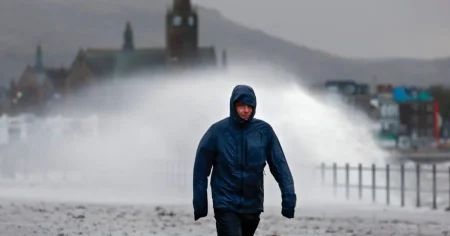
The Kaur-Lal family’s ordeal was just one small part of a much larger catastrophe that unfolded across the United Kingdom that weekend. Storms Austen and Boelo brought winds exceeding 80 miles per hour, relentless rain, and widespread flooding that left entire communities battling the elements. In many places, roads turned into rivers, buildings lost their roofs, and trees toppled like matchsticks. The scale of the destruction was immense, and by Sunday evening, the Energy Networks Association reported that around 90,000 customers across the UK and Ireland were still without power. For countless people, the simple comforts of heat and light were unavailable, and the storm’s fury was far from over. Tragically, the weekend also claimed lives. Authorities confirmed the deaths of two men who were struck by falling trees. One man, in his twenties, was pronounced dead in north London after a tree fell onto the car he was driving, a sudden and horrifying end to an ordinary journey. Another man, in his sixties, was hit by a tree near Castle Douglas in Dumfries, succumbing to his injuries at the scene. In Aberfeldy, Perth and Kinross, two women were taken to hospital after being hit by a toppling tree, their lives forever changed by a moment of bad luck. These were not just statistics; they were people with families, with stories, with futures that were tragically cut short or irrevocably altered by the unrelenting force of nature.
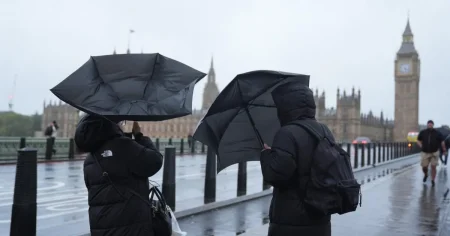
As the nation tried to catch its breath, forecasters delivered more sobering news. The Met Office had issued another yellow weather warning, which remained in place overnight as gusts and downpours continued to batter parts of northern England, Scotland, and Northern Ireland. The weather system was far from finished. Met Office meteorologist Alex Burkill explained that conditions would improve only briefly before more rain arrived. “There are more heavy rain and strong winds to come because of a deepening area of low pressure – another one – which is heading towards us,” he said. He offered a small measure of comfort by adding, “Albeit, this low doesn’t look as deep or is coming quite as close as Boelo did.” But for those still recovering from the weekend’s devastation, even a lesser storm felt like a threat. The Environment Agency had issued ten warnings where flooding was expected, along with sixty-five alerts where flooding was possible, while the Scottish Environment Protection Agency reported ten flood warnings and eleven flood alerts in place. These official warnings were a stark reminder that the danger had not passed, and that communities across the country needed to remain vigilant. For families like Aman’s, every gust of wind and every drop of rain would now be met with a tightening of the chest, a quick glance at the roof, and the haunting thought: could it happen again?
In the end, the story of this Southampton family is not just a tale of destruction; it is also a story of resilience, love, and the fragile nature of human security. As they stood amid the rubble, holding each other close, they were reminded of what truly mattered. Possessions can be replaced, walls can be rebuilt, and even the beloved fish in the pond can be mourned and remembered. But life itself is irreplaceable, and the fact that all four of them walked away with only scratches is a piece of grace that no storm can take away. In the coming days and weeks, Aman, Harmesh, Sam, and Angelian will face the difficult task of rebuilding their home and their sense of safety. There will be insurance claims, repairs, and countless sleepless nights. The scar on their house will eventually heal, but the emotional scar will remain, a persistent reminder of the night they thought a bomb had gone off in their living room. Their story also serves as a broader warning to all of us. Storms are becoming more frequent and more ferocious, and no home is truly immune to the power of nature. As the wind howls and the rain falls, we should hold our loved ones a little closer, appreciate the stability of our roofs, and extend a hand of help to those who have lost so much. For that family, and for so many others across the UK, the road to recovery will be long, but it begins with the simplest and most powerful act of all: being grateful to be alive, together, under whatever sky remains.