

If you find yourself wandering the halls of the International Convention Centre in Birmingham this week, there is really no danger of missing the centrepiece. Delegates have barely stepped through the doors before they are greeted by bright arrows, all pointing in the same direction, toward something called the Birmingham Tapestry. It is an 80-foot extravaganza, a knowingly ridiculous parody of the Bayeux Tapestry, and it has become the unofficial star of the Conservative Party Conference. In the days before the event, it was all anyone could talk about; now that it is here, it is drawing crowds of bemused and delighted party members. The “embroidered” panels—apparently generated with AI rather than stitched by hand—depict a version of recent British political history that is equal parts surreal and savage. There, in thread-like detail, is Angela Rayner vaping contentedly in a little dinghy. There, in another panel, is Nigel Farage locked in debate with Count Binface, the cult political candidate with the bin on his head. It is not exactly the dignified image of statesmanship the party used to project. But that is precisely the point. The Tapestry is silly, self-aware, and unapologetically strange, and its presence at the heart of conference tells you more about the current Conservative Party than any speech could. It marks the end of the apology era. The party has spent more than two years licking its wounds after the historic defeat of July 2024, and they are done being ashamed of themselves. They know they are in opposition, they know they lost, and they have clearly decided that the only way out is to stop walking around with their heads bowed and start acting like a party that believes it has a future. The Tapestry is the visual proof of that new confidence: a party willing to laugh at itself, and at its opponents, while it tries to work out how to become a viable force again.
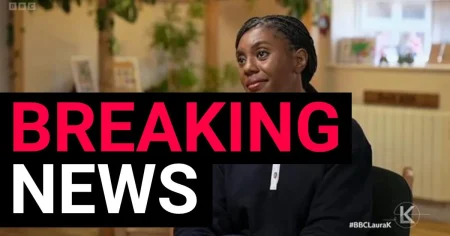
If much of this new mood rests on anyone’s shoulders, it is Kemi Badenoch’s. Two years ago, when the party gathered in Birmingham, the Tories were still deep in the messy process of choosing Rishi Sunak’s successor. The contest had been bruising, and the arrival of Badenoch did not instantly convince everyone that the right call had been made. Her first few sessions at Prime Minister’s Questions were shaky, hesitant, and easy to mock; critics muttered that the party had chosen a leader who was not ready. But there is something about being in opposition that forces a politician to sharpen up, and Badenoch has done exactly that. With time, she has grown into the role, and her position at the head of the party now looks as secure as any opposition leader can reasonably hope to be. The departure of Robert Jenrick, her most obvious rival, to Reform UK removed a constant source of internal tension. The party’s official narrative is that Jenrick’s defection was a useful bit of purification; the Tapestry even depicts the moment with a gleeful embroidered caption: “Here Kemi expelleth the turncoat.” It is all part of the show, of course. But it also reflects a genuine consolidation of Badenoch’s authority. The polls suggest that voters are slowly warming to her. Her personal approval ratings have risen significantly since this time last year, even if the Conservative Party as a whole has not seen the same bounce. And they are still in the game: the contest with Labour and Reform at the top of the polls is fiercely tight, and the Tories have even managed to win a Westminster by-election in Aberdeen South earlier this year. It was not the kind of victory that grabs headlines—especially since it happened on the same day as a much more celebrated Labour win in Makerfield—but it mattered. It proved that the party is not dead, that it can still organise, still fight, and still win. The mood in Birmingham reflects that.
So what exactly is the approach that Badenoch believes is paying off? She sets it out in the conference programme, and it is built, she says, on principles the party should never have abandoned. Free enterprise, solid borders, and something older and more fundamental: the idea that Conservative governments should actually be conservative. Her argument is a simple one, and it has become the central story she tells the party. The previous Conservative governments that led to the disaster of 2024 were not true Conservative governments, at least not in her telling. They lost their way, drifted from the basic instincts that built the modern Conservative Party, and paid the price. She is trying to take the party back to its roots. In practice, that means a series of bold, almost deliberately provocative policy positions. Abandoning net zero targets? Yes, she says, if that is what it takes to put British interests before ideological abstractions. Leaving the European Convention on Human Rights? Absolutely, if it means the country can control its own borders without legal interference. These are not policies designed to appeal to the political centre. They are policies designed to draw a bright line between the Conservatives and their rivals on the centre-left, and to reclaim territory that Nigel Farage has occupied for years. The uncomfortable question for Badenoch is whether she is merely talking like Reform UK in smarter clothes. As Reform’s poll numbers dip, after months of uncomfortable scrutiny of its finances and its ultra-wealthy backers, the Tories sense an opportunity. They can present themselves as the more competent, less chaotic version of right-wing politics. Whether that message will land is another matter entirely. The Reform surge was not just about policy; it was partly about personality, about a visceral style of politics that Badenoch cannot, and perhaps does not want to, replicate.
But for all the renewed optimism in the halls of the ICC, there is a long, difficult road ahead. The Conservative Party is not just in opposition; it is in a strange kind of political exile, stripped of the intellectual and institutional muscle it once had. Since the departure of big-hitters like Sir James Cleverly and Dame Priti Patel from Badenoch’s shadow cabinet, the team feels thin. I would be amazed if the average person on the street could name a single member of the Conservative frontbench right now. There is no obvious shadow chancellor, no household name, no figure generating excitement. In a world where politics is increasingly celebrity-driven, that is a real problem. And beyond the question of visibility, there is the even murkier question of what happens after the next election. British politics is more fragmented than it has been in generations. There is Labour, there is Reform, there are the Lib Dems, the Greens, the SNP, and all the smaller parties carving out their own patches. In such a landscape, it is entirely possible, even likely, that no single party will win a working majority. The arithmetic of the next parliament could force the Conservatives to find friends wherever they can. The most obvious potential partner is Reform UK, despite all the bad blood. Badenoch has explicitly and emphatically ruled out any deal with Farage’s party. She has said it in interviews, in speeches, and in private conversations with her MPs. But the Lib Dems, for one, do not believe her. They have made clear they intend to build their electoral strategy around the fear of a secret Badenoch-Farage pact, warning voters that a vote for the Tories is effectively a vote for Reform. It is a cleverly damaging narrative, one that taps into a genuine anxiety inside the Conservative Party itself. Many Tory MPs privately suspect that, if the numbers do not add up after the election, any promise made in opposition can be quietly forgotten in government.
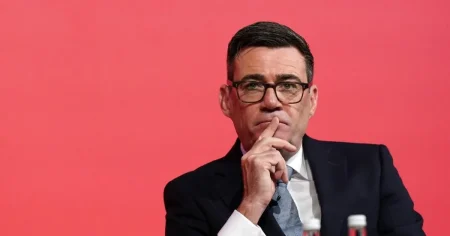
This, perhaps, is why the Birmingham Tapestry feels so fitting. It is a brilliantly light-hearted addition to the conference, a way for a party to show that it still has a sense of humour. But look closely at the scenes it depicts, and you can see the anxieties of the party rendered in thread. There is the image of Badenoch chasing down Andy Burnham and John Healey in a tank, a fantasy of political triumph that acknowledges just how much this party now defines itself against the other side. There is the open mockery of Farage and the indulgence of Rayner as a comic character. It is all very funny, but it is not entirely relaxed. The Tapestry is a way of laughing at the past because the future is too uncertain to face head-on. The party is in a strange moment. It has a leader who is popular with the faithful, and whose stock is rising nationally. It has a message that feels clearer than it has in years, even if that message borrows freely from Reform. And it has a renewed confidence, a sense that perhaps the worst is over. But it is still a party in opposition, still working out how to construct a government, still unsure whether it can return to power without making bargains that would horrify its own supporters. The smiles at this year’s conference are genuine, but they are not untroubled. The Tapestry, with its absurdity and ridiculousness, serves as a reminder that the party is trying to control a story that is, in reality, very much out of its hands. There is only so long a joke can sustain you. Eventually, the laughter fades, and you have to face the serious business of politics.
By the end of the four days, the delegates will go home with their goodie bags and their leaflets, and the scaffolding around the Birmingham Tapestry will be taken down. But the questions hanging over the Conservative Party will remain. Can Badenoch translate her own revival into a revival for the party as a whole? Can she hold the line against Reform without losing the Right to Farage? Can she build a team that looks like a government in waiting? And, perhaps most importantly, can she find a way through the electoral arithmetic without betraying the promises she has made? None of this is impossible. Parties have come back from worse. But the road is long, and the party’s history over the past few years has been one of self-inflicted wounds and unforced errors. The Tapestry is a fun way to mark the end of the apology era, but it is not a policy platform. It is not a shadow cabinet. It is not a coalition agreement. It is a joke, told with admirable confidence, by a party that finally feels comfortable enough to laugh again. And sometimes, in politics, that is the best you can do. The next general election is still a few years away. There is time for the Tories to rebuild, to find new stars, to modernise their pitch, to win back the trust they lost. There is also time for it all to go wrong again. In Birmingham this week, under the eye of the Tapestry, the party is allowing itself to believe that the good times are coming back. Whether they are right is another question entirely. But watching the delegates laugh at the absurdity of their own situation, you have to admit: it is at least a nice change from the misery. The Conservative Party of 2026 is not the Conservative Party of 2024. It is leaner, more focused, more confident, and more willing to poke fun. Whether that will be enough is the biggest question of all. For now, though, the party is smiling, and with a star exhibit like the Birmingham Tapestry at the heart of the conference, who can blame them?