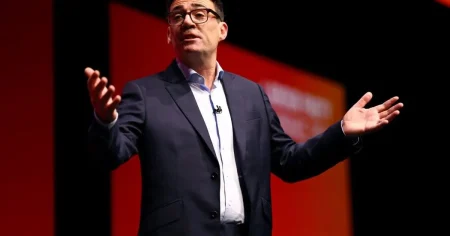


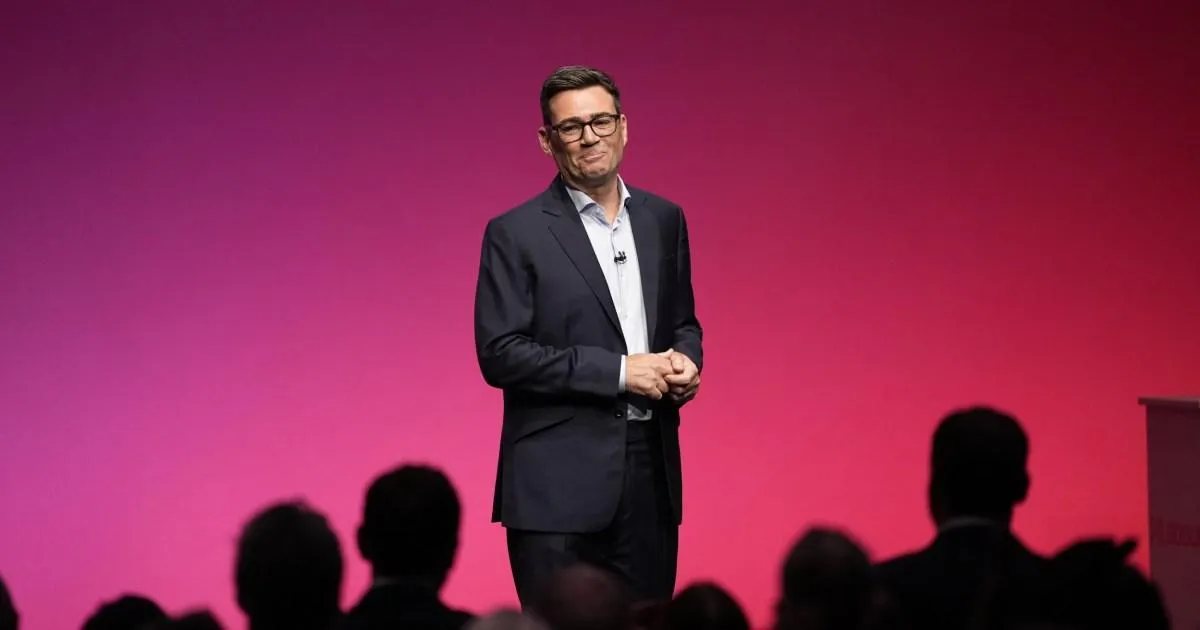
If you were anywhere near the Liverpool convention centre yesterday afternoon, and if your ears are attuned to the quiet popping of corks, you might have caught the faintest celebratory fizz. It wasn’t the sound of a victory party, nor the clinking of glasses over a minor policy tweak. It was the sound of economists, financial planners, and a significant number of policy wonks in the press gallery, finally hearing the words they thought they would never hear from a mainstream party leader: a commitment to dismantling the state pension triple lock. Andy Burnham, the Prime Minister, strolled to the podium with a quiet confidence that belied the political bomb he was about to drop. For years, the triple lock has been the third rail of British politics—the untouchable, sacred cow that no serious leader dared to slaughter for fear of the electoral backlash from millions of pensioners. Yet here was a sitting Labour PM, not just questioning its long-term viability, but announcing a radical adjustment to the policy, framing it not as an act of cruelty but as a necessary act of intergenerational justice, funneling the saved billions directly into the creation of a National Care Service. The anticipation in the room was palpable; the usual polite applause that greets a conference address turned into a bewildered silence as the implications sank in. It was a moment that felt politically impossible just 24 hours earlier, a testament to Burnham’s unique ability to break through the noise of Westminster’s risk-averse consensus and speak the brutal arithmetic that everyone knew was coming but no one had the courage to articulate.
The mechanics of Burnham’s proposal are deceptively simple, yet they represent a seismic philosophical shift in how the state views retirement income. Currently, the annual increase of the state pension is pegged to whichever of three figures is highest: the rate of inflation, average wage growth, or a guaranteed floor of 2.5%. Burnham is proposing to sever the automatic link to wage growth entirely. Under his plan, pensioners would still see their payments keep pace with the cost of living, and they would never receive less than a 2.5% boost each year, but they would no longer automatically benefit from a booming economy that drives up salaries. The rationale, he argued, is brutally logical: pensions are funded by the taxes on current workers’ wages. If pensioners’ income grows faster than the workers who fund it, the system mathematically collapses. By cutting the wage link, the government saves billions which will be recycled to pay for the promised National Care Service, a policy that has been kicked into the long grass for decades. Burnham was precise about the timeline—the change would not hit pensioners’ bank accounts until April 2030, giving ample time for public consultation and legislative wrangling. He explicitly outlined that this would be enshrined in the next Labour Party manifesto, effectively asking the public for a direct mandate to break this promise. The moment he uttered the words, a collective gasp could be heard. For those unfamiliar with the intricacies of UK social security, the triple lock has been an unassailable fortress since its introduction in 2010. It has historically inflated the state pension in real terms, ensuring that the oldest members of society share in the national wealth. But as Burnham pointed out, the demographic cliff edge is looming. With an aging population and a shrinking workforce, the cost of keeping the full triple lock is projected to explode, threatening to devour the entire health budget within a generation. He presented it not as a choice, but as a mathematical inevitability that only a fool would ignore, framing his proposal as the only responsible way to preserve the very concept of a state pension for future generations.
The political fallout was instantaneous and, in many ways, expected. Standing in the Brighton conference centre just a week prior, I had watched Lib Dem leader Sir Ed Davey defend the triple lock with the passion of a man defending his own mother. He had looked out at his own party members, many of whom raised their hands to indicate they would scrap the policy, and he overruled them, insisting that the public would never forgive a party that touched their pensions. Similarly, Reform UK and the Conservative Party wasted no time in issuing condemnatory statements, accusing Burnham of throwing pensioners “under the bus”. This is the classic Westminster playbook: weaponise the fears of the elderly vote, paint any reform as an act of war, and rake in the electoral dividends. The conventional wisdom dictates that older voters turn out in droves, they care intensely about their pension cheques, and they are the most reliable voting bloc. To touch the triple lock is akin to political suicide. Yet, Burnham stood there, unflinchingly, seemingly confident that the British public possess a far more sophisticated understanding of the country’s fiscal reality than the political class gives them credit for. He didn’t just present a cut; he presented a trade-off—a better funded, comprehensive care service for the nation’s most vulnerable, in exchange for a slightly slower trajectory of pension growth. The stark contrast between the panic happening on the benches of other parties and the composed calmness of the Labour leader was striking. It suggests a fundamental misreading of the electorate by those who have spent decades coddling them, treating them as stubborn children who cannot handle the truth of a national budget, rather than as the discerning citizens they actually are.
The most shocking revelation, however, came not from the stage but from the polling data that landed in the evening. A YouGov survey conducted immediately after the speech found that 48% of British adults supported the move to reduce the strength of the triple lock in order to fund a National Care Service. Only 28% were opposed. That is a resounding ideological victory for the Prime Minister. It suggests that the public is far more receptive to nuance than the clamouring politicians in Westminster believe. They seem to understand that you cannot give with one hand without taking from the other, and they see the glaring injustice of a nation that worships its elderly pensions while simultaneously leaving millions of younger people, and indeed frailer pensioners, languishing on waiting lists for social care, forced to liquidate their homes to pay for their own end-of-life care. The poll undercuts the very foundation of the “third rail” myth. Perhaps Britons are tired of being treated like children who cannot handle the brutal arithmetic of national budgets. They are looking at a system where a wealthy pensioner receives a generous inflation-busting raise, while a 30-year-old worker pays 40% tax and cannot afford a home, and they are deciding that the current balance is fundamentally broken. The human story here is impossible to ignore. We are living through a crisis where families are tearing themselves apart trying to care for ageing parents, where nurses and care workers are paid barely above minimum wage, and where the very idea of “dignity in old age” is a luxury reserved for the wealthy. The National Care Service is not just an abstract government project; it is a promise of relief for millions of sandwiched generation adults—those caught between raising their own children and caring for their own parents. To see a Prime Minister finally address this elephant in the room with a concrete proposition, even if it means sacrificing a sacred cow, resonates with a public that has been demanding long-term solutions for decades. The 28% who oppose the change are likely to be the wealthier pensioners who benefit most from the current system, but they are also the exact demographic that politicians traditionally fear. Burnham’s gamble rests on the assumption that these voters are open to reason, and the initial polling suggests his faith might be well-placed.
Ahora, va más allá. The triple lock, however, is merely the tip of the iceberg. What made Burnham’s speech truly historic was the boldness with which he shattered multiple long-standing political taboos in one single sitting. My mind immediately drifts to the European Union. For years, the mantra from all major parties has been “look forward, don’t look back,” and Brussels has been treated as radioactive. Yet Burnham hinted, with a wry smile, that the UK’s relationship with the EU was not set in stone, and that rejoining the single market or even the bloc itself might need to be revisited if the economic benefits were clear and the public were on board. He also threw the gauntlet down on electoral reform, suggesting Labour might back a proportional representation system—a move that would fundamentally alter the British political landscape, breaking the two-party duopoly and forcing coalition politics. Each of these issues, like the triple lock, has been deemed too dangerous to touch, interned in the “too difficult” box by career politicians who value their seats over the national interest. Burnham, displaying the confidence of a man who has already won the highest office, is systematically unlocking this box, inviting a national conversation on everything previous leaders have dodged. It is a profound transformation in the style of political leadership. Burnham is not waiting for a royal commission or a green paper to start the debate; he is using the platform of a party conference to force the issues live. He is betting that the British public are more intelligent and more forward-thinking than the commentators who claim they only want easy answers. He is offering a vision of a state that is not afraid to be honest about trade-offs—where fairness for the young is considered as important as comfort for the old, and where the systems of government are aligned with the actual demographics of the 21st century.
As I sat in the press gallery and later wrote my immediate impressions of the hour-long address, I realized we were witnessing the birth of a new political era. The transformation has not merely begun; it is accelerating. Even before any of his plans are enacted in 2030, the landscape has shifted forever. The other parties are now forced to respond. Can they continue to campaign on a triple lock that the public decisively support altering? Will they look a fiscal gift horse in the mouth? The economist’s celebration is justified, but it goes deeper than their giddy gear. This is about political courage. It is about a leader choosing to prioritise the nation’s long-term solvency and social cohesion over a few quarters of short-term popularity. Nick Ferrari, the radio host, once observed that Burnham’s greatest asset is that he is not Keir Starmer—he possesses a charisma and a connection with the working class that his predecessor lacked. But watching him yesterday, I would argue his greatest asset is his willingness to confront the brutal truths that others have spent a decade ignoring. He has set aside the safety of the mantra and embraced the risk of actual governance. The corks may have been for the economists, but the cheers should be for the democratic maturity of a country that is finally being spoken to like adults, and a Prime Minister who has proven that some ideas are not too toxic to touch—they just need a leader brave enough to hold them to the light. Whether the policy succeeds or fails, the political landscape will never be the same again, and for that, we should all be grateful.