

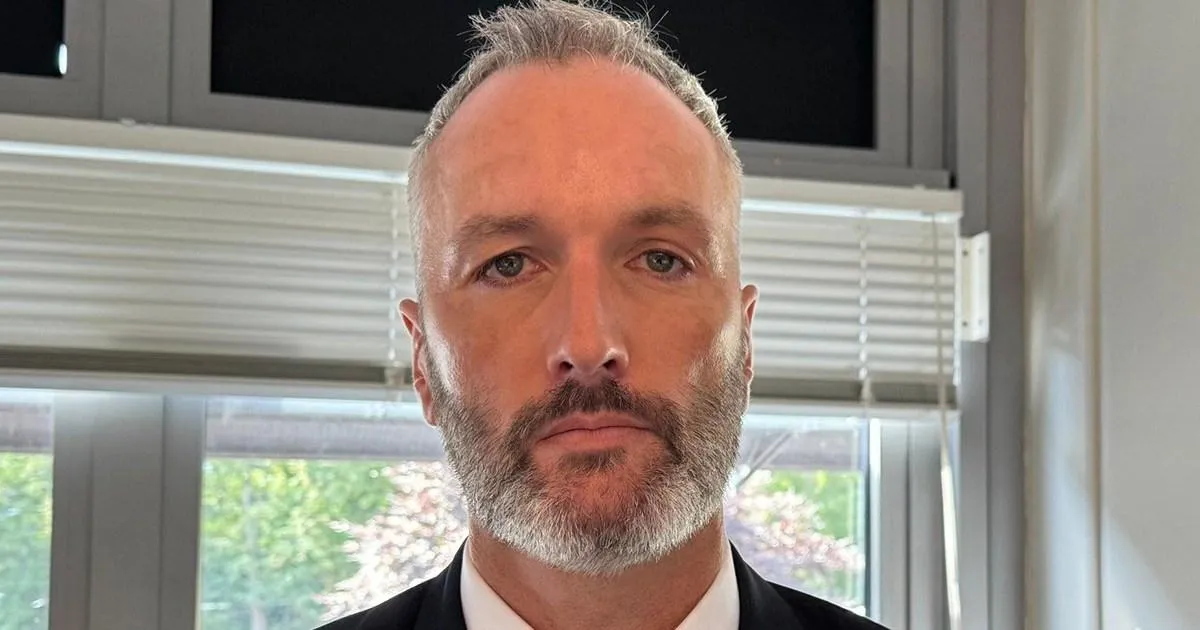
Every once in a while, a news story arrives that feels less like a simple report and more like a broken promise. Detective Constable Lee Harshey-Jones, 45, stood in Chester Magistrates’ Court on Wednesday and admitted that he had upskirted a teenage girl. The phrase itself is almost too clinical. It does not fully capture the humiliation, the invasion of privacy, or the quiet terror a young woman must feel when she learns that a man in a position of authority was secretly capturing images of her body. Harshey-Jones pleaded guilty to a count of voyeurism, and the court heard that the incident took place in Colwyn Bay, Conwy, on June 11. He was arrested that same day, and North Wales Police later suspended him. But the damage to his reputation was only beginning. He also pleaded guilty to intending to pervert the course of justice, after he factory reset his phone in an apparent attempt to conceal evidence from criminal investigations. In addition, he admitted a third charge of corrupt or improper use of police powers and privileges by viewing an internal log related to the incident. These are not the actions of someone who made a momentary mistake. They are the actions of someone who, when confronted with his own misconduct, used the knowledge and access he had gained as a police officer to try to erase the record and protect himself. The public expects police officers to be held to a higher standard than the people they arrest. When that standard is broken so completely, the sense of betrayal cuts deep. It may be cold comfort to know that he has admitted what he did, but it is also an important first step toward accountability. The law does not distinguish between a detective who investigates murders and a stranger in a crowd; voyeurism is voyeurism, and a violation is a violation. It also makes the rest of the case harder to read, because the same hands that once handled evidence in one of Wales’ most horrific murder investigations are now accused of causing a different kind of harm to someone who was simply going about her life.
To understand the painful irony of Harshey-Jones’s fall, you have to go back to another tragedy, one that once made him appear to be everything a detective should be. In 2021, two-year-old Ethan Ives-Griffiths was murdered by his grandparents, Michael and Kerry Ives. Harshey-Jones was the lead investigator in the case, and he was previously hailed for his work in bringing them to justice. The trial, which took place last year, was one of those cases that lingers in the memory of everyone who followed it. Jurors were visibly upset at various points, and the courtroom heard details that were almost too painful to absorb. CCTV footage showed Michael Ives carrying Ethan by the top of his arm, as if the child were a piece of luggage, and then appearing to punch him after putting him in a car seat. The mental image is not one that easily fades: a tiny boy who should have been protected by his family, facing violence at the hands of the people who were supposed to be his safest refuge. Harshey-Jones was the one who had to walk through that horror, piece together the timeline, interview the witnesses, and make sure the killers did not escape accountability. In that courtroom, he represented the possibility that justice could still be done, even for a child who could no longer speak for himself. That is part of why this new case feels so disorienting. It is not just another story about a corrupt officer. It is a story about how a person can be both capable of great professional dedication and capable of committing a gross personal violation. The human heart seems to be able to hold contradictions that we would rather not look at. Maybe Harshey-Jones believed that his record as a detective would protect him. Maybe he thought that the goodwill he had earned by working on such a difficult case would outweigh the shame of what he had done. But justice does not work that way. The same skills that make a good investigator—attention to detail, knowledge of police systems, understanding of how evidence is gathered—became tools for concealment when turned toward his own conduct. And in the end, the story of the little boy he once fought justice for will forever be linked in public memory with the story of the teenage girl he victimized.
Let us be clear about what Harshey-Jones actually admitted, because the legal language can sometimes hide the human reality. Voyeurism is not a technicality. It is a sexual offense. It involves capturing images of a person without consent, usually in a moment of vulnerability, and doing so for sexual gratification. The teenage girl in this case did nothing wrong. She was simply in a place where she had a reasonable expectation of privacy, and a middle-aged detective used his phone to violate that privacy. The fact that he was a police officer makes it worse, because victims of such crimes are often reluctant to report them, fearing they will not be believed. When the offender is someone who is supposed to enforce the law, that fear becomes even more rational. Then there is the second charge: intending to pervert the course of justice. This is a specific criminal offense in the United Kingdom, and it is treated seriously because it strikes at the heart of the justice system. By factory resetting his phone, Harshey-Jones tried to destroy evidence. He did not simply deny the allegation and hope for the best. He took deliberate steps to make sure that the evidence could never be found, using his own knowledge of how digital forensics works. That is a premeditated attempt to obstruct justice, not a moment of panic. The third charge is equally troubling. By viewing an internal log of the incident, he misused his police powers and privileges to pry into an investigation that was, or would soon become, about him. He used his badge as a key to information that should have been off-limits. Taken together, the three charges paint a portrait of an officer who believed he could protect himself from the consequences of his own actions. Perhaps he thought that resetting the phone would be enough, or that no one would think to check the internal logs. Perhaps he believed that the status he had earned as a lead detective would offer him a layer of insulation. If so, the guilty pleas he offered in court on Wednesday represent the point at which that illusion collapsed.
The courtroom scene on Wednesday was, by all accounts, a quiet and procedural one, but the weight of what happened was visible in the charges read aloud to the court. Harshey-Jones’s defense lawyer, Ryan Donoghue, asked for a pre-sentence report and reminded the court that his client was of previous good character. That phrase is a standard part of many criminal cases, and it can sometimes sway a judge toward a more lenient sentence. It is a reminder that human beings are not the worst thing they have ever done, and that a person’s past contributions should not be ignored entirely. But in this case, the phrase is hard to hear. To the teenage girl who was upskirted, Harshey-Jones’s previous good character does not undo the moment of violation. To the public, it does not change the fact that an officer abused his position. And to the investigators who must now work in the shadow of a colleague who tried to hide evidence, it does not restore the trust that was broken. Recorder Mark Ford KC, the judge presiding over the case, made it clear that he was not making any promises about the outcome. “The fact that I have adjourned the case for a pre-sentence report should not be taken by you as any indication as to what sentence will be passed on these serious counts,” he said. It is the kind of warning that judges often give, but it carries extra weight in a case involving a former police officer. Harshey-Jones was granted conditional bail, meaning he will remain out of custody until his sentencing date on November 19 at Chester Crown Court. For the next few months, he will have to wait in the same world that the teenage girl still lives in—the same streets, the same routines—while a pre-sentence report is prepared and the court decides how many years, or months, or alternatives to custody, are appropriate. Those weeks will not be easy. There will be time to think, time to replay the choices made on June 11, and time to wonder what became of the career that once seemed so promising. But for the victim, the waiting may feel very different. She did not choose to be part of this story, and she will have to live with the memory for the rest of her life.
After his court appearance, North Wales Police confirmed that Harshey-Jones had resigned from the force. In a short statement, the force said: “Criminal proceedings and North Wales Police misconduct protocols remain active and the force is unable to provide comment at this time.” It is a familiar ending: an officer under investigation steps away from the job before the institution has to dismiss him. But resignation is not the same as accountability. It does not erase the misconduct, and it does not restore the public’s trust in a police force that has now been connected, however indirectly, to a case of voyeurism and obstruction of justice. The statement is careful, measured, and professional, but it also has a tone of exhaustion. Every time a police officer appears in court as a defendant, the entire institution feels the ripple. Every time the public reads about an officer who used police powers for personal benefit, the harder it is for ordinary officers to do their work with credibility. This is not to say that North Wales Police are to blame for Harshey-Jones’s actions. He alone made the decision to take those photographs, to reset that phone, to look at that internal log. But institutions have a responsibility to respond to such cases clearly and transparently, and to make sure that other officers understand the gravity of abusing their position. The fact that Harshey-Jones was a lead investigator in a horrific murder case only adds to the difficulty. It means that his name is now associated not only with his own crimes, but with the memory of a little boy who cannot defend himself, and with the family who had to bury him. That connection is painful, and it is also unavoidable. Resignation may mean he will never have to put on a uniform again, but it cannot mean he is free. The criminal courts will decide that. And the misconduct protocols that remain active suggest that the police are determined not to let the case disappear quietly. For the public, the real question is what this moment should teach us about the need for integrity in those who carry the badge.
In the end, this story is more than a scandal about one man’s disgrace. It is about the many people who are now collateral damage. It is about the teenage girl who was the victim of the original crime, and who now has to navigate the world knowing that her dignity was violated by a detective, of all people. It is about her family, who may wonder how a system meant to protect them could produce someone who would do this. It is about the family of Ethan Ives-Griffiths, who once trusted Harshey-Jones to help them find justice, and who must now reconcile their memories of him as a dedicated investigator with the terrible new reality. It is about the colleagues who shared an office with him, the officers who must now answer questions about an arrest that never should have happened, and the wider community in North Wales, where trust in the police has never been more fragile. We do not know what sentence Harshey-Jones will receive. The judge’s words suggest that he is not being promised leniency, but pre-sentence reports can go many directions, and the court will weigh all the circumstances. Perhaps he will serve time. Perhaps he will not. Either way, no verdict can fully repair the harm that has been done. The same man who once helped put away two people for the murder of a two-year-old child will now be remembered in the context of an upskirting case, and that thought is almost too strange and sad to process. It reminds us that human beings are not made of a single story. We are all capable of change, but not always for the better. The best we can do as a society is to ensure that when a person in power fails, the law does not look away. The teenage girl deserves that. The memory of Ethan Ives-Griffiths deserves that. And the idea of justice itself deserves that. Perhaps the only comfort to be found in this dark story is that the truth did finally come out. The phone was reset, but the charges were still filed. The internal log was viewed, but the investigation continued. The detective attempted to protect himself, and still the system held.