

It’s hard to explain to anyone who didn’t live through it just how deeply the Top Gear “trying to kill a Toyota Hilux” episode burrowed into popular culture. In 2003, Jeremy Clarkson, James May and Richard Hammond set out to do something gloriously stupid: destroy a pickup truck. They threw everything they could at it, and the truck simply refused to die. It was funny, absurd and strangely moving all at once. Twenty years later, Toyota has decided to revisit that famous moment—not with a nostalgic clip show, but by dropping a caravan on a brand-new electric Hilux. The result is both a tribute to an old television miracle and a bold statement that the Hilux legend has survived the switch to battery power. The original challenge became a kind of folk tale. You didn’t need to care about cars to understand it: here was a machine that kept going no matter what. The image of a battered pickup emerging from a collapsed building, or being dragged out of the sea and driven away, was pure television magic. It also made the Hilux more than a product. It gave it a personality—one of stubborn, unglamorous endurance. That legacy is exactly why the latest stunt matters. It repeats the caravan test that originally served as the climax, and it does so with an electric truck that has to answer a simple question: can a vehicle powered by electricity inherit the indestructible soul of its diesel ancestor? If the new footage is anything to go by, the answer appears to be a defiant yes.
Let’s remember what the original episode involved, because the new test makes a lot more sense when you appreciate the full history. The Top Gear team didn’t just throw one thing at the Hilux and call it a day. They subjected it to a wrecking ball, submerged it in the sea, and placed it on the roof of a 23-storey building that was then demolished underneath it. The truck was battered, bent, flooded and buried under rubble. Yet each time they pulled it out, it started. The most famous final insult was the caravan drop: a crane lifted an old caravan above the truck and released it, smashing down onto the cab. This was supposed to be the knockout blow. It wasn’t. The Hilux escaped with dents but kept running. For viewers, it was one of the greatest moments in motoring television. It had everything: the ridiculousness of a caravan being used as a weapon, the genuine tension of watching an expensive object get destroyed, and the astonishing payoff of the truck refusing to give up. It also became shorthand for reliability. Car manufacturers love talking about engineering, but you don’t need technical knowledge to watch a building fall on a truck and understand what toughness means. That’s why the memory has lasted so long. It wasn’t a marketing campaign. It was a piece of storytelling, and the Hilux happened to be the hero.
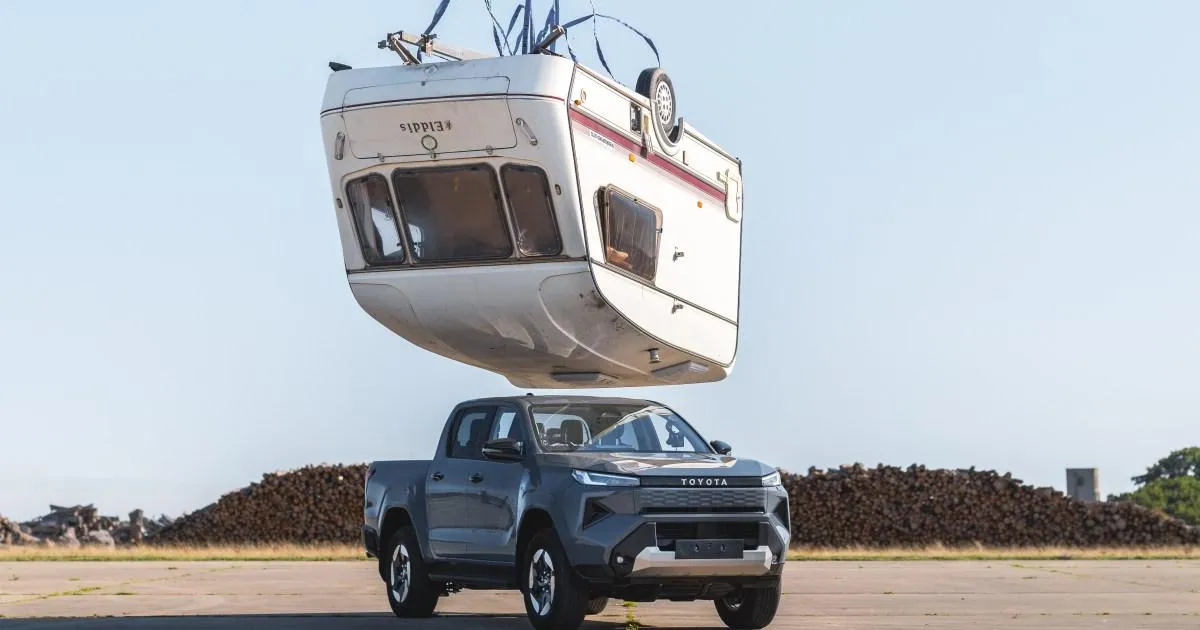
Fast-forward to the present, and Toyota clearly understood that no ordinary launch video would do. To promote the all-new electric Hilux, the company did something unexpected: it went to Reddit. Toyota invited UK subreddits to decide how the new truck should be tested. The choice was between a one-tonne wrecking ball slamming into the Hilux repeatedly or a faithful recreation of the legendary caravan drop. The response was overwhelming. Hundreds of people voted, and the caravan option won by a landslide. There is something gloriously appropriate about this. The caravan drop was the most memorable punishment from the original Top Gear challenge, so letting the public choose it made the new stunt feel like a community decision rather than a corporate one. Toyota then took the electric Hilux to Bentwaters airfield in Suffolk, where a caravan weighing more than three-quarters of a tonne was craned up to 30 feet above the ground. The truck sat waiting beneath it, looking almost serene. Then the caravan was released. The footage shows the moment of impact—a crunching, chaotic cloud of debris. It is impossible to watch without wincing. But the engineers in attendance, like viewers at home, knew this was exactly what the Hilux was built to prove. Strict safety conditions were observed throughout, but the whole point was to push the truck to its limits in public view.
When the dust finally settled, the scene was remarkably anticlimactic in the best possible way. The electric Hilux had clearly taken a hit. There were bodywork scars and bits of caravan scattered everywhere. But the truck was still standing. The engineers walked over, inspected the damage, and then—without any dramatic hesitation—powered it up. It drove away silently. That silence is worth pausing on. Unlike the original diesel truck, the electric Hilux doesn’t need to cough or rumble back to life. It simply hums away as if nothing has happened. For Toyota, that was the point. Chris Hayes, Director of Products & Services Division, said: “Hilux has earned its reputation as the world’s toughest pick-up. Following on from our launch of the ninth-generation model earlier this year, we wanted to honour that legacy and demonstrate how Hilux is still as impressive as it was decades ago, even when it’s powered by electricity. Dropping a caravan on it wasn’t just about repeating the famous TV stunt; it was our way of showing how Hilux’s core toughness remains intact.” That quote captures the delicate balance of the whole exercise. It is a stunt, yes, but it is also a serious engineering claim. Toyota didn’t choose the caravan drop because it was cheap theatre. They chose it because it was the truest public test they could think of, and because it was the test the audience wanted to see. By repeating the moment, they proved that the electric era hasn’t softened the Hilux’s character.
This latest spectacle was not a one-off attempt to recreate past glory. The electric Hilux has already been through an extreme development programme designed to make sure it can handle whatever real life throws at it. Toyota engineers have driven it through deep water, subjected it to brutal off-road trials across every kind of rough terrain, and even completely immersed the battery to check it can survive conditions that would make most vehicles stop permanently. The caravan drop was just one more box to tick. But toughness is only half the story. The new Hilux is also a genuinely practical workhorse. It can carry a payload of up to 1,065kg and, depending on the powertrain, tow trailers up to a hefty 3.5 tonnes. Those are serious numbers for anyone who uses a truck for actual work—farmers, builders, overland adventurers, or anyone who needs a vehicle that doesn’t flinch. And importantly, the electric Hilux isn’t a stripped-out utilitarian machine. It is available with both battery-electric and Diesel 48V power, and it comes with a comfortable double cab, fully digital instrumentation and a comprehensive multimedia package. In other words, you can still drive it to a building site in the morning, then take the family out in comfort later. The combination of old-fashioned toughness and modern technology is exactly what Toyota wants people to understand. This is not just an electric vehicle trying to win over green-minded city drivers. It is a vehicle that has to satisfy people who genuinely rely on their pickup for a living, and who will not forgive a single weakness.
And the caravan drop is only the beginning. Toyota has handed the keys to the electric Hilux over to the Top Gear YouTube channel, which means the truck is likely to face even more absurd, extreme and destructive tests in the coming months. That is a smart move, because Top Gear’s online team has inherited some of the old show’s joyful chaos. They know how to push vehicles to the limit and, more importantly, how to make viewers care. Whether they will attempt something bigger than a caravan is anyone’s guess, but the internet is already speculating. The story, however, is already complete in a sense. By recreating the caravan drop, Toyota has done more than make a viral video. It has connected its past reputation to its future ambition. The Hilux has always represented something simple: dependability. In a world where cars are increasingly complex, fragile and software-driven, there is enormous comfort in a vehicle that can survive a falling caravan and simply drive away. The electric Hilux may not have a roaring engine, but it has the same quietly stubborn heart as its ancestor. That matters. It reminds us that the shift to electric power does not have to mean losing the qualities that made cars meaningful in the first place. The original Top Gear Hilux became a legend because it refused to die. The new electric Hilux is now proving that the legend can evolve. And if a caravan drop is the price of that proof, so be it.