


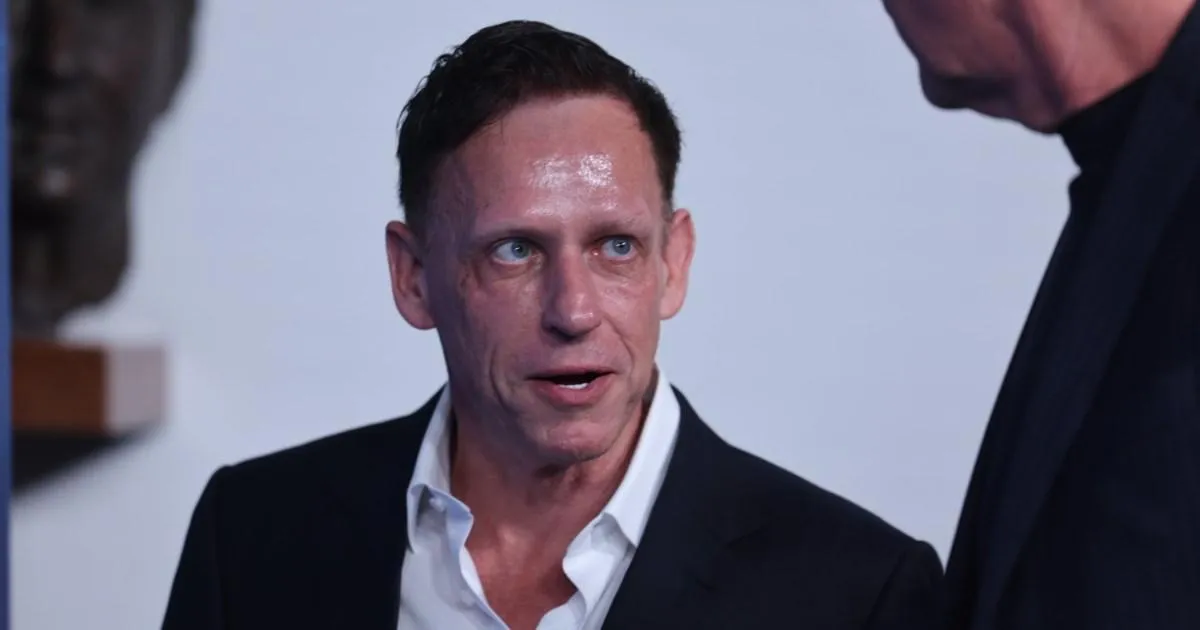
Peter Thiel is not someone who says boring things, and he knows it. The Palantir co-founder and billionaire venture capitalist has built a reputation as one of Silicon Valley’s most provocative thinkers, someone who enjoys dropping intellectual bombshells and then watching the fallout. His latest detonation came during a conversation with Mathias Döpfner, the CEO of the German media group Axel Springer, in an interview that touched on artificial intelligence, politics, literature, and the nature of evil itself. When Döpfner asked whether AI would be positive or negative for humanity, Thiel did not give a tidy answer. Instead, he warned that he was “going to get in trouble” for what he was about to say, and then said it anyway: “I think we moralise way too much.” From there, he went further, arguing that being evil is “actually kind of good.” His logic? “If you’re evil, you’re at least competent,” he said. “And if you’re evil, you’re not bad and therefore maybe you’re actually kind of good because you’re at least getting something done.” It is the kind of statement that sounds like a paradox, or perhaps a troll, but Thiel appeared to mean it, at least in a carefully qualified way. He was not praising murderers or tyrants. He was trying to draw a sharp line between moral badness and practical uselessness, and then asking which one we should fear more.
To make his point feel less abstract, Thiel reached for two strange analogies, both of which left many listeners scratching their heads. First, he compared evil people to sports cars. “A Ferrari is an evil car because it doesn’t get many miles per gallon,” he said. “A trabby is a bad car; it’s less good than a golf car.” The comparison is deliberately crude, but the underlying idea is simple enough. A Ferrari is flashy, powerful, and exciting, but it is also wasteful and impractical, so we call it evil. A Trabby, or Trabant, the tiny, unreliable car produced in communist East Germany, is not evil at all; it is just bad. It fails at the most basic function of a car, which is to get you where you need to go without breaking down. A Volkswagen Golf, by contrast, is a decent, sensible, reliable car. It is not glamorous, but it works. Thiel’s point, buried under the weirdness, is that we should not confuse two different kinds of badness. There is the badness of being wicked, and there is the badness of being useless. Thiel is saying that the second one might actually be worse, because at least an evil person, like a Ferrari, has the capacity to do something. A bad car just sits there, or worse, fails when you need it most.
Then came the literature lesson, because no Thiel interview would be complete without a nod to the Western canon. He turned to the legend of Faust, the scholar who sells his soul for knowledge and power. In Christopher Marlowe’s play “Doctor Faustus,” the title character is a fake scientist, a magician, a fake alchemist. His work is bad science, and at the end of the play, he is dragged off to hell. Thiel is not impressed. Marlowe’s Faustus is a failure, someone who does not even make a good deal with the devil. In Goethe’s version, however, Faust also makes a pact with the devil, and he gains knowledge and power through morally dubious means. But here is the crucial difference: in Goethe, it works. Faust gets what he wants, and in the end, he is redeemed. Thiel makes his preference clear: “It’s better to be good than evil, I want to be very clear, but you know I prefer Goethe’s Faust to Marlowe’s.” The literary comparison is not accidental. Thiel is fascinated by people who break the rules and get results, especially if they do so on a grand scale. Marlowe’s Faustus is a cautionary tale, a warning about the dangers of overreaching. Goethe’s Faust is a celebration of human striving, even when that striving is messy, ambiguous, and morally compromised. For Thiel, the worst sin is not failing morally; it is failing to achieve anything at all.
If that were all Thiel said, it would have been enough to spark a thousand think pieces. But he went even further, explaining what he sees as the real problem in the world. “99%” of businesses, companies, people, and political leaders, he claimed, are “totally incompetent” and therefore “not even evil.” This is the heart of his worldview. Thiel is not actually obsessed with evil in the traditional sense. He is obsessed with mediocrity. He looks at governments, corporations, and institutions and sees a world run by people who are not sinister but simply incapable. They make terrible decisions, they move slowly, they avoid risk, and they produce nothing of value. In his eyes, such people are not good and they are not evil; they are just a waste of space. And because they are incompetent, they cannot even be held morally responsible for the harm they cause. A competent villain at least has a plan. A bumbling bureaucrat just makes everything worse without ever meaning to. This is why Thiel can casually say that evil is “kind of good.” He is using the word in a strange way, but he is trying to make a serious philosophical point: if you care about the state of the world, you should care about effectiveness, not just intentions. Good intentions without results are worthless. Evil intentions without results are almost as worthless. What matters is the ability to actually get something done, whether that something is good or bad.
The interview also touched on one of Thiel’s older and more controversial ideas. In 2009, he wrote an article in which he claimed that he no longer believed freedom and democracy were compatible. It was a stunning thing for an American tech billionaire to write, and it followed him around for years. Döpfner brought it up, and Thiel responded with a kind of clarification. He said he had issued a correction just two weeks after the original piece was published, explaining that his real target was not democracy itself but libertarians who put too much faith in politics. He said, “I don’t think democracy will go anywhere and what I was arguing for was a certain depoliticisation, a de-intensification of politics.” In other words, he was not calling for a dictator or a king. He was saying that we expect too much from politics, that we treat elections and laws as if they are the only way to solve problems, and that this obsession with politics has made us worse at solving problems in the real world. It is a familiar argument among Silicon Valley types who believe that technology, not government, will save us. Thiel’s version is more cynical than most. He does not trust the crowd, he does not trust the political class, and he is not convinced that democracy can deliver the kind of bold, ambitious change that he wants to see. Instead, he wants to lower the temperature, to move power away from noisy political battles and toward the quiet, efficient world of innovation and markets.
Finally, there is the uncomfortable fact that Thiel is not just a philosopher. He is the co-founder of Palantir, one of the most powerful and controversial data-analytics companies in the world. Palantir works with governments and intelligence agencies, building software that can predict, track, and monitor human behavior. It is exactly the kind of company that makes people worry about surveillance states and runaway technology. In London, Mayor Sadiq Khan blocked a £50 million deal between the Metropolitan Police and Palantir because of the company’s links to U.S. Immigration and Customs Enforcement (ICE) and its alleged involvement in Israeli attacks on Gaza and Lebanon. Palantir already has contracts worth hundreds of millions of pounds with NHS England and the Ministry of Defence. So when Thiel says that evil is “kind of good,” he is not speaking from an abstract ivory tower. He is a major figure in a company that profits from state power, secrecy, and mass data collection. To his critics, his comments are not just a philosophical provocation; they are a confession. He genuinely believes that power and effectiveness matter more than morality, and he has built a company that puts that belief into practice. To his defenders, he is simply describing reality. The world is not changed by polite people who follow the rules. It is changed by bold, driven, sometimes ruthless people who are willing to do whatever it takes. Thiel wants to be one of those people, and he wants Palantir to be one of those companies. Whether that makes him a visionary or a menace is a question we are still trying to answer. But one thing is clear: when Peter Thiel talks about evil, he is not just trying to shock people. He is telling us what he believes, and we should pay attention.