

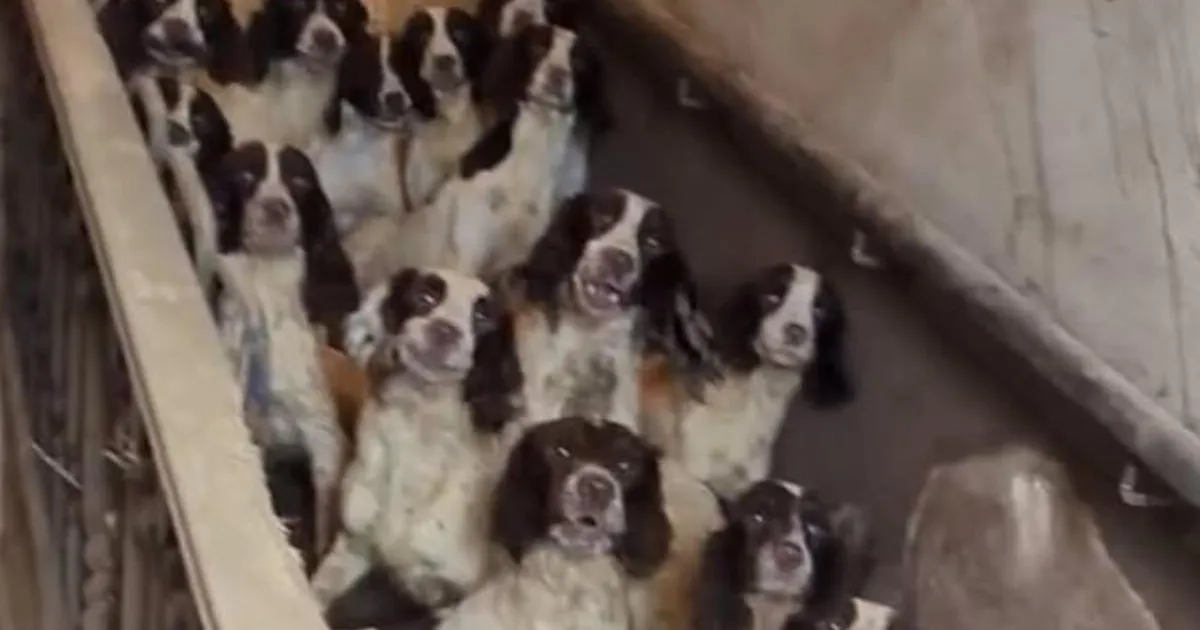
On 18 April last year, RSPCA inspectors walked into a house in the quiet town of Tickhill, near Doncaster, and entered a nightmare. The smell hit them before they reached the door. Inside, 84 dogs—80 Springer Spaniels and four Patterdale Terriers—were living in squalor so severe that the scene would stay with everyone who witnessed it for a long time. The property was caked in dog excrement and dirt, and the animals, many of them severely underweight, were trembling in corners, their eyes filled with confusion and fear. They were not pets in any meaningful sense. They had never been walked, never been socialised, never known the comfort of a soft bed or a kind word. Instead, they had been left to exist in a house that had become a prison of filth and neglect, with no proper food, no clean water, and no human kindness. The rescue operation that followed was enormous. Officers moved carefully through the house, collecting frightened, malnourished dogs from every room, from behind furniture, from piles of waste. Some of the animals had never felt grass under their paws. Some flinched at the sound of a voice. It took hours to bring all 84 animals to safety, and the sight of them being carried out into the daylight was both heartbreaking and hopeful. Each dog was one more life saved from an unbearable existence, but the RSPCA team knew that the real work was only just beginning. These dogs needed more than food and water. They needed to be nursed back from the brink, taught how to trust, and shown that human hands could be gentle. They had to learn the most basic skills—how to walk on a lead, how to approach a stranger without fear, how to curl up in a safe place and sleep through the night. For many, the world outside that filthy house was terrifying. But the rescuers refused to give up. They made a quiet promise to every one of those 84 animals: no matter how long it took, they would help them find their way home.
The journey to recovery was slow and often heartbreaking. Many of the rescued dogs were so underweight that their ribs pressed against their skin, and their coats were matted with waste and dirt. They carried infections and parasites, and their bodies were weakened by months or years of neglect. The RSPCA’s veterinary teams worked tirelessly to stabilise them, treating illnesses, addressing malnutrition, and beginning the long process of physical rehabilitation. But the emotional damage was just as profound. Some dogs cowered at the sound of a human voice. Others hid at the back of their kennels, unable to understand that they were finally safe. The simple act of offering a treat was met with suspicion, and every small step forward felt like a miracle. Staff and volunteers spent countless hours with the animals, sitting quietly beside them, speaking in soft tones, and letting them approach when they were ready. They introduced leads and collars with enormous patience, because many of these dogs had never been outside and had no idea how to walk beside a human. The first time a dog walked through a doorway without hesitation, or lifted its tail in a tentative wag, the team celebrated as if they had won a race. Slowly, the dogs began to emerge from the shadows of their past. They learned that a raised hand could mean a gentle stroke rather than a blow. They learned that a bowl of food would not be taken away. They learned that the world was bigger than the four filthy walls they had known. Each rescued animal carried its own story of survival, and each one needed a different kind of care. Some blossomed quickly, while others needed months of patient reassurance. But the RSPCA never stopped believing in them. Every dog was given a name, a record, and a future. And as the months passed, the transformation became visible—in brighter eyes, healthier coats, and the growing confidence of animals who were finally learning what it meant to be loved.
Now, almost two years after the rescue, many of those once-forgotten dogs are living the lives they always deserved. The RSPCA has been overjoyed to see so many of them find happy, loving homes, and each adoption story is a testament to the power of compassion. Take Polly, one of the youngest dogs rescued from the house. She has been taken in by Lisa Marchant, from Hull in East Yorkshire, who describes her as a dog who is simply “high on life”. Lisa said: “Everything is wonderful to her. She’s such a smart girl and is absolutely bonkers for a ball. She’s brilliant with my children, our cat, Joy, and everyone who meets her.” It is hard to imagine that this joyful, bouncy dog was once living in a house covered in excrement, so thin that her bones showed, and so frightened that she barely knew how to be a dog. But Polly has embraced her second chance with an enthusiasm that leaves her new family laughing every day. Her love of play, her devotion to her human siblings, and her friendship with the family cat are reminders that animals do not hold grudges. They live in the present, and the present, for Polly, is wonderful. Her story is just one of many. Each time an RSPCA volunteer sees a photograph of a rescued dog curled up on a sofa, or running across a beach, or sleeping beside a child, they know that every sleepless night and every difficult rehabilitation session was worth it. The dogs who arrived at the rescue in a state of terror are now being given the chance to be exactly what they were always meant to be: loyal, playful, affectionate companions. For the adopters, too, these dogs are not just pets. They are reminders that even the most broken beginnings can lead to beautiful endings.
Fifi’s new owner, Keira Kirkup, from Chester-le-Street in County Durham, knows that healing is not always a straight line. Fifi has been adopted and is thriving in her new home, but she still carries a few scars from her past. Keira explained: “She still has anxious moments and isn’t keen on certain things, like saucepans being brought out of a cupboard. She’ll also try and eat any bits of rubbish she sees lying on the floor.” These small quirks are the echoes of a life spent scavenging and surviving in chaos. A saucepan clattering out of a cupboard might have meant noise and fear in the house where she once lived. A scrap of rubbish on the floor might have been the only food she ever found. But Keira approaches these moments with patience and understanding, giving Fifi the security she needs to gradually let her guard down. Similarly, Joanna Baldwin, from Southport in Merseyside, has given a home to Darcy, another survivor. Joanna says: “She’s come so far. She’s so affectionate and a joy to be around.” The progress that Darcy has made is visible in the way she greets her owner, the way she asks for attention, and the way she relaxes into a cuddle without fear. These stories highlight something important: adoption is not about finding a perfect dog. It is about finding a perfect match. The RSPCA carefully works to pair each animal with an owner who understands their history and is willing to give them time. The adopters who step forward are not looking for a show dog. They are looking for a friend. And in return, they receive a loyalty that is nothing short of extraordinary. Fifi may still startle at the sound of pans in the kitchen, but she is also learning that her new home is a safe place, where no one will hurt her and where food is always given freely. Darcy may have begun her life in misery, but she now greets every day with an open heart. These are the quiet victories that make rescue work so meaningful.
The wave of adoptions has continued to spread happiness across the country. Sprite, another of the rescued dogs, has been adopted by Sue and Jason Kairies in Lichfield, Staffordshire, while Mac has settled into a home in Mansfield, Nottinghamshire, with a couple named Georgia and Ben. Each of these dogs has a different story, a different personality, and a different path to recovery, but they all share the same triumphant arc—from despair to hope, from neglect to devotion. For Sue and Jason, Sprite has become a beloved member of the family. For Georgia and Ben, Mac has brought a new kind of energy and love into their lives. The fact that so many of the 84 dogs have found homes is a remarkable achievement, especially given the difficult start they had. When the rescue first made headlines, the public reaction was one of shock and anger. How could anyone let so many animals live in such terrible conditions? But that anger quickly transformed into action, with people from all over the country expressing interest in adopting the dogs. The RSPCA’s rehoming team worked carefully to ensure that every dog went to a suitable home, and their efforts have paid off. Seeing the dogs now—healthy, glossy-coated, and full of personality—it is hard to believe they are the same animals who once cowered in a filthy house. Their transformation is a tribute to the tireless work of the rescue staff, the veterinary teams, and the kind-hearted adopters who opened their homes and hearts. It is also a testament to the resilience of dogs themselves. They do not dwell on the past. They forgive. They trust again. And they love with a purity that humans can only aspire to. For every dog that has been adopted, there is a family that has been changed forever. The rescue that began in such darkness has ended in a cascade of happy endings, one wagging tail at a time.
Behind these happy endings lies a serious legal outcome. Three people from Doncaster are set to be sentenced on 9 December for their neglect of the animals, following a thorough investigation by the RSPCA. The charges relate to the appalling conditions in which the 84 dogs were found, and the case serves as a reminder that animal cruelty is not a victimless crime. The dogs in that house endured real suffering, and the people responsible are being held to account. While no sentence can undo the months or years of misery those animals experienced, it can send a clear message that neglect will not be tolerated. For the RSPCA, this case is one of the largest and most complex they have handled, and the outcome reflects the dedication of everyone involved. But the story does not end with the courtroom. It ends with dogs like Polly running after a ball, Fifi cautiously learning to trust, Darcy snuggling into Joanna’s lap, Sprite exploring her new garden, and Mac discovering the joy of a long walk. It ends with families who chose to look past the trauma and see the potential. It ends with the knowledge that every animal deserves a chance to be loved. The rescue in Tickhill will not be forgotten, but neither will the transformation that followed. In the face of cruelty, a community of humans and animals chose hope. And that hope has multiplied, spreading into homes across the country, one rescued dog at a time. For anyone considering adopting a rescue animal, these stories are a powerful reminder that the most broken hearts are often the most capable of love. The dogs from that house have not only been saved—they have been given a new beginning. And in giving them a second chance, their adopters have found something irreplaceable too: the unconditional love of a grateful dog.