

1. In the quiet, settling hours of a Tuesday evening, when most of Derby was winding down after work and dinner, a small local shop became the stage for a terrifying ordeal. It was just after 8pm when a young man walked into Gastronom Natali, a modest convenience store that serves as more than just a place to buy groceries—it is a community cornerstone, a friendly face at the end of the street, a spot where neighbors exchange greetings and familiar conversations. For the lone shopkeeper on duty, the evening likely seemed unremarkable until the stranger’s demeanor shifted. What began as a demand for money quickly escalated into a nightmare: the suspect produced a huge machete, its long blade glinting under the fluorescent shop lights, and threatened the worker directly. In that frozen moment, the mundane routine of stocking shelves and counting change was shattered by primal fear. The weapon was not just a prop; it was an imminent threat, a promise of violence that turned a simple request into a life-or-death ultimatum. One can only imagine the shopkeeper’s heart pounding, the instinctive calculation of whether to comply, resist, or flee. In such seconds, survival becomes the only thought, and the face of the assailant, along with the chilling sight of the blade, becomes etched into memory.
2. The robber, clearly brazen but perhaps not calculating enough, made his intentions known before showing his hand. CCTV footage from the store captures him entering, demanding cash from the worker, and then pulling out the large bladed weapon to emphasize his point. The cameras also documented the aftermath: the suspect grabbing a sum of cash, its exact amount undisclosed, and then making a hasty exit. In a strange juxtaposition of crime and casual urban transport, he escaped on an e-bike, disappearing into the night with an ease that feels almost anticlimactic after the drama inside. Police have since described the man as a young white male, approximately 5 feet 7 inches tall, with a build that suggests youth but not necessarily athleticism. From the CCTV stills, his face is partially obscured, but his attire is unmistakably distinctive. He wore a black bandana over the lower half of his face, adding a bandit-like mystery, and a hat with a camouflage pattern—a detail that would prove crucial to investigators. The e-bike getaway adds another layer to the story: it speaks of a local perpetrator, someone familiar with the area’s bike lanes and shortcuts, or at least someone who knew that an e-bike offers speed and anonymity in a crowded city. The entire incident took only minutes, yet its impact would ripple outward, stirring anxiety among business owners and residents alike.
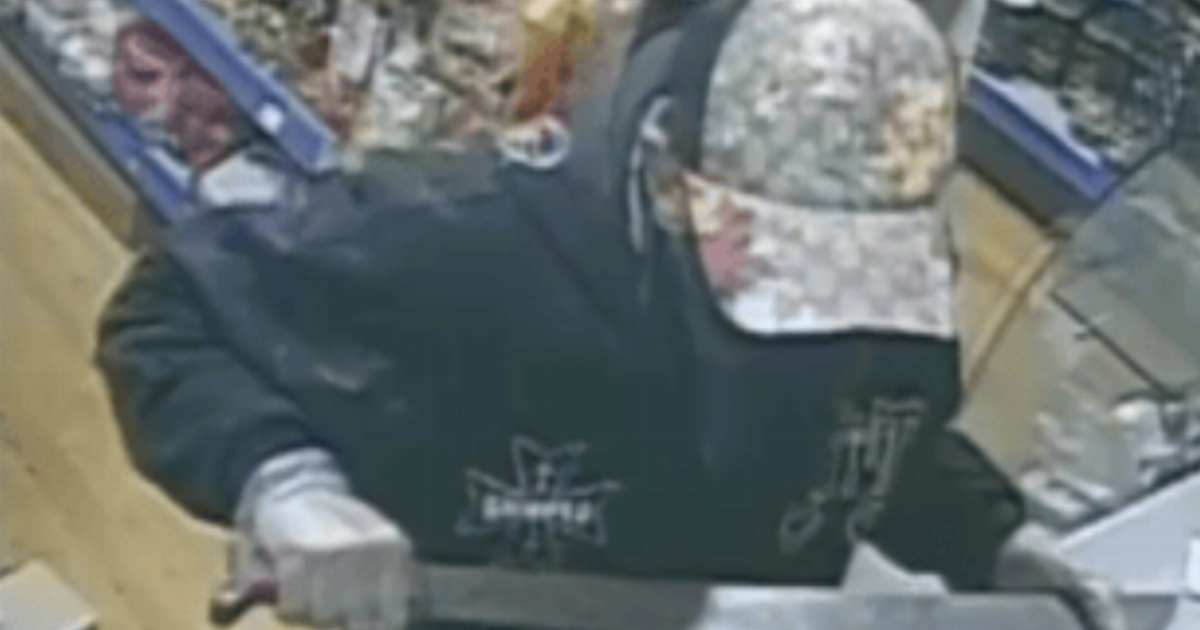
3. The robber’s clothing was not just a camouflage for his identity; it was also his undoing. His jacket was a black hoodie festooned with several logos on the chest and sleeve, a flashy garment that is far from generic. On the back, it bore white and yellow symbols, and around the outside of the hood in a distinctive white ring—a combination that makes it stand out in a crowd. Along with the camouflage-patterned cap, the outfit paints a picture of a young man trying to be both fashionable and menacing, yet unwittingly leaving behind a detailed description that would be broadcast to the public. Two days after the incident, in a park not far from the shop, officers made a significant discovery: clothing and a machete that appeared similar to the weapon the suspect brandished. This find ratchets up the drama—it suggests a perpetrator feeling the heat, attempting to discard evidence in a panic, hoping to bury the truth among bushes or undergrowth. For the police, this was a validation of their investigative instincts: the suspect was likely local, and he was now aware that his image was everywhere. The discovery also offers a glimmer of forensic hope—DNA, fingerprints, or fibers that could crack the case wide open. For the community, it adds a chilling thought: the machete and clothes spent days in a public park, a stone’s throw from where families walk their dogs and children play.
4. Now, the police have turned to the public for help. Their appeal is straightforward yet urgent: do you recognize this man? The grainy but clear CCTV images show him in his peculiar outfit, and investigators are banking on the fact that someone knows who he is. Perhaps a neighbor, a friend, a fellow e-bike rider, or a family member will spot the jacket with its logos and symbols and remember seeing it draped over a chair or folded in a laundry basket. The police are also asking for information about anyone who has recently discarded clothing that matches the description—a subtle but savvy request, implying that the offender might have tried to explain away the missing clothes by claiming they were old or torn. The incident has sent a shiver through the community, and Derbyshire Constabulary is all too aware of the tension. To reassure the public, they have increased patrols in the area, a visible show of force that combats the unease and reminds residents that blue lights are on their side. These patrols are not merely cosmetic; they are an active attempt to gather intelligence, to let the community see that the police are present, listening, and gathering leads from conversations and tip-offs.
5. A spokesperson for Derbyshire Constabulary addressed the public directly, treading the fine line between acknowledging fear and projecting control. “We understand an incident of this nature may be concerning to business owners and residents,” they said, offering empathy for the shockwaves that such a brazen robbery sends through a neighborhood. Then, the reassurance: “Officers have been out patrolling the area and making extensive enquiries.” These are not just empty words; they signal a well-oiled investigative machine at work, with detectives combing through CCTV, speaking to witnesses, and coordinating with the recovery of the discarded items. The spokesperson’s final entreaty is a call to action: “Anyone with information about the incident or knows who the man in the CCTV is, please contact us using one of the methods below and quote incident reference 26*525160.” That reference number is a unique key, a way to ensure that every piece of information from the public slots directly into the case file. It is also a psychological prompt—by asking people to cite this specific code, the police are making the process feel personal, organized, and consequential. The quoting of a reference turns a casual tip into a formal act of citizenship, an invitation to step out of the role of passive observer and into the role of active participant in restoring justice.
6. As the search continues, this machete-armed robbery serves as a stark reminder of the vulnerabilities of small shopkeepers, the invisible backbone of our high streets. They open early, close late, and often face the public alone, trusting that a smile will be reciprocated but always aware that unpredictability lurks. The incident at Gastronom Natali has not only instilled fear but also strengthened community resolve. For anyone with information, the avenues are clear: contact the police, cite the incident reference, and know that even the smallest detail—perhaps a glimpse of that camouflage cap or a memory of a friend suddenly getting rid of a jacket—could be the puzzle piece that leads to an arrest. The e-bike, the machete, the telling hoodie—they all paint a picture of a young man who made a catastrophic mistake, one that he now tries to hide behind a veil of discarded clothing. But in an age of omnipresent CCTV and community watchfulness, hiding is nearly impossible. The door of the Gastronom Natali shop remains open, its owner mustering the courage to continue, while the police urge the public to play their part. “Get in touch with our news team” is a separate matter, but for those with direct knowledge, the call to the constabulary is paramount. After all, a safe Derby is a shared responsibility—and justice for a terrified shopkeeper begins with a single phone call, a single memory, a single step forward.