
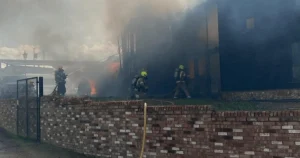

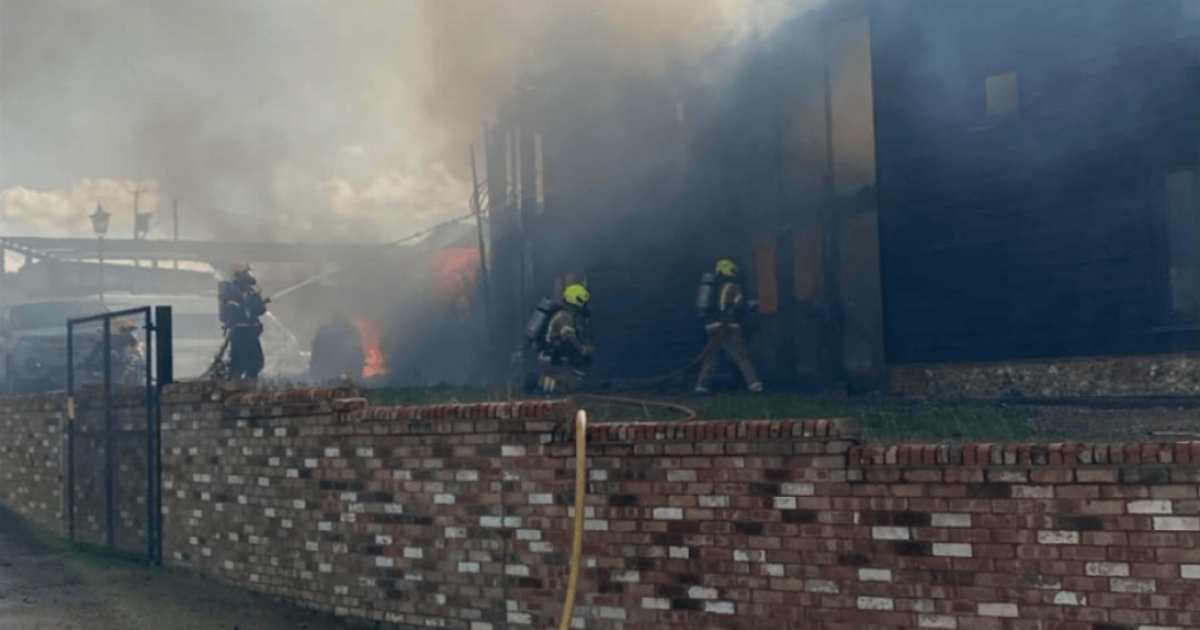
Smoke was already boiling into the sky above Little Walden before the first sirens echoed through the surrounding countryside. What had begun as an ordinary day at D&K Vehicle Services quickly turned into a scene of total devastation, as a family home and a business that had taken a decade to build were swallowed by fire. The blaze erupted in the workshop on the property, and within minutes it had grown into an inferno that demanded the combined response of ten fire engines and a water bowser. Crews were brought in not only from Essex but also from neighbouring Suffolk and Cambridgeshire, an unusual and immediate sign that this was no small incident. At the heart of the fire was a 1990s Japanese campervan—a vehicle with no valid MOT that had apparently been sitting on the garage’s MOT ramp when it suddenly burst into flames. What should have been just another day repairing an ageing vehicle became a catastrophe that destroyed a house, engulfed the workshop, and sent dense, black smoke high into the air, visible for miles across the rolling Essex landscape. For locals in this quiet corner of northwest Essex, the sight was both alarming and deeply unsettling. It was a reminder of how quickly ordinary routine can be replaced by chaos. But for the Ogborn family, who owned and ran the business, the fire represented far more than an emergency. It was the collapse of everything they had built, saved for, and worked toward. Firefighters were met with fierce heat and a range of hazards that made the operation “particularly challenging,” according to Essex County Fire and Rescue Service. The remote location, the age of the building, and the clutter of vehicles and equipment meant that every step had to be taken carefully. Most critically, the local water supply was inadequate, forcing crews to call in extra resources and adapt their tactics. Only after hours of grueling effort were they able to bring the fire under control—and by then, both the family home and the workshop had been reduced to smoking ruins. As one mechanic stood with his colleagues in the debris, the emotional weight of the loss began to settle in.
Callum Ogborn is the company director and a mechanic, and he knows every inch of the workshop that now lies in ruins. For the past ten years, he and his family had poured their physical labour, their savings, and their pride into D&K Vehicle Services. What had started as a modest local garage had grown into a trusted name, a place where customers knew they would be treated honestly and where vehicles were repaired with genuine care. The workshop was filled with the tools of a small working business: lifts, compressors, spanners, test equipment, files, signed photographs, and all the small clutter that comes from years of doing a difficult job well. It smelled of oil, rubber, and commitment. And then a single vehicle changed everything. The campervan at the centre of the fire was an ageing Japanese import from the 1990s. It had failed its MOT test four days before the blaze, which meant it was still on the garage’s ramp, waiting for attention and a follow-up inspection. Nothing in its presence seemed extraordinary. Vehicles fail MOT tests every day, and a repair garage is precisely where they should be taken for care. Yet something went horribly wrong. In an instant, the vehicle burst into flames, and the fire raced through the workshop with terrifying speed. Ogborn and his colleagues had just enough time to escape. There was no opportunity to grab phones, tools, paperwork, or even a favourite jacket. “We just had to get out the building and there was nothing more we could do – we all just had to stand there and watch our entire workshop burn to the ground,” he told the BBC. His voice, in the aftermath, carried the stunned, hollow quality of a man trying to process the unacceptable. “It’s absolutely soul-destroying,” he said. And in those two words, he captured the unique grief of losing a family business. A decade of effort, of early mornings and late nights, of faces and names and promises kept, had dissolved into smoke. The financial implications are staggering: two vehicles were completely destroyed in the inferno, while a further six were severely damaged by the heat, the falling roof, or the water forced onto the flames. For a family-run garage, losing eight vehicles and an equipped workshop is not just a blow—it can be an existential catastrophe.
From the moment the first fire engines arrived, it was obvious that this would be a long, hard fight. Little Walden is a rural community, and the local water supply was nowhere near enough to feed a fire of this size. Firefighting is, at its core, about water: finding it, moving it, and directing it onto whatever is burning. Without mains water of sufficient pressure, crews had to summon a water bowser, a specially designed tanker that can travel to a distant hydrant or natural source, fill up, and return to pour a fresh wave of water into the blaze. Ten fire engines were eventually called to the scene, an enormous commitment of resources. Even that was not enough, so the incident commanders requested help from neighbouring counties. Firefighters from Suffolk and Cambridgeshire crossed the border into Essex to join the battle. It is the kind of mutual aid that is rarely needed but invaluable when it is, and witnesses spoke quietly about the professionalism of the coordinated response. Inside the workshop, however, the dangers were growing. Fire crews were aware that acetylene cylinders were stored on the property. Acetylene is a gas used widely in vehicle repair for welding and cutting metal, but it is also extremely volatile. A cylinder exposed to intense heat can rupture violently, sending shrapnel through the air and releasing a ball of fire that could injure or kill nearby firefighters. The presence of those cylinders dictated the entire strategy. Rather than charging blindly into the building, crews worked carefully, hosing down the cylinders from a safe distance, trying to keep them cool and stable while attacking the main body of the fire. Group manager Andy Message later paid tribute to the discipline and endurance of everyone involved. “Firefighters have worked extremely hard with the support of crews from neighbouring counties in Suffolk and Cambridgeshire to extinguish the fire,” he said. “We are now in a position to scale the incident down and have crews remaining to monitor and cool hotspots.” The danger was far from finished. Hotspots can smoulder for hours, suddenly reigniting if left untended. The acetylene cylinders remained a threat until they were fully cooled. And the smoke, toxic from burning plastics, paints, and machinery, was another hazard that required constant vigilance. It was a professional, methodical, and exhausting operation.
To truly understand what happened in Little Walden, it is necessary to move beyond logistics and think about the human loss. For Callum Ogborn and his family, the garage was never just a way to pay the bills. It was a future chosen and built by hand. It was a craft they had learned, refined, and passed on to others. It was a reputation earned one honest repair at a time, through sweat and stubbornness and a refusal to cut corners. They had spent long hours and late nights on difficult jobs, weathered the uncertainty of the local economy, and built lasting bonds with customers who trusted them with the vehicles that carried their own families. The workshop was full of evidence of this history: tools bought one by one, notes scrawled in the margins of job cards, the distinctive smell of oil and rubber and effort. When the fire tore through it, that world was erased in front of them. Ogborn was not exaggerating when he described standing and watching it all happen. There is perhaps no more painful helplessness than knowing the thing you have spent years building cannot be saved. He called it “absolutely soul-destroying,” and the phrase deserves to be taken seriously. It is not just about money. It is about the mornings spent planning the day, the familiar weight of a wrench, the satisfied sound of an engine turning for the first time after a difficult repair. It is about the family home, also destroyed, where generations had gathered after work. Home and livelihood were merged on the same property, and now both were gone. The damage to vehicles only deepens the heartache. Two cars were completely destroyed; six more were badly damaged in the intense heat and smoke. For a small garage, each vehicle brought in by a customer was a contract of trust. Those cars were not simply metal and plastic; they represented somebody’s commute, somebody’s school run, somebody’s holiday plans. With the workshop gone, Ogborn cannot finish the jobs he had already promised to complete. Customers will have to find other garages, insurance companies will need to be called, records will need to be reconstructed. The physical loss is monumental. But the deepest wound is not in the beams and bricks; it is in the sudden silence where a thriving workshop used to stand.
Now that the smoke has cleared, the Little Walden community is beginning to understand the scale of what has happened. The sight of fire engines filling country lanes and smoke darkening the sky was enough to unsettle anyone. For the firefighters themselves, it was one of the most demanding incidents they had handled in recent years. The need to bring in crews from Suffolk and Cambridgeshire was a reminder that even the best local services sometimes need help, and the way that support arrived won admiration from all who watched. Fire, however, does not simply stop when it is put out. The aftermath can be as complicated as the inferno itself. Even as the last water was drained and the flames were reduced to glowing embers, crews remained at the scene to monitor and cool hotspots. They were unwilling to leave until they were confident that nothing could reignite. For the Ogborn family, the process of rebuilding is just beginning. It will mean hours of conversations with insurance assessors, the painful work of sorting through charred belongings, and the enormous task of deciding whether and how to rebuild. It will also mean coping with the questions and memories that linger long after the emergency has faded. But a community is often at its best in the aftermath of disaster. Neighbours have already offered food, accommodation, spare tools, and the use of their driveways. Customers who heard the news have reached out with sympathy. The story has also carried a practical warning. A car without an MOT is not just a legal issue; it may carry unrecognised mechanical dangers. The Japanese campervan involved in this fire was an ageing vehicle that had failed its test only days earlier. Exactly how the blaze started will be investigated, but the incident reinforces the importance of taking vehicle defects seriously and never postponing necessary repairs. It is easy to assume that a strange noise or a small leak can wait. In the worst case, as this fire demonstrates, it cannot. In the middle of all this loss, the response of the emergency services is a reminder of the enormous value of public servants—people who run toward a fire while everyone else runs away, and who then stay long afterwards to make sure that their neighbours can begin again.
The emotional fire will take far longer to go out than the one that consumed the building. Callum Ogborn is facing a future defined by uncertainty. He has lost his workshop, his family home, his tools, his livelihood, and the ordinary rhythm of his days. The team of mechanics that stood beside him through years of work has been scattered. The customer phone calls have stopped. The workshop is a shell. And yet, if you spend any time around people who work in the trades, you learn a particular kind of resilience. They are problem-solvers by necessity. They are used to looking at a broken engine and figuring out where to begin. That discipline will be essential in the months ahead. The rebuilding of D&K Vehicle Services, if it happens, will not take days or even months. It will take patience, courage, and a great deal of help from the community. Firefighters from three counties have already demonstrated what can happen when people work together across boundaries. The same cooperation will now be needed to support the family as they salvage everything they can and plan for the future. There is a temptation to reach for the image of the phoenix rising from the ashes, an image almost too neat for such a raw and recent tragedy. But there is something in the stubbornness of small business owners that refuses to be extinguished. They do not give up easily. They know how to make do, how to patch things up, how to find a solution when all the options seem closed. That spirit is still intact, even among the scorched timbers of the workshop. The family’s skills were not burned. Their memories were not burned. Their commitment to the community and their identity as craftspeople were not burned. In the coming weeks, the support of friends, neighbours, customers, and complete strangers who read their story will make an enormous difference. Every small act of kindness, every offer of help, every decision to choose a local garage over an anonymous chain will be a step toward renewal. This fire was devastating, and it will leave scars. But it did not destroy the most important things: their hope, their knowledge, and their willingness to begin again. As the last wisps of smoke drift away from Little Walden, the future remains uncertain. But it is not without possibility. And hope, as anyone who has survived deep loss knows, is one thing that no fire can ever consume.