

It was meant to be a journey of mercy, a medical evacuation ferrying a patient and a loved one from Bermuda to the lifesaving care of a Boston hospital. Instead, it became a nightmare unfolding in the dark skies above the Atlantic. The Latitude Air Ambulance, carrying six people, vanished from radar during a violent storm, and the world has been holding its breath ever since. According to flight data, the aircraft suddenly dropped roughly ten thousand feet from an altitude of twenty-five thousand feet just after 1 a.m., before disappearing entirely from tracking systems. Searchers have since recovered wreckage from the deep sea, confirming the plane went down, but all six souls remain missing: four Canadian crew members—two pilots and two medical personnel—and two Bermudian passengers, a patient and their relative traveling to Boston for care. The discovery of debris has only deepened the anguish for the families waiting on shore, their hopes caught between devastating certainty and the desperate need for answers. Every passing hour feels heavier, as the promise of a routine medical flight has been swallowed by the sea.
The investigation is now piecing together the final, frightening moments that led to the crash. Air traffic control audio captured by LiveATC.net reveals a pilot wrestling with catastrophic conditions, declaring an emergency as the aircraft approached the coast. A controller on the ground can be heard asking the pilot for clarity, repeating his words in disbelief: “Roger, you said you’re coming in blind. Is that what you said?” The phrase “coming in blind” paints a chilling picture: a plane loaded with vulnerable passengers, flying into a brewing storm, robbed of the instruments that guide a pilot through the clouds. The crew was likely battling a serious electrical failure at the worst possible moment, with the storm looming straight ahead. Without reliable instruments, the airplane becomes a fragile metal shell hurtling through darkness, and the pilots would have had little more than instinct to keep it upright. The terrifying data tells the rest of the story—a sudden, catastrophic drop from the sky, and then silence. It is a scenario that chills even the most experienced aviators, because it strips away the layers of technology that modern flying depends on, leaving only human fallibility in the face of nature’s fury.
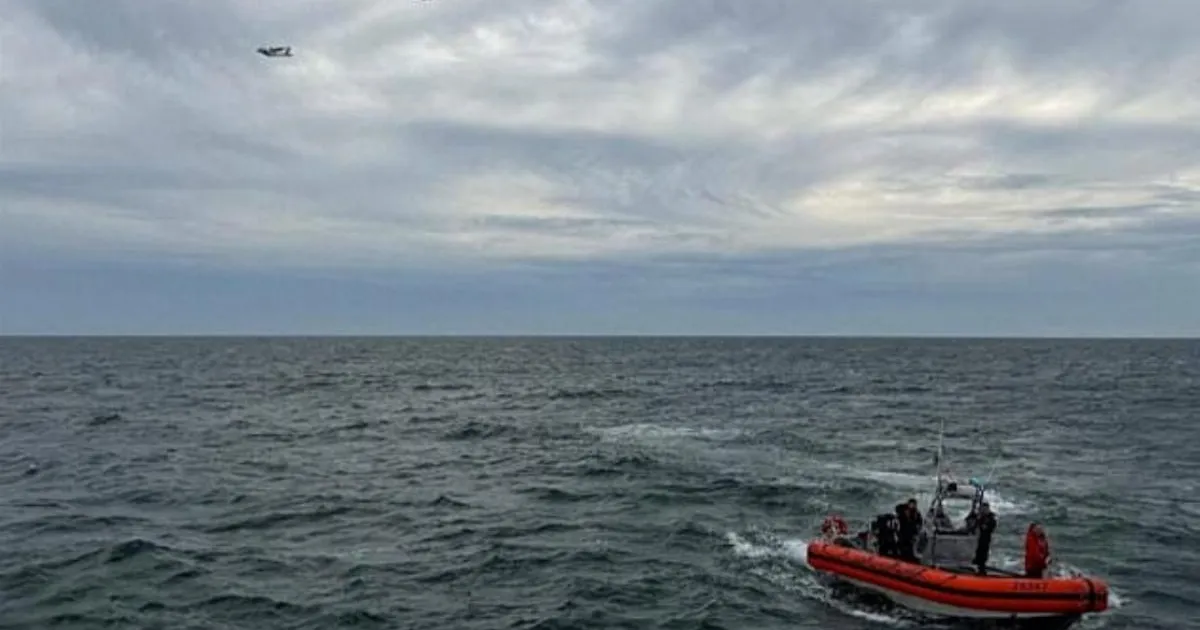
Through the night, search crews refused to surrender to the ocean’s vastness. The United Cajun Navy, a volunteer coastguard service, reported that search and rescue operations continued ceaselessly off the coast of Massachusetts, with Coast Guard cutters and specialized aircraft scouring the waters south of Nantucket. The fast response cutter William Sparling was among those pushing through grueling conditions, scanning black waves for any sign of the missing. The volunteers and uniformed responders alike knew that every minute mattered, not just for hope of survival—however faint—but also for the closure that families desperately need. The United Cajun Navy shared a poignant message urging the public to keep the families in their thoughts and prayers, describing the wait as “unimaginable.” They also asked for prayers for the crews themselves, who worked through darkness and difficult weather to bring answers and hope. It is a heartbreaking reminder that behind every alert, every search grid, every rise and fall of the sea, there are human beings driven by compassion, clinging to the belief that they can still make a difference in a tragedy that seems to have none.
Aviation experts have weighed in on the likely cause, and their observations only amplify the danger of the situation. Mary Schiavo, former Inspector General of the U.S. Transportation Department, said it plainly: “Something bad happened with this big drop, and they flew into this big storm.” She explained that losing instrument capability in that environment is an unthinkable challenge for any pilot. “It’s a terrible place to have a loss of your instruments and be flying blind,” she said. “It’s very easy to get disoriented and not know if you’re turning, climbing, descending, etc.” Her words highlight the human element of the tragedy—the split-second decisions, the wave of confusion, the terror of knowing that a sick patient and a terrified family member are depending on you, while the world below offers no comfort. The ability of a pilot to navigate without instruments, known as spatial disorientation, has claimed many experienced aviators throughout history. In the dark, inside a storm, with no visual reference points and flickering cockpit displays, the brain can send false signals that feel utterly real. The body may say the plane is level when it is diving, or climbing when it is falling flat. For the people on board Latitude Air Ambulance, the math was brutally unforgiving, and the margin for error was zero.
As news of the crash spread, it was impossible to ignore the ominous mystery of the region. This latest disappearance quickly reignited talk of the Bermuda Triangle, that infamous stretch of ocean where stories of vanishing ships and planes have become legend. The timing only fueled the theories: just last month, a family plane also crashed on its way to Miami, Florida, adding to the uneasy feeling that something strange lurks beneath the surface of these waters. Social media is already filling with speculation, ancient map references, and whispered suggestions of forces beyond human understanding. Yet for the families of the six missing people, these theories offer little comfort. They know this was not a story—it was flesh and blood, a loved one in a seat, a crew member doing a difficult job. The urge to find meaning in tragedy is human, and nowhere is that more powerful than in places with a reputation like the Bermuda Triangle. But the cold reality is that the Atlantic can be brutally dangerous on its own, especially when a storm rages and a plane loses its electrical systems. The legend may be compelling, but the truth is often simpler and far sadder: weather, equipment failure, and one terrible night.
Still, the official voices of reason have stepped forward to calm the storm of myth. The United Nations National Oceanic and Atmospheric Association, known as NOAA, has long insisted that there is no supernatural explanation for disasters at sea. In a statement, the agency reminded the world that the U.S. Navy and Coast Guard have consistently argued against any magical forces at work in the Bermuda Triangle. “The ocean has always been a mysterious place to humans, and when foul weather or poor navigation is involved, it can be a very deadly place,” NOAA said. “This is true all over the world. There is no evidence that mysterious disappearances occur with any greater frequency in the Bermuda Triangle than in any other large, well-traveled area of the ocean.” Those words may not ease the pain of the families, but they bring perspective: the sea is vast, storms are merciless, and accidents happen regardless of myth. Ultimately, the story of Latitude Air Ambulance is not a legend. It is the story of six people whose lives were cut short while others were trying to save one. It is a story of pilots battling impossible odds, nurses and medics caring for a patient until the very end, and a family member who never left their side. Until the wreckage yields answers and the ocean gives up its secrets, all that remains is hope—hope for the families awaiting word, hope for the searchers still scanning the waves, and hope that out of this tragic loss, something meaningful will be found.