

Paragraph 1
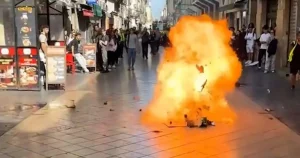
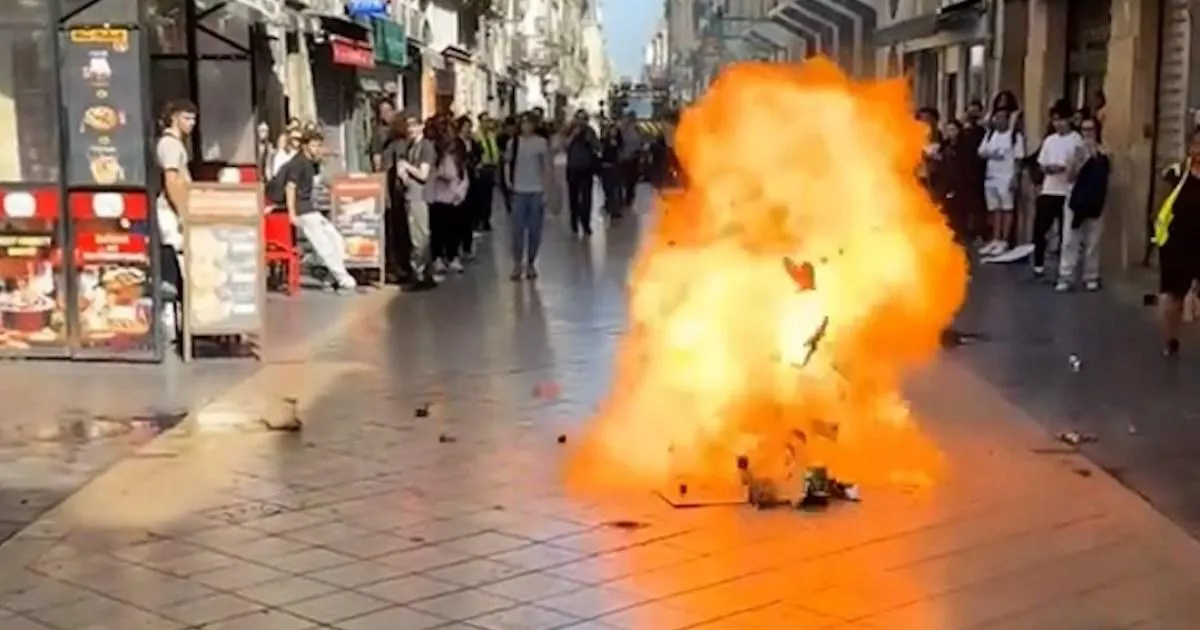
The video arrives with the jolt of something that should never have been recorded. In the middle of a street in Bordeaux, during a day already thick with tension and anger, a burning object sits on the asphalt. The camera captures the scene from a distance, but the focus is unmistakable. A firefighter, dressed in protective gear, walks toward the flames. There is something almost routine in the movement, a trained professional doing the job he has done many times before. Then, in a sudden, violent flash, the object erupts. The firefighter is swallowed by fire. For a moment, the footage feels unreal, like a scene from a movie rather than a social media post meant to document life in a French city. But the scream, the scramble, the sight of a human silhouette moving desperately through flames, makes it brutally real. The firefighter manages to escape, running to safety, but the image has already seared itself into the minds of everyone watching. On TikTok and across social media, the footage spreads quickly, horrifying viewers and reigniting the debate over the protests that have gripped France. This is not a distant conflict from another country. It is happening in a European nation, on ordinary streets, in front of schools and town halls. The firefighter’s brush with death is a powerful reminder that protests, no matter how righteous the cause, carry consequences that no one fully controls. Behind the uniform, there is a person, someone with a family, someone who may have spent the morning hoping for a quiet shift, someone who now has to live with the memory of being engulfed by flames. The explosion in Bordeaux is not just news; it is a human story, one that speaks to the fragility of safety and the urgent need to understand why so many people are willing to take to the streets in defiance.
Paragraph 2
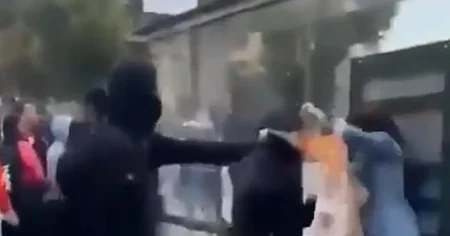
The firefighter was not caught in some random accident. He was responding to the chaos of a nationwide protest against the French government’s planned budget cuts, specifically the proposed 2027 budget that is expected to bring heavy reductions in public spending. For months, the country has been simmering with discontent, and now that dissatisfaction has boiled over. Demonstrations have erupted in Paris, Bordeaux, Lyon, and Lille, with thousands of people, many of them young students, taking to the streets to make their voices heard. Some of the most striking images coming out of the protests show high school students, their faces masked, blocking the entrances to their own schools. It is a strange and poignant sight: young people preventing access to places of learning because they fear that the very institutions meant to prepare them for the future are being dismantled. These students are not simply looking for a reason to skip class. They are acting on a deep-seated belief that the system is failing them, that the cuts will fall hardest on the most vulnerable communities, and that their generation will be left to deal with the consequences of decisions made by people in power who seem far removed from their daily lives. The scenes of burning trash cans, graffiti-covered walls, and lines of riot police may dominate the news, but behind them lies a quieter, more personal anxiety. There is the student who worries about whether she will be able to afford university, the teacher who fears losing his job, the parent who sees no future for her children in a country that seems to be tightening its grip. Protesting is not a casual choice for most people. It is a last resort, a way of saying, “We cannot stay silent while our lives are decided for us.” And so they gather, in the cold streets of Bordeaux, in the crowded squares of Paris, in the working-class neighborhoods of Lyon and Lille, hoping that their collective voice will be louder than the sound of budget reports and policy briefings.
Paragraph 3
The human cost of these protests is staggering, and the numbers painted a grim picture of the violence and anger that have come to define the movement. France’s education minister, Edouard Geffray, reported that 200 people in total had been injured during the demonstrations, a sobering figure that includes protesters, police officers, and bystanders caught in the chaos. Interior minister Laurent Nunez offered an even more alarming statistic: 440 people, most of them minors, were arrested on Tuesday alone in connection with the high school protests. It is difficult to wrap one’s mind around that number. Four hundred and forty young people, many still teenagers, found themselves handcuffed and taken into custody, their day transformed from a protest march into a criminal matter. But perhaps the most disturbing detail came in the reports of violence: seven separate incidents in which demonstrators threw hydrochloric acid at police. That is not a rock or a bottle. It is a corrosive substance capable of causing severe burns and permanent injury. The image of a police officer in Saint-Denis, bleeding from an injury, serves as a stark reminder that the men and women in uniform are not faceless enforcers. They are human beings, too, with fears and families, who put themselves in harm’s way every time they put on that uniform. The firefighter in Bordeaux, engulfed by flames, and the police officer in Saint-Denis, bleeding in the street, are two sides of the same tragic story. They are the people who are expected to manage the consequences of decisions made far above their pay grade, and they are the ones who suffer when peaceful protest turns into violent confrontation. It is easy to reduce these events to statistics or to use them as ammunition in a political argument, but behind every number there is a person. A young police officer waking up in a hospital bed, wondering if his career is over. A student sitting in a holding cell, frightened and confused. A firefighter unable to sleep because every time he closes his eyes, he sees flames. The violence touches everyone, and no one walks away unharmed.
Paragraph 4
President Emmanuel Macron has responded to the unrest with a mixture of condemnation and recognition, a delicate balancing act that reflects the complexity of the situation. He has forcefully criticized the violence, saying, “High schools are meant to be open and to share knowledge. They are not meant to be blockaded or to have trash cans set on fire.” There is a truth to those words. Schools are sacred spaces in a democratic society, places where young people should be safe to learn, debate, and grow. When those spaces are turned into battlegrounds, something fundamental is broken. But Macron also took the unusual step of acknowledging that the difficulties in high schools should not be dismissed. He seemed to understand that the protests are not simply the work of troublemakers or agitators, but rather a symptom of real grievances that have been left unaddressed. The question is whether that acknowledgment is enough. For many protesters, words are cheap. They have heard promises before, and they have seen little change. The political landscape in France has become increasingly polarized, and the protests have been embraced by political figures who see an opportunity to challenge the establishment. Leaders of France Unbowed, the left-wing movement headed by presidential candidate Jean-Luc Mélenchon, have been at the forefront of several demonstrations, lending their voices and their organizational power to the cause. For Mélenchon and his supporters, these protests are not just about budget cuts; they are about a broader vision of social justice, economic equality, and the future of the French Republic. But critics argue that the involvement of political leaders only inflames the situation, turning genuine student frustration into a weapon in a larger electoral struggle. The line between authentic protest and political opportunism becomes blurred, and in that confusion, the original message of the demonstrators can be lost. Yet, for the young people standing in the streets, politics is not an abstract game. It is about their lives, their futures, and their place in a country that often feels as though it has forgotten them.
Paragraph 5
Nowhere is that sense of abandonment more palpable than in the working-class suburbs that ring France’s major cities, places like Saint-Denis, where inequality is not just a word in a report but a daily reality. It was there that Bally Bagayoko, the mayor of Saint-Denis, sparked outrage after he was shown dancing with demonstrators outside a school. The image of a public official, someone entrusted with upholding the law and maintaining order, celebrating alongside protesters was too much for many to stomach. Politicians from across the spectrum condemned his behavior, and the Paris Police Prefecture formally filed a complaint against him for “incitement to commit a crime.” For his critics, Bagayoko’s dance was a betrayal of his office, an endorsement of chaos that undermined the authority of the state. But the mayor’s supporters saw something different: a man who understood the anger of his community, who refused to stand aloof while the people he represented felt ignored and humiliated. The tension is impossible to ignore, and it is rooted in the lived experiences of people like Gamze, a 17-year-old student in Saint-Denis who joined the protests. “It’s always us… who are suffering when, in Paris or in the countryside, they’re not in such a situation,” she told Reuters. Her words carry the weight of generational frustration. She is not talking about abstract politics. She is talking about her school, her neighborhood, her friends, her own life. She is saying, with painful clarity, that the burden of France’s economic choices falls disproportionately on people like her, and that no one seems to care. This is not just a story about budget cuts or protests or fires in the street. It is a story about the widening gap between the France that has and the France that has not, between the gleaming boulevards of Paris and the gritty streets of Saint-Denis, between those who feel they have a stake in the future and those who believe that future has already been decided against them. When a mayor dances with demonstrators, he is making a statement about which side he stands on. Whether that statement is courageous or irresponsible depends on the observer, but it is impossible to deny the pain that lies beneath the gesture.
Paragraph 6
The firefighter who was engulfed by flames in Bordeaux represents something more than a moment of danger. He represents the human cost of a society struggling to find its way. In the end, after the smoke clears and the last protestor goes home, France will still have to answer the questions that have caused so much anger and despair. How do you cut a budget without cutting hope? How do you maintain order without crushing dissent? How do you listen to the voices of young people who feel invisible, without condemning the violence that some of them resort to? These are not easy questions, and there are no simple answers. But the protests have forced the nation to confront them. In the streets of Bordeaux, Paris, Lyon, and Lille, a generation is trying to tell its story. Some of them are using peaceful marches, others are using rage, and a few are crossing lines that no one should cross. But beneath all the noise and destruction, there is a plea for connection, an appeal to be seen, heard, and taken seriously. The firefighter survived, but the memory of those flames will never leave him. The police officer will carry his scars. The students will carry their disillusionment. And France, a country built on the principles of liberty, equality, and fraternity, must find a way to bring them together rather than letting them tear each other apart. The social contract is fragile, and it is being tested in the most visible way possible. The images from the protests are difficult to watch, but they must not be forgotten. They are a reminder that democracy is not a static achievement but an ongoing struggle, a living conversation between the people and the institutions meant to serve them. The next chapter of that conversation is still being written, and it will depend not on violence or slogans, but on the willingness of everyone, from the president to the teenager in Saint-Denis, to listen to one another and to find a path forward that honors the dignity of all. Until then, the fire will keep burning, and the people will keep walking through it.