


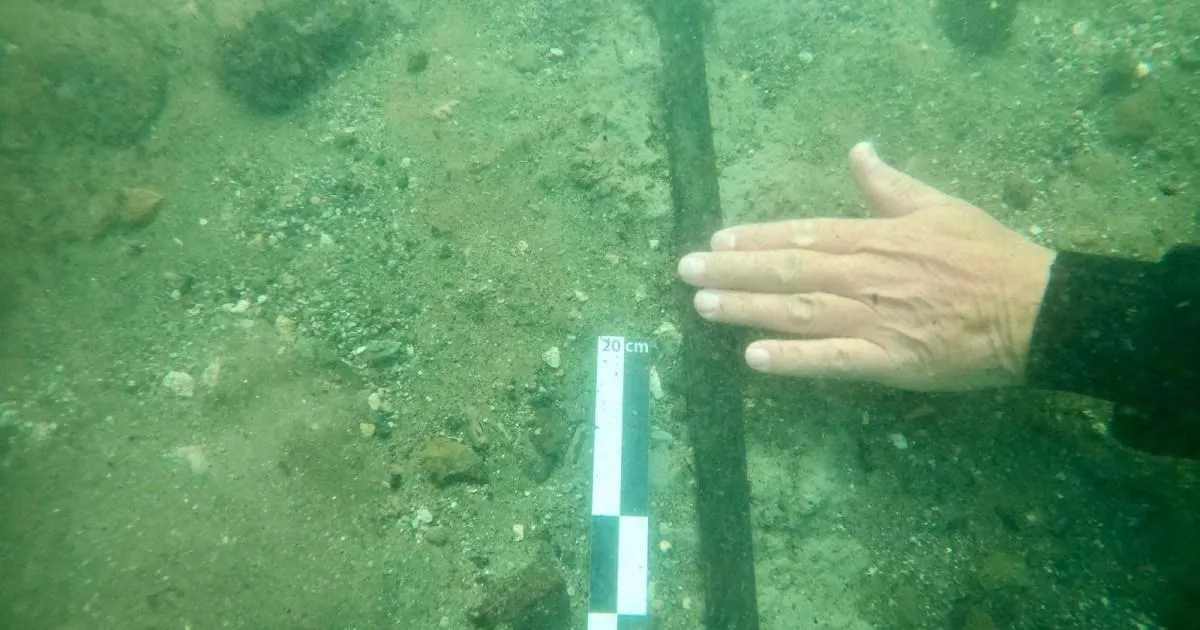
There are moments in archaeology when time seems to fold in on itself, and the discovery of a perfectly preserved Bronze Age sword in a quiet Italian lake is exactly that kind of moment. On September 28, divers working in Lake Mezzano, a volcanic lake in the region of northern Lazio, emerged from the water carrying something extraordinary: a bronze sword, so intact that it might have been lost only yesterday rather than some three thousand years ago. Known as a “spada a lingua da presa,” or tang-tongue sword, the weapon was found along a part of the southern shore that had never received much archaeological attention. It was not alone. Nearby, researchers also found intact pottery vessels, a bronze axe, and a bronze razor, all resting in the same ancient layer of the lakebed. This is the third sword recovered from Lake Mezzano since archaeological investigations first began there in the 1970s, and the latest find has left experts genuinely puzzled. The Superintendency for Archaeology, Fine Arts and Landscape for Viterbo and Southern Etruria, the government body overseeing the work, described the discovery as extraordinary. But the sword’s flawless condition, combined with the way it was lying among other objects, has raised a tantalizing possibility: that this was not merely a lost weapon, but a deliberate offering, a ritual gift placed in the water by people who lived at the lake thousands of years ago. If that is true, then the blade changes how we understand the people who made it and the world they inhabited.
To understand why this sword matters so much, you have to picture Lake Mezzano itself. It lies west of Lake Bolsena, in a dramatic landscape shaped by ancient volcanic activity, a crater lake with dark, mineral-rich waters. Beneath the surface there is an entire lost village. During the Bronze Age, roughly between 1700 and 1150 BC, a substantial settlement stood here, built partly on wooden platforms supported by hundreds of piles driven into the clay. The site was first identified in the early 1970s, when archaeologists realized that the shallows concealed the remains of a large pile-dwelling community. For the next two decades, they returned intermittently, digging and mapping what they could. Then the work stopped, and for many years the lake kept its secrets. In 2025, after a long break, systematic underwater research resumed, and the results have been remarkable. Archaeologists have already mapped more than six hundred wooden piles rising from the clay lakebed, even though their survey has covered only about one-third of the known settlement. The sheer scale suggests that Mezzano was not a small hamlet or a temporary camp; it was a thriving, busy community built out over the water. The renewed investigations have also revealed an unusually large collection of metalwork. In the first campaign alone, more than twenty-five bronze objects were recovered, including winged axes, spearheads, fibulae, rings, a pin, and a beautifully preserved sickle. Fragments of bronze ingots have also been found, raising the possibility that the settlement was a center for metalworking. The lakebed, it turns out, is not just a graveyard of lost items; it is a treasure trove of everyday life, and every new object is a clue to a civilization that left no written records.
What makes the new sword so intriguing is not just its beauty, but the mystery of how it ended up beneath the water. Archaeologists have long debated the meaning of the objects found at Lake Mezzano. One explanation is simple and practical: the settlement was built on wooden structures, and over many centuries things could easily have fallen from platforms, rolled down slopes, or been redeposited as the shoreline shifted. A dropped razor, a lost axe, a pot knocked into the water by accident—these are all plausible, human accidents. But the growing concentration of weapons challenges that straightforward interpretation. Why would so many swords, spearheads, and other valuable bronze objects end up in the same place? Bronze was not cheap or common in the Bronze Age; it was a high-status material, often associated with warriors, chiefs, and rituals. To lose one sword might be carelessness. To lose three swords, along with a whole collection of metalwork, seems more like intention. Researchers are now investigating whether some objects were placed in the water deliberately, perhaps as offerings to gods, spirits, or ancestors. The term “cult offering” has been whispered in connection with these finds, and for good reason. Many ancient societies regarded lakes and rivers as sacred boundaries between the world of the living and the world of the divine. Throwing a valuable object into the water might have been a way of asking for protection, giving thanks, or communicating with forces beyond human understanding. The new sword, with its remarkably preserved surface and untouched edges, looks less like a weapon that had been used in battle and more like something carefully selected and intentionally surrendered.
The earlier swords found at Lake Mezzano offer a meaningful clue. The Museo della Preistoria della Tuscia e della Rocca Farnese in nearby Valentano, which houses material from the site, describes those earlier blades as being in excellent condition. One of them, in particular, had not been sufficiently hardened to serve as a practical weapon. For a sword, that is almost like having a ceremonial sword that would never have survived serious combat. Museum staff have interpreted that blade as a possible sacrificial offering rather than a warrior’s tool, an object meant to be given, not used. The museum also associates the later phases of the settlement with a possible cult function, during which bronze objects including swords, a spearhead, and other valuable metalwork may have been deposited in or around the lake. Now, with a third sword in hand, researchers are revisiting this theory with fresh eyes. The newly discovered sword has not yet been conclusively identified as an offering itself, but the circumstances are telling. It was found in a relatively unexplored sector of the southern shore, together with intact pottery vessels, an axe, and a razor. These were not broken, scattered, or degraded items. They looked as though they had been placed together with care. It is impossible not to imagine a Bronze Age person standing on a wooden platform, looking out over the dark water, and letting go of a precious blade, watching it sink into the depths. Perhaps it was an offering for a safe journey, a plea for healing, or a farewell to someone who had died. We may never know the words that accompanied the gesture, but the sword itself speaks across the centuries.
The extraordinary preservation of these objects adds another layer of wonder. Lake Mezzano’s oxygen-poor clay, which surrounds many of the finds, has acted as a natural preservative, preventing the bronze from corroding and keeping surfaces remarkably intact. During the 2025 campaign, archaeologists reported that some bronze objects still had the kind of well-preserved surfaces that seem almost too good to be true. This means the lake is not just an ordinary archaeological site; it is a rare kind of time capsule, one that has kept fragile metal objects safe for thousands of years. The submerged settlement itself also appears to cover a considerably larger area than early investigations indicated. And researchers are beginning to understand how the village changed over time by studying where artifacts are found at different depths. Earlier material seems to be concentrated in deeper areas, while later remains are closer to the modern shoreline. This pattern could provide valuable evidence about how the settlement responded to fluctuating water levels, as the lake expanded or receded and the community adapted to an ever-changing environment. The latest sword was found in a part of the southern shore that had received comparatively little archaeological attention, which suggests that much more might still lie hidden beneath the lakebed. Other artifacts could be waiting in the mud, offering new insights into a civilization that lived and worked on the water. Every bronze object recovered from Lake Mezzano is a small miracle, and the fact that so many remain means the best discoveries may still be ahead.
For now, the question of how and why the weapons reached the water remains unresolved. Some may have belonged to a community whose buildings eventually collapsed or burned, sending their contents crashing into the lake. Others may have been deposited deliberately, for reasons that are still unclear. With three swords now known from Lake Mezzano, determining how and why they ended up beneath the lake is likely to be an important focus of future research. Each new find forces archaeologists to think more deeply about the people of this ancient village: how they lived, what they valued, and what they feared. The sword recovered from the southern shore is not just a beautiful object; it is a question in bronze. Was it a weapon that failed its owner, a tribute to a river god, a grave offering, or simply something that slipped through the cracks of a wooden walkway and was never retrieved? In a way, the mystery is part of its power. It reminds us that history is never fully settled. The people of Lake Mezzano were not so different from us. They had work and families, tools and worries, and they stood at the edge of the water wondering what might be watching from below. Now, thousands of years later, their sword has come back into the light, still sharp, still whole, still carrying the weight of an unanswered question. As researchers continue to map the lakebed and explore the hidden reaches of the settlement, one thing is certain: Lake Mezzano is not finished revealing its secrets. The ancient lake still has plenty to say, and the third sword is only the beginning of the conversation.