

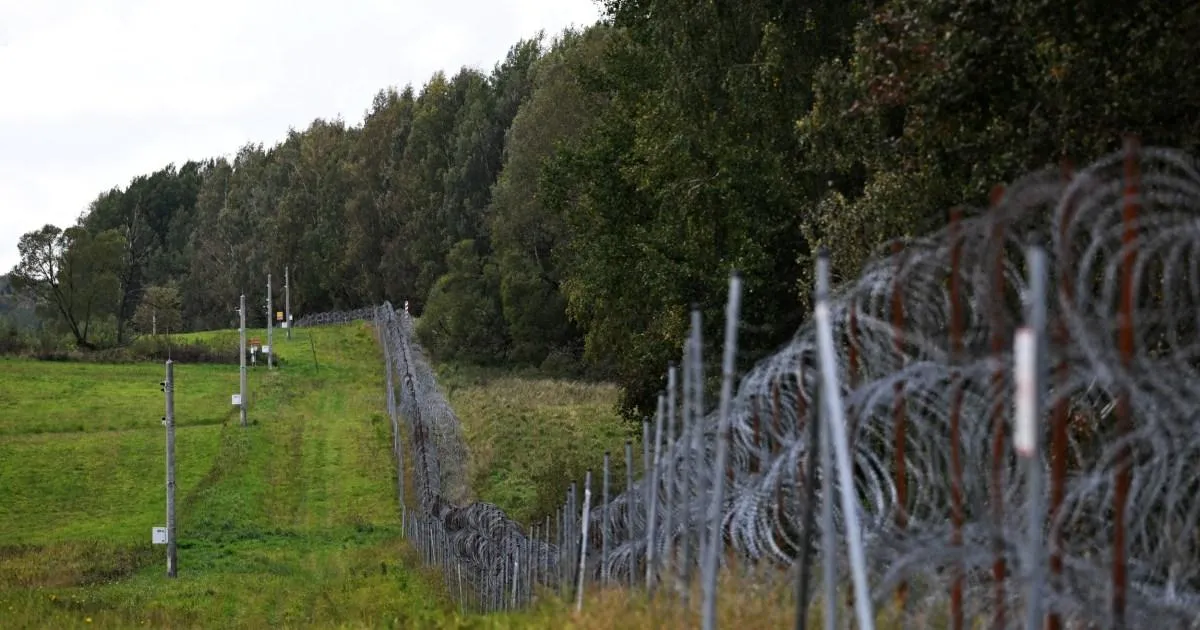
Amid the serene, birch-lined landscapes of Eastern Europe, a stark symbol of geopolitical fracture cuts through the earth: a razor-wire fence running along the Polish and Lithuanian border with the Russian exclave of Kaliningrad. This shimmering, deadly barrier isn’t just a line on a map; it is the physical manifestation of a terrifying standoff. It is here, in this tiny sliver of Russian territory sandwiched between NATO allies, that the specter of nuclear war has once again been dragged violently into the daylight. Vladimir Putin, the Kremlin’s master of brinkmanship, has issued a chilling ultimatum, warning that he is prepared to unleash “all weapons” in Russia’s vast arsenal—explicitly including nuclear arms—should the West ever attempt to attack or blockade Kaliningrad. His words, delivered with a cold, fatalistic certainty, echo through the corridors of global power like the tolling of a bell. Putin framed the situation not as a choice, but as an inevitable chain reaction, stating that if a direct attack occurs on Russian soil—which he defines as including this isolated exclave—the use of every devastating weapon in the nation’s stockpile will be placed “inevitably and unavoidably” on the agenda. It is a statement designed to instill maximum fear, a potent reminder that the frozen conflicts of the twentieth century have thawed into a boiling, volatile present.
To understand the gravity of this threat, one must first appreciate the peculiar, almost surreal geography of Kaliningrad. Situated roughly 200 miles from mainland Russia, it is a geopolitical island, a heavily militarized remnant of a past world. Once known as Königsberg, a proud Prussian city known for its philosophers and trade, it was absorbed into the Soviet Union after World War II and renamed after Mikhail Kalinin. Today, it serves as the home of Russia’s Baltic Fleet and is a crucial strategic outpost, bristling with anti-ship missiles, nuclear-capable Iskander rockets, and advanced air-defense systems. For NATO, Kaliningrad represents a potential dagger aimed at the heart of Europe. It sits astride the “Suwalki Gap,” a tiny 60-mile borderland between Poland and Lithuania that is widely considered the most dangerous stretch of land on the planet—the only land link between the Baltic states and the rest of the NATO alliance. For Putin, Kaliningrad is a fortress, a symbol of Russian power projection and a permanent denial of NATO’s ability to casually maneuver in the region. Yet, for the civilians who live there, the roughly one million residents going about their daily lives—shopping, raising children, sipping coffee overlooking the Baltic Sea—it is simply home. They are not pawns in a game; they are ordinary people trapped in a geopolitical pressure cooker, their futures held hostage to the paranoia and ambitions of distant leaders in Moscow, Brussels, and Washington.
The rhetoric has escalated far beyond the usual diplomatic maneuvering, largely fueled by a furious ideological campaign spearheaded by one of Putin’s most senior and hawkish advisors, Sergei Karaganov. At seventy-four years old, the man ominously nicknamed “Professor Doomsday” has become a leading voice in the Kremlin’s security apparatus. Karaganov, the honorary chairman of the Praesidium of Russia’s Council on Foreign and Defence Policy, has issued horrifying public warnings that attempting to push Russia toward the brink will result in catastrophic human suffering. He has explicitly stated that Moscow will go nuclear if the West sends troops into Ukraine or makes a single aggressive move toward Kaliningrad. His chilling prophecy is that “millions of innocent people would perish,” a phrase that cuts through the abstract jargon of geopolitics to expose the raw, visceral horror of what a nuclear exchange would mean. Karaganov paints a picture of a post-apocalyptic Europe, where the civilized cities of Warsaw, Berlin, and Paris would be reduced to silent, radioactive wastelands. He speaks of nuclear war as a grim, acceptable price for Russian survival, attempting to frame it as a defensive necessity rather than an act of insanity. By giving voice to these threats, Karaganov is not merely predicting a future; he is actively trying to shape it, convincing the Kremlin that aggression is the only language the West understands, while simultaneously terrifying NATO populations into abandoning their support for Ukraine.
The background to this terrifying ultimatum is the grinding, brutal war in Ukraine, which has transformed from a regional conflict into a proxy war between Russia and the collective West. NATO has responded to Russia’s belligerence by conducting military exercises near Kaliningrad, officially designated as purely “defensive” drills designed to strengthen deterrence and reassure anxious alliance members. But to Moscow, these maneuvers are visibly provocative encirclements, a rehearsal for a potential invasion. The Kremlin views every troop movement, every fighter jet sortie, and every naval flotilla within the Baltic Sea as a direct threat to its territorial integrity. When Putin speaks of a potential blockade—strangling the seas and land routes that supply Kaliningrad—he is referencing a nightmare scenario for Moscow. A blockade would cut off the exclave, isolating Russian troops and civilians alike, crippling its economy, and publicly humiliating the Russian military. This fear of encirclement and strategic suffocation is deeply embedded in the Russian psyche, a lingering ghost of Napoleon and Hitler’s invasions. Therefore, the threat of nuclear retaliation functions as the ultimate, grim guarantee that no conventional force or naval blockade will ever be permitted to undermine Russia’s hold on this precious territory. The logic is catastrophic: because Kaliningrad is impossible to defend conventionally against a full NATO surge, Russia’s only credible defense is the threat of mutually assured destruction.
NATO’s official response to these nuclear tantrums has been a carefully calibrated mixture of defiance and bureaucratic boilerplate. The organization issued a statement saying, “We strongly denounce the threat of force, including any irresponsible nuclear rhetoric,” and reassuring the public that “NATO is a defensive Alliance and none of our activities or exercises pose a risk to any part of Russia.” But on the ground, this diplomatic recalibration does little to calm the nerves of ordinary citizens. For the people of Poland and Lithuania, the sound of military jets roaring overhead is no longer a distant thrill but a soundtrack of anxiety. Parents worry about what legacy they are leaving their children, while mental health professionals report a significant spike in climate and nuclear anxiety—a “doom-scrolling” generation facing existential dread. The human cost of this brinksmanship is not measured in missiles alone, but in the sleepless nights, the eroded trust in institutions, and the precariousness of normal life. The globe becomes a giant game of psychological chess, where every chess piece represents millions of real human hearts beating with fear. As leaders trade stern press releases and military briefings, ordinary people are left to grapple with the terrifying reality that the decision to end their existence could be made by a single, exhausted man in a bunker, or a delusional advisor whispering in his ear.
Ultimately, we are left staring into the abyss of human folly. Putin’s declaration that using nuclear weapons is “unavoidable” if Kaliningrad is threatened is not the language of a statesman seeking peace; it is the fatalistic creed of a gambler willing to burn down the casino because he doesn’t accept losing. The razor wire that separates Kaliningrad from the rest of Europe is a metaphor for a world increasingly fragmented by fear, where geography dictates destiny and where ancient grudges are weaponized against future generations. The historian’s warning echoes in the background: those who do not learn from history are doomed to repeat it. But the nuclear triad is a uniquely modern horror—a weapon so powerful that it makes previous wars look like minor quarrels. In the face of such threats, the “Professor Doomsday” figures of the world become prophets of their own demise. The only human, and therefore sane, response is to look past the geopolitical posturing and see the shared vulnerability of the human species. We all inhabit the same fragile planet, breathing the same air, drinking the same water. The razor wires at the border are merely illusions of safety. If the unthinkable happens, there will be no winner, no triumphant parades, only the silent ash of a failed civilization and the horrific realization that we were all, in the end, hostages to a fabricated conflict. The question is not whether we can deter the bombs, but whether we can summon the collective humanity to dismantle the fear that makes them necessary.