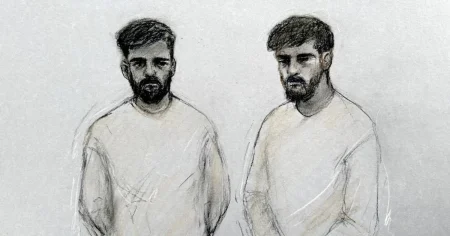




There are some court cases that sound more like psychological thrillers than family disputes, but every detail in them represents a real person’s life. This is the story of a woman in her early fifties and a man in his thirties, a couple whose relationship became the stage for a cruel and elaborate illusion. The woman admitted that she had convinced her partner she was pregnant twice, that she had given birth to two children, and that she had then sold those children for £500. The man, frantic and desperate, went to court to find out what had happened to his children. Instead, he learned something even more devastating: those children had never existed. She had never been pregnant. The ultrasound images were fake. The photographs were not photographs of his children. The baby’s cry he heard in a voice message was a YouTube video played in the background. She had even visited a tanning shop on the day she claimed to have given birth, so that her skin would look healthy and glowing, as if she had just come from the maternity ward. The deception was not a random moment of panic. It was a planned, layered performance that lasted for years. For the man, who had stood by her side during the first pregnancy in 2022 and had placed his hand on what he believed was her enlarged stomach, the revelation was not just about being lied to. It was about losing children who had never existed. For months, he had lived as an expectant father. He had imagined a future with a family. He had allowed himself to love someone who was nothing more than an illusion. And when that illusion collapsed, it took with it not only his trust, but also his memories of a time he thought was real.
Think about what it means to prepare for a child. The man felt her stomach grow. He heard her talk about the baby. He probably felt hopeful, anxious, and proud, the way any expectant parent might. She sent him photographs and an ultrasound, perhaps with loving messages attached. He had no reason to doubt, because he had been physically present. When the first baby was due in May 2023, the couple had a terrible argument. She called the police. He was arrested and held on remand for several months. From prison, he may have been terrified and helpless, wondering if he would ever meet his child. She sent messages to his stepfather saying the baby had been born. Then she sent her partner a voice message with a baby crying in the background. That simple sound, so natural to a new parent, was actually a YouTube clip of a baby crying, played in the room and recorded. It was a trick that exploited the most basic human response to a child in distress: the instinct to comfort, protect, and love. The woman also produced bank statements showing she had visited a tanning shop the day she was supposed to have given birth. Her skin was brown because she had tanned, not because she had experienced the exhaustion and joy of labour. Every detail had been thought out, from the visual evidence to the audio evidence, to make the impossible seem real. She was not simply telling a lie. She was constructing an alternate world, and she drew the man deeper into it with every message, every photograph, and every sound. She controlled the story completely, and he believed it because he wanted to believe it, because he loved her.
Why did she do it? The woman told the court that the pregnancy stories were not a random act of cruelty but a form of revenge for abuse she claimed she and her son had suffered at the hands of her partner. This is a complicated and painful detail. We cannot verify her accusations, and the judge’s ruling focused on the deception rather than on whether the past abuse was true. But if we try to humanize this story, we should acknowledge that humans often do terrible things when they are in pain, afraid, or desperate to regain control. The woman was menopausal at the time she was supposed to have given birth, which meant she knew her own body could not easily hide a real pregnancy. Yet she still chose to invent one. Perhaps she felt trapped in a relationship she could not escape. Perhaps she wanted to hurt him the way she felt she had been hurt. Perhaps she wanted to keep him attached to her through guilt, motherhood, and concern. The second pregnancy made this even more complex. She told him she had another baby in August 2024, the same month the couple split up. This was not a lie designed to bring them together; it was a lie designed to continue the emotional hold after the relationship had ended. For a man who had just been through police custody, a reported first birth, and a child he could not see, the second pregnancy may have made him feel obligated to her, concerned, or hopeful. It may have made him think there was still a chance to repair what was broken. She was not just lying about her body. She was lying about the future, about the family, about everything he loved.
The truth only came out when the man did something natural and heartbreaking: he went to court because he believed his children had been sold. That belief itself is horrifying. Imagine trying to explain in an official application that the mother of your children sold them for £500. Imagine saying the words out loud to a lawyer, trying to make sense of something that makes no sense. The judge, Mrs Justice Judd, examined the evidence and found no trace of any births. There were no records on the woman’s phone, no records with the local authority, and no records with the police. The relationship had resumed after the man was released from prison, and the woman continued the deception even then. She told him that the baby was with a family member and that the local authority had said he was not permitted to see her. She showed him many pictures of the baby, but she could not let him meet the child because the child did not exist. The judge concluded that the woman had engaged in a campaign of deception lasting for about three years in order to make the applicant believe that he was going to be, then was, the father of children. The judge also described the behaviour as cruel, leading a man and his mother to believe they had children and grandchildren respectively. The legal system, which should be a place of truth, was used as a stage for continued manipulation. The man’s love for his imaginary children had been weaponized against him. And even in court, there was no clean ending, because no one could say for sure why she had done it or how much harm had been done.
Let us pause and think about the emotional devastation underneath the legal coldness. This man was not just deceived once; he was deceived over and over for three years. He felt his baby kick, or thought he did. He heard a newborn cry, and his heart must have melted. He told his mother she was going to be a grandmother. He imagined his children growing up, taking their first steps, saying their first words. Then he was told that those children had been sold for £500. That sentence alone would break almost anyone. He spent months worrying, searching, grieving, and perhaps feeling guilty for not being able to protect them. Then he learned they had never existed. There were no children to rescue, no family to reunite, no photographs to cherish. The grief is different from losing a child; it is the grief of a real love that had no real object. The man’s mother also lost grandchildren she may have loved unconditionally before they were born. She may have knitted blankets, bought gifts, told her friends about her son’s growing family. The judge’s phrase “cruel” is exactly right. It is a quiet cruelty, not physically violent, but it attacks the very bonds of family and trust. This kind of psychological abuse can leave scars that are hard to see. A man may never be able to trust a partner again. He may wonder if his memories are real. He may question his own perception every time someone says they love him. And there is no grave to visit, no picture to hold, no child to bury. The loss is invisible, but that doesn’t make it less real. It may take years of counselling and support before he can feel whole again, and even then, the memory of the lie may never completely leave him.
Finally, this strange and painful case asks us to think about what drives a person to fabricate pregnancy, motherhood, and birth. The woman is not simply a monster. She is a human being who, for reasons that may never be fully understood, chose to build a false world instead of facing the true one. We cannot excuse her actions. The harm she caused was severe, and the court was right to identify it as a sustained and cruel campaign. But humanizing the story does not mean forgiving it. It means recognizing that both people in this terrible situation were trapped in a cycle of pain: he, trapped by love and hope; she, trapped by her own trauma or need for control. Some experts might recognize patterns of factitious disorder or other forms of compulsive deception, but we should be careful about diagnosing anyone from a news report. What we can say is that this case highlights how much we all need honesty, support, and healthy ways to resolve conflict. A relationship built on lies is not a relationship; it is a prison. A family built on false love is not a family; it is a tragedy. In the end, the truth came late, but important truth did emerge. The man finally knows that he did not fail his children, because there were no children to fail. He was not a father who lost his kids; he was a man who was manipulated by someone he loved. That distinction matters. It may help him heal. And for all of us, the lesson is simple: love must be grounded in truth. Everything else, no matter how beautiful the fake photos, how real the ultrasound, or how convincing the baby’s cry, is only shadow.