
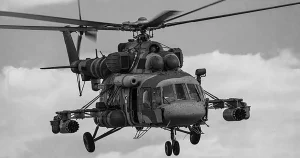

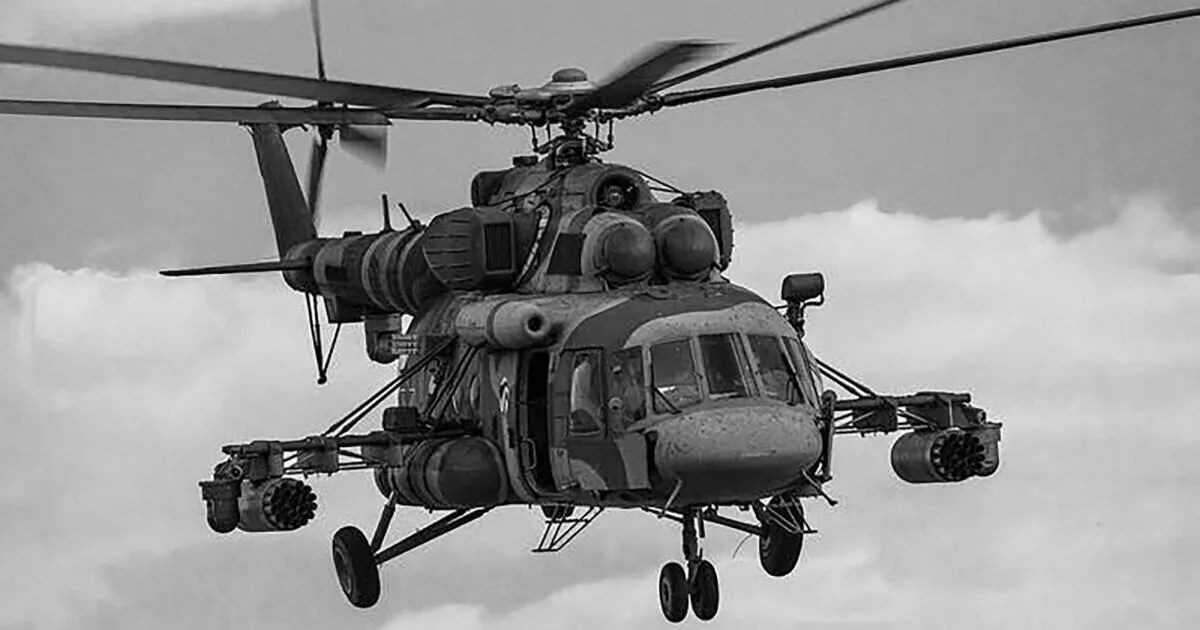
In an already brutal and exhausting conflict, there are moments that feel almost absurdly cruel. One of those moments unfolded recently over the Voronezh region of western Russia, where a Mi-8 military helicopter—a machine worth roughly £11 million and flown by a crew of three—was shot out of the sky. The weapon that destroyed it wasn’t a Ukrainian missile, nor a drone, nor any piece of NATO-supplied hardware. It was a missile fired by Russia’s own air-defense system. The helicopter had been sent up in an attempt to intercept and deter Ukrainian drones that were threatening the area. Instead, it was treated as an enemy aircraft and blown apart, killing the pilot, the navigator and the gunner in a matter of seconds. The loss is staggering both in financial terms and in human terms, but it is the shocking nature of the friendly-fire shootdown that has left even hardened Russian war supporters speechless—and furious. The Voronezh region, which lies close to the border with Ukraine, has become a frequent target for drone raids as the war has dragged on. Packs of Ukrainian drones, often cheap and crude but deadly, have penetrated deep into Russian territory, forcing the military to react quickly. On this particular day, the Mi-8 was the response. The crew likely took off with tension in their chests, scanning the horizon for small, buzzing threats. They probably never imagined that the missile meant for them would come from below, from the ground crews and radar operators who were supposed to be on their side. The air-defense battery that fired the missile may have been acting on a moment’s panic, or it may have been responding to a misidentified radar return. Either way, the result was the same: three dead, one aircraft scattered across the steppe, and a new wound opened in the already tattered relationship between Russia’s pilots and its air-defense forces. It is a stark reminder that in the fog of war, the most dangerous fire can sometimes come from your own side.
The three men who died were not abstract soldiers in a propaganda broadcast. They were a fully trained aircrew, each with years of experience, each with families who will now receive the kind of call that no military can ever soften. The pilot, the navigator and the gunner had climbed into their Mi-8 that day to do their job. The Mi-8 is a twin-engine transport and utility helicopter that has been in service since the 1960s, a sturdy, reliable machine often described as the backbone of Russian military aviation. It is not built for high-speed dogfights or complex electronic warfare; it is built to move troops, deliver supplies, support missions and, increasingly, to act as an aerial watchdog against drone threats. To lose such an aircraft is painful enough. To lose it to one’s own side, in a moment of panic or miscommunication, turns a routine sortie into a grave and avoidable tragedy. Every detail of the incident, reported by Russian outlets and picked up by international media, seems to deepen the sadness: the crew were defending their own homeland, and the very systems meant to protect them instead became their executioners. For their families, the pain will be doubled by the knowledge that they died not at the hands of an enemy but through a catastrophic mistake. There will be no heroic narrative of a last stand, no enemy pilot to blame, no clear reason that can ever make sense of their loss. The only narrative is one of incompetence, and that is a hard thing to live with. In a country where the official media still tries to spin the war as a special operation, where casualties are buried quietly and funerals are often private, the deaths of this crew may not even be acknowledged publicly in full. But the men who died had names, faces, histories—and all of that was erased in a split second over a dark field, by a missile that should never have been fired.
The fury that followed has been loud and visceral, especially among pro-war Telegram channels that once served as the most vocal cheerleaders for Putin’s invasion. These channels, often staffed by soldiers, veterans and military bloggers, are not pacifists. They support the war and want Ukraine to lose. But they are also brutally honest about mistakes on the Russian side, and this incident has pushed many of them over the edge. One channel wrote a post that seemed to tremble with anger: “I will not name the causes. The cause is a classic one, one that humanity is unlikely to ever manage to defeat.” The post then accused senior commanders of being “****ing morons.” The frustration is not random. It reflects a growing belief inside Russia’s military community that the high command is detached from reality, that it sends men and women to the front lines without proper coordination, and that friendly-fire incidents are becoming a terrifyingly common feature of a war now preparing to enter its fifth year in February. The anger is not just about one helicopter. It is about a system that seems to be cannibalizing itself. When those who support the war most loudly begin to call their own leaders morons, something is deeply wrong. The channels are filled with dark jokes and bitter commentary, with accusations of corruption, with demands for accountability, and with a sense of dread that the war is not going as well as the Kremlin pretends. They know that friendly fire is not a new phenomenon, but the frequency of these incidents suggests a military that is learning nothing, coordinating poorly, and losing control of the very battlefield it claims to dominate. For the men on the ground, it means dying in confusion. For the men in command, it means explaining another unacceptable loss.
This is not the first time such an incident has happened. In 2024, in a strikingly similar episode, a Russian stealth drone—an advanced and secretive aircraft worth an estimated £11.5 million—was shot down in a case of friendly fire. Footage emerged of two aircraft speeding across the sky over eastern Ukraine. The trailing plane, believed to be Putin’s Su-57 warplane, fired a missile at the other. The attacked aircraft exploded and plummeted to the ground in a ball of fire, while the Su-57 veered off to the side, its pilot apparently unaware that he had just killed his own ally. The drone was one of the most expensive pieces of equipment in Russia’s arsenal, a stealthy flying-wing design intended to evade enemy radar. That it was destroyed by Russia’s own premier fighter jet remains a bitter pill for military experts to swallow. The pattern is undeniable: when the sky is crowded with drones, missiles and aircraft, and when communication between air-defense units and pilots is disjointed, tragedy follows. And it follows more often in this war than in any modern conflict in recent memory. These incidents expose a dangerous irony. Russia has invested heavily in advanced military hardware, and yet the coordination between its own platforms is so weak that it cannot tell its own drones from its own fighters. The Su-57 is supposed to be Moscow’s most advanced warplane, a fifth-generation fighter designed to dominate the skies. But if it cannot identify a slow, expensive drone flying ahead of it, then what is it actually capable of? Military experts have pointed out that friendly fire is often underreported, and that the true number of such incidents in the war may be far higher than what appears in the media. Each case chips away at the myth of Russian military superiority, and each case adds to the growing pile of evidence that the Russian armed forces are fighting a modern war with outdated command structures and dangerous levels of confusion.
Behind these individual tragedies lies a deeper structural problem. Russia has been fighting a long and costly war in Ukraine, and the pressure on its military is enormous. Soldiers and airmen are being asked to do more with less, to react quickly to threats, and to operate in an environment where the front line is often blurred and the sky is full of hostile drones. In such chaos, “friendly fire” can seem almost inevitable. But the sheer frequency of such incidents, and the fact that senior commanders still refuse to learn from them, has led many to a harsher conclusion: the Russian military is not just overstretched, it is dangerously incompetent. The pro-war channels that expressed such rage are not enemies of the Kremlin; they are its most passionate defenders, and their frustration matters. They see billions of roubles being poured into the war effort, record military spending, and yet they also see expensive helicopters and drones being destroyed by their own side. They see commanders who seem more concerned with saving face than saving lives. And they sense, perhaps, that a military that cannot protect its own aircraft is one that cannot ultimately win a war. The timing makes this even more painful. As the conflict prepares to enter its fifth year in February, there is no end in sight, no peace plan, no turning back. Instead, there is only an endless grind, punctuated by absurd and horrifying moments like the downing of the Mi-8. Moscow has responded by increasing military spending by 27 percent, reaching a record £150 billion for the next year. That money is meant to buy security, to replace losses, to project strength. But no amount of money can buy back the confidence destroyed by friendly fire, and no budget can undo the message that these incidents send: that the Russian military is its own worst enemy.
In the end, the story of the Mi-8 is a story about the human cost of war in its most absurd and tragic form. There is no heroism in a friendly-fire death, no enemy glory, no strategic victory to explain it away. There is only waste—the waste of three lives, the waste of an £11 million machine, and the waste of a military doctrine that cannot distinguish friend from foe. The phrase that the Telegram channel used—”a classic one, one that humanity is unlikely to ever manage to defeat”—speaks to something profound. Friendly fire is as old as warfare itself, a sad and unchangeable part of how humans fight. But knowing that does not make it easier for a wife to lose her husband, for children to lose their father, or for a nation to wake up and realize that its own protectors are falling from the sky. As the war in Ukraine prepares to enter its fifth year, with no end in sight, incidents like these remind us that the deepest wounds of conflict are not always inflicted by the enemy. Sometimes they are inflicted by the people on your own side. And those wounds, once inflicted, can never be healed, only mourned. The crew of the Mi-8 went up to protect their country. They died under the banner of a military that mistook them for the enemy. In the months and years to come, their names may be forgotten, buried in a news cycle that never stops turning. But for their families, the pain will not fade, and for the soldiers and pilots who continue to fly into the chaos, the knowledge that they might be killed by their own side is now an unavoidable part of the mission. That is the real tragedy of friendly fire: it does not just kill people. It kills trust. And without trust, a military is just a collection of frightened people waiting for the next mistake.