

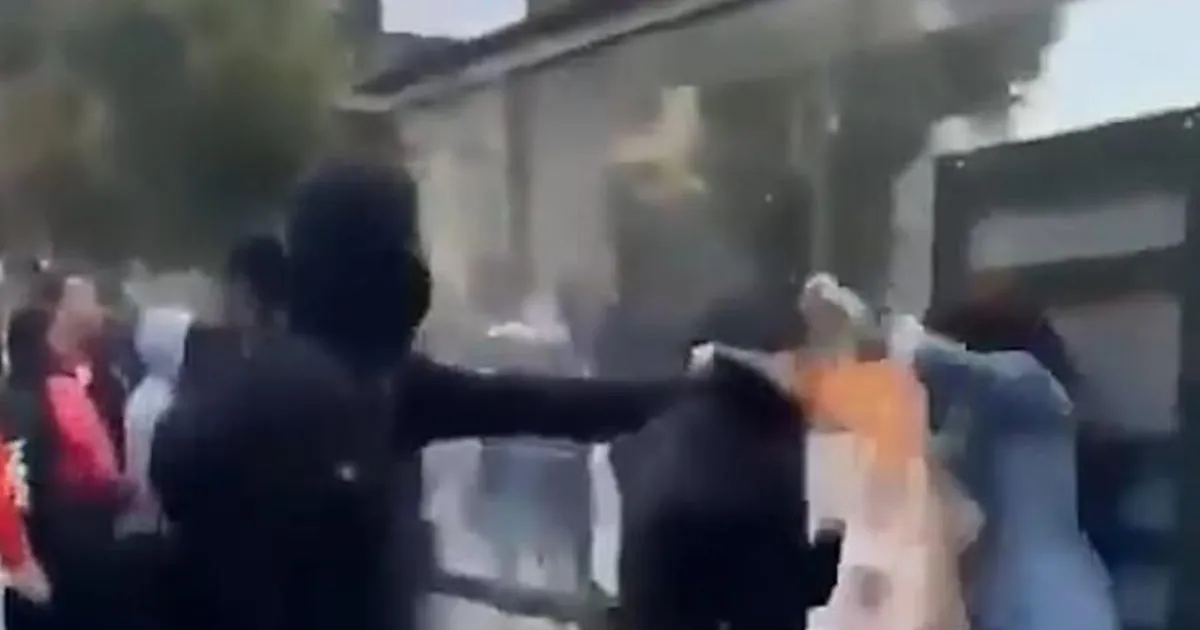
A quiet morning at a bus stop in Marseille turned into a scene of sheer terror yesterday, as a woman was attacked with a makeshift flamethrower by a masked protester during escalating school demonstrations across France. Police have now launched a manhunt for the individual, who was seen on shocking video pressing the nozzle of an aerosol spray can in front of a lighter and directing a burst of fire directly at the woman’s face. The incident unfolded near Place du 4 Septembre, a busy public square in the southern port city, where protests had intensified throughout the day. The footage, filmed by horrified onlookers, shows the woman engaged in a tense tug-of-war over a metal barrier with a group of masked protesters. Moments later, a hooded figure dressed entirely in black steps forward, ignites the improvised weapon, and calmly walks away after the attack, leaving the woman reeling as screams fill the air. It is a violent, senseless moment that has sparked outrage across the country, not only because of the brutality captured on camera, but because of what it represents: a school system in crisis, young people at the breaking point, and a protest movement that is increasingly veering into dangerous territory. The woman, whose name has not been released, reportedly filed a formal complaint with police in Marseille earlier today, and her friends are now pleading for witnesses to come forward to help identify the attacker. For now, the search continues, but the images of that burning spray have already seared themselves into the public consciousness.
The attack did not happen in a vacuum. It came at the tail end of weeks of unrest that began in the Paris region in late September before spreading like wildfire to cities across France. At the heart of the movement are secondary school pupils, mostly aged fifteen to eighteen, who have taken to the streets with a list of demands that many adults would find entirely reasonable: more teachers, better-funded schools, action on overcrowded classrooms, and urgent repairs to run-down facilities. They are also pushing back against the crushing pressure of long timetables and the anxiety-inducing university admissions platform known as Parcoursup, which many students say has become a source of deep stress and uncertainty about their futures. For years, students and educators alike have warned that the French education system is being stretched to its limits, with crumbling infrastructure, overworked staff, and too many pupils squeezed into too few classrooms. The protests were initially peaceful, a cry for help from a generation that feels neglected. But as the movement gained momentum, it also attracted a more chaotic element. Some demonstrations have descended into clashes with police, vandalism of public property, and the lighting of fires. What began as a plea for better schools has, in some places, morphed into scenes of urban disorder. And it is within that volatile environment that yesterday’s horrific attack took place, turning a protest about education into a moment of real violence and leaving many to wonder where the line between activism and lawlessness has gone.
The footage of the attack itself is harrowing to watch, even in still frames. The woman appears to have been waiting for a bus when a group of young protesters, some wearing masks, began wielding a metal barrier and attempting to smash up the bus shelter. It is not clear why she got involved, but according to friends, she tried to intervene, stepping forward to block the destruction and reason with the young people. What happened next was a brutal betrayal of that courage. As she struggled with the barrier, a hooded individual, clad from head to toe in black, approached. In his hands was an aerosol spray can and a lighter. He sprayed the flammable contents into the air, ignited it, and aimed the resulting jet of fire at the left side of her face from close range. Onlookers screamed, some covering their mouths in disbelief. The attacker, seemingly unfazed, turned and walked away, disappearing into the crowd as if nothing had happened. The woman’s friends rushed to her side, terrified that she had been seriously burned. In the chaos that followed, firefighters and gendarmes arrived at the scene and provided immediate assistance. Fortunately, the injuries were not as severe as they could have been. The woman sustained first-degree burns, enough to cause pain and shock but not permanent disfigurement. Still, the emotional trauma of having her face set alight by a stranger during a protest cannot be measured in degrees. It is an image that will likely stay with her for a lifetime, and a reminder of how quickly a demonstration can turn dangerous when anger is armed with nothing more than everyday objects turned into weapons.
In the aftermath of the attack, the victim’s friends have been vocal in their search for justice. One friend, who was present during the incident, shared a statement pleading for witnesses to come forward. “This morning, we were waiting for the bus when, all of a sudden, among the high-school students, some stupid girls took the metal barrier and started trying to smash up the bus shelter,” the statement read. “My friend tried to stop them, blocking them and talking to them. She was violently attacked, and one of them burned the left side of her face by spraying her with a spray and using a lighter.” The friend also expressed relief that the burns were not more serious, noting that the firefighters and gendarmes intervened quickly. But the plea was also a call for accountability. The friend specifically asked for anyone who saw what happened to come forward, especially a woman wearing a black vest who was described as the only person to intervene before the attackers fled. “I hope the CCTV camera was working,” the friend added, capturing the desperation of ordinary citizens who feel that without video evidence, such acts of violence might go unpunished. The statement paints a picture of a chaotic scene in which bystanders were caught off guard by the sudden escalation. It also highlights the courage of the victim, who did not stand by while public property was destroyed, but instead paid a painful price for her willingness to step up. As police continue their investigation, the search for the masked attacker and any accomplices remains ongoing, and authorities are likely combing through surveillance footage and social media posts to piece together the identities of those involved.
The protests themselves have become a defining moment for France’s youth. What began as a localized grievance in the Paris region has evolved into a nationwide movement, with high school students at its core and university students increasingly joining in. The demands are clear and deeply rooted in the daily realities of French education. Teachers are overworked, classrooms are overflowing, and many school buildings have fallen into a state of disrepair that is both demoralizing and, in some cases, unsafe. Students speak of long hours, heavy backpacks, and the constant pressure of exams and university admissions. Parcoursup, the online platform that matches students with university programs, has become a particular source of frustration. Many young people describe it as a stressful lottery, one that can determine their futures based on algorithms and quotas rather than their own abilities and ambitions. For those with less access to guidance or resources, the system can feel especially cruel. It is no surprise, then, that so many students have taken to the streets, demanding not just better facilities but a genuine investment in their futures. Yet the movement has also been marred by incidents of violence and vandalism, actions that risk alienating the very public support the students need. The attack on the woman in Marseille, carried out in the name of a protest that was supposed to be about education, has left many feeling conflicted. It is possible to understand the frustration behind the demonstrations while still condemning the brutality of what happened. The challenge for the movement now is to reclaim its voice, to separate itself from the masked provocateurs who turn peaceful protests into scenes of fear, and to refocus on the issues that matter before more innocent people are hurt.
As the manhunt for the masked attacker continues, France finds itself at a crossroads. The image of a woman being burned in the street is a stark reminder of how quickly collective anger can spiral into individual violence. It forces a difficult conversation about the nature of protest, the responsibilities of young people, and the role of a society that has allowed its education system to reach such a breaking point. There are no easy answers. The students who march for better schools are not wrong to demand change, and their frustration has been simmering for years. But the actions of a few violent actors threaten to overshadow the legitimate grievances of the many. For the victim, yesterday’s attack was not a political statement; it was a terrifying, painful assault that could have left her scarred for life. For the witnesses, it was a moment of helplessness, a reminder that even a routine wait for a bus can be shattered by the chaos of the streets. For the protesters who believe in a better education system, it is a tragedy that their cause is now associated with a flamethrower and a woman’s burned face. In the days to come, police will work to identify the attacker, and the courts will decide what justice looks like. But beyond the legal outcome, there is a deeper need: the need for France to listen to its students before their frustration turns into fury, and to address the crumbling schools and anxious futures that drive them into the streets in the first place. The woman at the bus stop should never have been caught in the crossfire. And the young people who should have been in classrooms, not masks, deserve a future that does not turn their desperation into violence. For now, the tears have been wiped away, the burns treated, and the complaint filed. But the scars on a wounded generation, and on a nation watching itself tear apart, will take much longer to heal.