

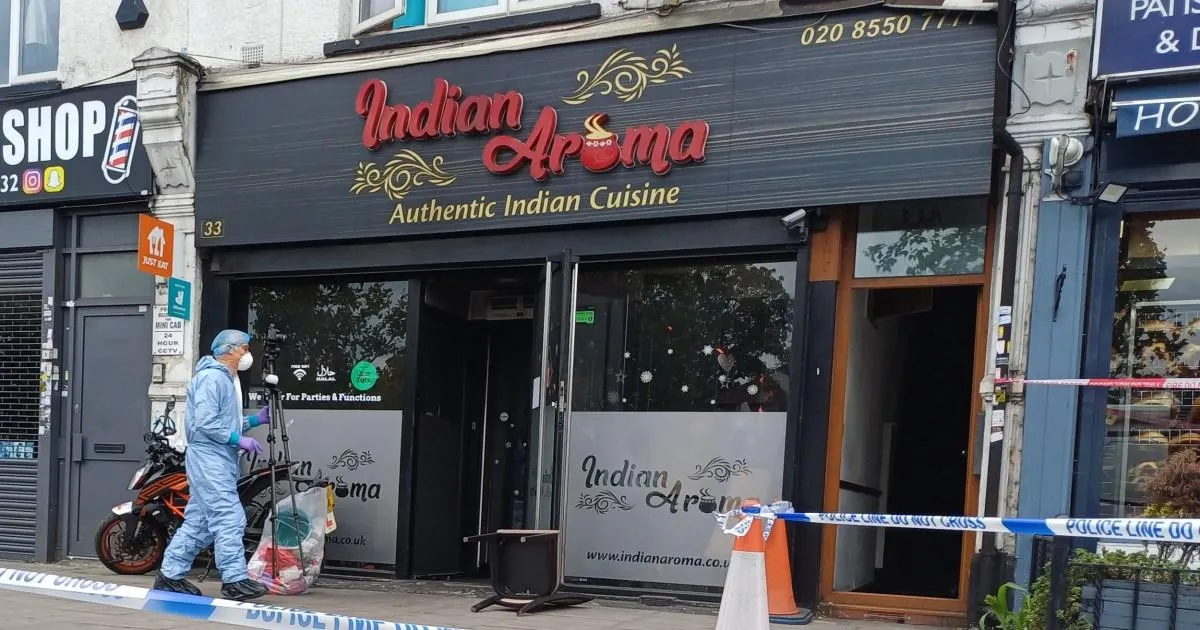
On the evening of 22 August, the Indian Aroma restaurant on Woodford Avenue in Gants Hill, east London, was a picture of ordinary life. Eight diners had come together for a meal, perhaps celebrating something small, perhaps simply finding refuge from the demands of a busy day. Laughter and conversation filled the room, and the warm smells of spices and cooking food created a sense of comfort that most people take for granted. At around 9pm, that comfort was shattered. The front door burst open and three figures stormed inside, armed with menacing long knives and swords. What followed was not a botched robbery or a sudden argument. It was a carefully planned act of violence, designed to terrify, injure, and possibly kill people who had done nothing wrong and were complete strangers to their attackers. The two teenagers now facing justice were part of that group, and while a third accomplice made his way to the back of the restaurant and began emptying containers of petrol across the floor and over the tables, the teenagers stood guard. They held the door mostly shut, trapping the diners in a room that was rapidly filling with the sharp, chemical smell of fuel. The customers were frozen in terror, unable to process what was happening. Then someone lit a slip of paper. The petrol ignited with an explosion that turned a peaceful dinner into a nightmare, engulfing some of the people in flames and leaving others with agonising burns. The attackers fled in a stolen car, leaving behind screams, chaos, and a scene that would require six London Fire Brigade vehicles to bring under control. In just a few minutes, a place that had been a symbol of hospitality became a scene of horror, and the lives of eight innocent people were changed forever.
The prosecution later described this attack in terms that made clear it was no accident and no moment of madness. The preparation, according to prosecutor James Dawes KC, was extensive. The execution was professional, and each offender had a separate, well-defined role. These were not teenagers who had simply run wild; they were carrying out an operation that had been planned and rehearsed, moving through the restaurant with a chilling sense of purpose. The two teenagers were armed with machetes and swords, weapons intended not just to threaten but to control. They ordered the customers to remain in their seats, ensuring that nobody would be able to escape the fuel that was being poured around them. The accomplice moved quickly, liberally spreading petrol on the chairs where the diners were sitting, drenching the very surfaces that should have been safe. Petrol was everywhere, and the attackers knew exactly what they were doing when they reversed out of the room, held the door mostly shut, and lit a piece of paper. The explosion that followed was not a random outcome; it was the intended result. In the words of the prosecutor, the customers were guaranteed to suffer burns. They sat frozen in terror as the flames took hold, and the physical damage was catastrophic. Even the judge, after reviewing the CCTV footage, noted that some details were debatable, such as whether petrol was poured directly onto the back of one customer. But that distinction did not matter. The fuel was spread around the chairs of the diners, and when the fire was lit, the injuries were inevitable. The attackers did not pause to reconsider. They did not stop to help. They simply left the scene, driving away in a stolen car as the fire began to consume the restaurant and the people still inside it.
The human cost of that night cannot be measured in charges or sentences. Among the eight victims was a woman whose injuries were so terrible that she was placed into a medically induced coma. Her clothing had melted into her skin, and she suffered burns covering 50% of her total body surface area, with 45% classified as full-thickness burns, meaning the damage went deep into the layers of skin and tissue beneath. Her husband was seen running out of the restaurant on fire, desperately trying to escape the flames that had become part of his body. He suffered mixed-depth burns covering 51% of his body, and in a victim statement, he explained that he woke up 45 days after being burnt. Forty-five days of unconsciousness, of uncertain survival, of a family waiting and wondering whether he would ever open his eyes again. Their lives, the prosecutor said, have been completely transformed by the ordeal. Another victim described herself before the attack as an independent woman with plans, prospects, and hope. Now, she said, she has a life that has been completely upended by 30 seconds of someone else’s violence. That phrase stays with you: 30 seconds. That was all it took for a group of strangers to destroy the life she had built. Another customer described the agonising physical pain felt during the incident, the kind of pain that no one should ever have to experience. These are not merely numbers in a court report. They are real people who went out for a meal and ended up in an inferno. They have endured surgeries, skin grafts, months of rehabilitation, and psychological scars that may never fully heal. The judge was right to say that it could have been worse. It could have been fatal. The fact that everyone survived does not diminish the severity of what was done; it only means that the victims carry their trauma every day, rebuilding lives that were shattered in a single, horrifying moment.
The legal process eventually brought the two teenagers to justice. They had denied the offences, but after a six-week trial earlier this year, they were convicted of arson with intent to endanger life and having a bladed article. One of them had also pleaded guilty at an earlier hearing to the additional charge of failing to disclose a PIN. On Friday, at the Old Bailey, His Honour Judge Michael Grieve KC sentenced them. He handed each an extended sentence of ten years in custody, with a further three years extended licence period. It is a significant punishment, but the judge’s words carried even more weight than the number of years. He described the attack as a sophisticated and professional operation, one that involved a high degree of planning. He told the teenagers that they were both fully aware of the almost inevitable consequences: the intention was to cause serious harm, up to and including death, to complete strangers. He spoke directly to the suffering of the victims, saying they had experienced agonising and life-changing injuries, and that it could have been worse. Perhaps most strikingly, the judge acknowledged that these two young men were not necessarily the masterminds behind the crime. He said he had no doubt that they were carrying out the operation on the direction of some older and more experienced criminal who had not been identified. But he did not let that fact diminish their own responsibility. They did so with cold blood, he said. Those words are hard to hear, but they are important. They remind us that even young people can make decisions that cause enormous harm, and that being manipulated by others does not erase the choices they made when they walked into that restaurant with weapons and petrol.
The sentencing hearing also revealed the painful complexity beneath the surface of the case. Mark Graffius KC, representing one of the teenagers, invited the judge to draw the reasonable inference that his client was subject to ongoing exploitation up to and until the offence. This was a young person, likely used by older criminals who saw him as disposable, a pawn who could carry out dangerous work and then be abandoned when the police arrived. Nneka Akudolu KC, representing the other teenager, said her client was sorry for the painful and life-changing injuries that the victims had suffered. She added that he had been told the restaurant would be empty. That last detail is deeply unsettling. It suggests that the boy believed he was participating in an act of destruction against property, not against people. He may have thought he was setting fire to a building, not to human beings. But the reality was that people were there, and he was armed, and he took part in a plan that involved pouring petrol around chairs and tables and then igniting it. Even if he was told the restaurant would be empty, he must have known that there was a risk. And when the diners were found to be present, he did not stop. He did not warn them. He did not refuse to continue. He went through with it, and people suffered terribly because of that choice. The judge recognised the possibility of exploitation, but he also recognised that the teenagers acted with cold blood. This is not an easy balance. Teenagers are still developing their sense of judgment, and they are vulnerable to pressure from adults who know how to exploit their desperation, their loyalty, or their fear. But the law also has to protect innocent people, and the community, and to send a message that certain acts are so grave that they cannot be excused, no matter who holds the matches.
In the wider community of Gants Hill and Ilford, this attack has left a painful mark. Restaurants are not just places to eat; they are gathering spaces where people celebrate birthdays, forge friendships, and share intimate conversations over plates of food. To turn such a space into a fiery trap is to violate something sacred in everyday life. The emergency services who responded to the scene faced a horrific challenge: flames, smoke, injured people running out of the building, and the knowledge that lives were hanging in the balance. The six fire engines that arrived were not just a logistical detail; they were a sign of how serious the situation was. Firefighters, police officers, and paramedics all reacted with professionalism, but they too carry the weight of what they saw that night. As for the survivors, their journey is far from over. They must continue to live with the physical scars, the limited mobility, the ongoing surgeries, and the psychological reminders that can appear at any moment, perhaps when they smell petrol or see a flame or simply try to sit down in a crowded room. The ten-year extended sentence handed to the teenagers is a substantial punishment, but no sentence can undo what happened. It cannot give the woman back the skin that was burned away. It cannot give her husband back the 45 days of his life that he lost to unconsciousness. It cannot restore the independent woman’s plans, prospects, and hope. What the sentence can do is acknowledge the seriousness of the crime, provide some measure of justice to the victims, and protect the public from these particular individuals for a significant period. It also leaves a lingering frustration, because the older and more experienced criminal who allegedly directed the operation has not been identified. As long as that person remains free, the full truth of this attack has not yet been uncovered. For the victims, the hope is that they can now begin to heal, slowly and on their own terms, knowing that their voices were heard, their suffering was acknowledged, and the two young men who helped set them on fire have been held accountable. The road ahead will be long, but the night that changed everything has at least reached a point of justice, and that matters more than any number of years behind bars.