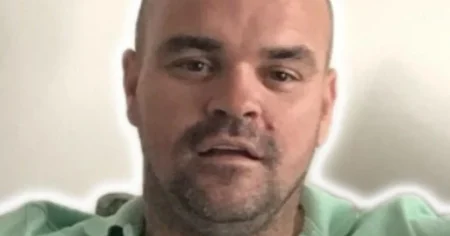


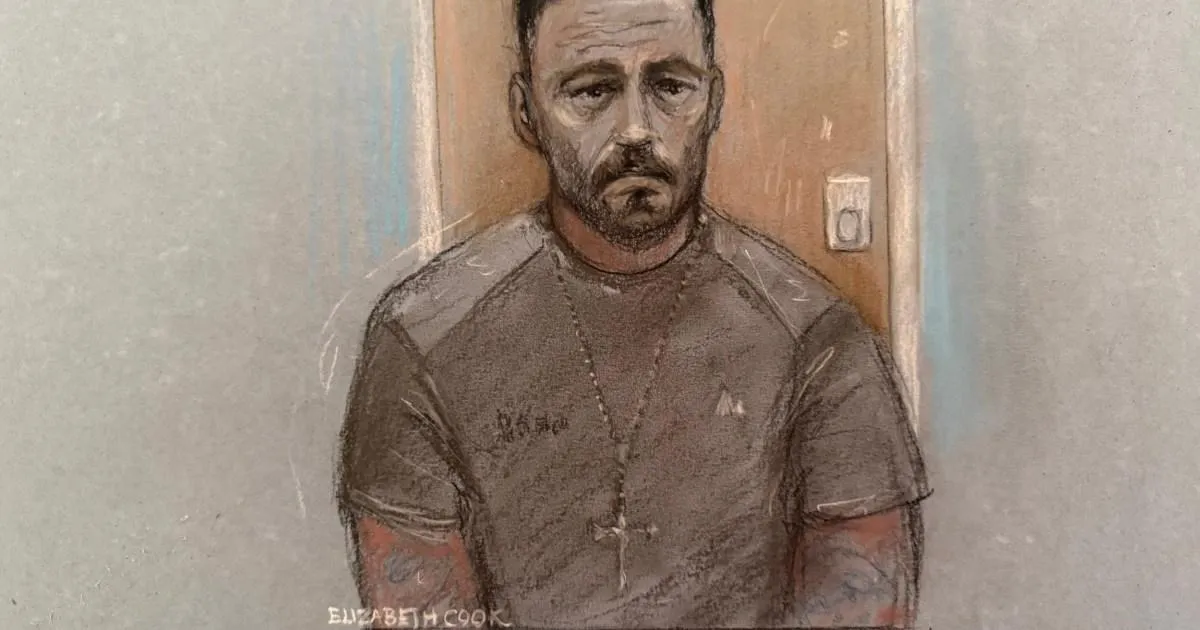
At Margate Magistrates’ Court in Kent, the video-link screen flickered to life, and Daniel Thomas appeared from custody. The 37-year-old anti-migrant activist, widely known as Danny Tommo, wore a grey T-shirt and rosary beads, a small human detail captured by the court artist in an otherwise impersonal remote hearing. District Judge William Nelson listened as Thomas confirmed his identity and heard the charges read out. The hearing was brief but consequential. Thomas had already pleaded guilty at a previous appearance on August 27 to entering a restricted zone at Western Jet Foil in Dover on March 31. On this day, he denied further allegations: using threatening words or behaviour in Dover on April 1; obstructing a person engaged in a lawful activity on April 6; entering or remaining in Dover Docks without lawful business or permission on April 1 and April 6; and racially aggravated harassment by allegedly using threatening or abusive words likely to cause harassment, alarm or distress on April 1. The case was sent to a further case management hearing at Westminster Magistrates’ Court on November 4. The courtroom, a place of formal routine, seemed to shrink under the weight of the details. For all the legal jargon, the charges are about real events, real places, and real people. Thomas’s video-link appearance meant that he was not physically present, but his image hovered on the screen, a reminder that behind every case is a person whose life is suspended while the law takes its course. His grey T-shirt and rosary beads offered a glimpse of a man outside the courtroom, someone who might pray, who might carry a faith with him into the bleak environment of custody. The judge, in a measured voice, scheduled the next hearing and Thomas disappeared from the screen, leaving the court to move on to the next case. But for Thomas, the wait continues. He remains in custody, accused of a series of offences that could lead to years in prison if he is convicted. The presumption of innocence, a cornerstone of the British legal system, is often hard to feel when you are watching from a cell. Yet the law requires that he be treated as innocent until proven guilty, however uncomfortable that may be for those who have strong opinions about him.
To understand the charges, one must understand the setting. Western Jet Foil is not simply a ferry terminal; it is a processing centre for people rescued from the English Channel after attempting to cross in small inflatable boats. It is a site of immense political and emotional weight, surrounded by high fences, security cameras and uniformed officers. A restricted zone exists there for operational and safeguarding reasons; entering it without permission is a serious matter. Thomas’s guilty plea places him inside that cordon on March 31, a day when border force officials were likely processing vulnerable migrants. The additional charges relate to a series of incidents in Dover itself over the following week. On April 1, he allegedly used threatening words or behaviour. On April 6, he allegedly obstructed someone carrying out a lawful activity. He is also charged with being inside Dover Docks without lawful business on April 1 and April 6, and with racially aggravated harassment for words or actions directed at a person who might reasonably have felt harassed, alarmed or distressed. These charges cover a period of sustained confrontation, suggesting that Thomas’s presence in Dover was not accidental but part of a planned campaign of protest. The law does not forbid dissent, but it does forbid crossing certain lines: threatening people, obstructing workers, trespassing in secure areas, and engaging in behaviour that can be seen as racially aggravated. Thomas denies all of these, and his denials mean that the prosecution will have to prove each element beyond reasonable doubt. The Crown Prosecution Service will need to present evidence that is credible, specific and sufficient to convince a jury. The defence, meanwhile, will likely argue that Thomas’s actions were either lawful or not what they seem, and that the allegations have been exaggerated or distorted for political reasons. The courtroom is not a place for moral panic; it is a place where facts are tested, witnesses are cross-examined, and justice is sought with the dispassionate rigor that the law demands.
The most serious allegation, however, came later. On September 22, Thomas was arrested and later charged with criminal damage to a boat in the English Channel. The prosecution alleges that he slashed the boat while an emergency responder was on board. The image of a damaged boat in one of the busiest shipping lanes in the world is alarming. Emergency responders risk their lives to save people in distress, and any act that endangers them is treated with utmost gravity by the courts. Thomas denies the charge. He also denies failing to disclose the PIN to his mobile phone to police, an offence under Section 53 of the Regulation of Investigatory Powers Act 2000. In an age of digital evidence, the refusal to provide a password or PIN can hinder investigations and is itself a criminal offence, separate from any underlying crime. The potential sentence for the criminal damage charge depends on the value of the damage. If the boat was damaged beyond £5,000, a conviction could carry up to ten years’ imprisonment, according to the Sentencing Council. If the damage is assessed at less than £5,000, the maximum sentence is a fine and three months’ custody. Given the seriousness of the allegations, Thomas has been remanded in custody. He now faces the bleak possibility of spending Christmas behind bars while waiting for his trial next year. His barrister, in a brief statement outside court, described the criminal damage allegation as “politically charged and fundamentally flawed”, signalling that the defence will challenge both the facts and the motives behind the prosecution. It is a striking phrase, one that invokes the wider debate about whether activists are being unfairly targeted by the state. But it is also a reminder that the legal system is not immune to political pressure, and that courts must be especially careful when the defendant holds unpopular or controversial views. The law is supposed to protect everyone, even those whom many people dislike, and that is a principle worth defending.
Behind the headlines and the court appearances, Daniel Thomas is a man with a life beyond the label of “activist”. The rosary beads around his neck suggest a faith that may be deeply personal. He is known publicly as Danny Tommo, a name that carries a certain bravado, but in the courtroom he is simply Daniel Thomas, a defendant facing serious charges. The transition from online persona to prisoner is stark. A video-link hearing means he sits in a bare room, far from the public gallery, with no physical presence in the dock. The court artist’s sketch captures a man who appears calm, his grey T-shirt and beads the only markers of his identity. His barrister’s claim that the case is politically charged speaks to a wider fear among some activists that the state is using the law to suppress dissent. Whether or not that is true, Thomas is entitled to the presumption of innocence. He has not been convicted of the crimes he denies, and the burden of proof rests with the prosecution. The justice system is designed to protect the vulnerable from the powerful, but it is also designed to ensure that even the most unpopular defendants receive a fair trial. Thomas’s case will test that principle. It is easy to see him as a symbol, either of resistance or of recklessness, but he is also a son, possibly a father, a friend, a man whose choices have led him into a courtroom and now a cell. Humanizing him is not to excuse any wrongdoing, but to remember that every defendant is more than the charges they face. The public may never know the full story of why he became so involved, or what he thought when he decided to cross the line, but that does not stop him from being a human being with hopes, fears and regrets like anyone else.
The case cannot be separated from the broader national debate over migration. Dover has become a frontline town in an ongoing crisis, with small boats crossing the Channel almost daily, bringing people fleeing war, poverty and persecution. The presence of migrant processing centres has galvanised local communities, who are asked to accommodate large numbers of newcomers, and activists from across the political spectrum have descended on the town to protest or support. Western Jet Foil and Dover Docks are not abstract locations; they are the physical gateways where people’s lives hang in the balance. The line between lawful protest and criminal conduct is often thin. Activists may block roads, shout at officials, or hold vigils, and the police must decide when a protest becomes an obstruction. Thomas’s alleged actions, if proven, went beyond holding a sign or chanting slogans. Entering a restricted zone, obstructing lawful activity, and using abusive words are direct challenges to the legal framework that governs the area. Yet the defence will argue that the charges are disproportionate and politically motivated. In a democracy, the right to protest is fundamental, but it is not absolute. The courts must weigh the rights of protesters against the rights of others to work, to be safe, and to go about their lives without fear. This tension is at the heart of Thomas’s case, and it will be decided not in the court of public opinion, but in a courtroom, under the rule of law. The coming months may see more protests, more heated rhetoric, and more attempts to influence the outcome, but the jury will be instructed to decide the case solely on the evidence presented. They will hear from witnesses, examine documents, and consider the legal definitions of each offence. They will not be asked to solve the migration crisis or to take sides in a culture war. They will be asked a much simpler question: did this defendant commit these crimes, and if so, what is the appropriate punishment?
As the legal process moves forward, the human cost remains visible. Thomas will spend the coming weeks in custody, awaiting the next hearing at Westminster Magistrates’ Court on November 4. His trial, likely next year, will examine the events in Dover and the English Channel in painstaking detail. If he is convicted, he could face a substantial prison sentence, especially for the criminal damage charge. If he is acquitted, he will walk free, though the months spent in prison will never be returned. Whatever the outcome, this case has already become a flashpoint in the migration debate. Supporters see Danny Tommo as a man willing to go to prison for his beliefs; critics see Daniel Thomas as someone who crossed the line from protest into crime. The truth, as always, lies somewhere in the evidence. But behind the political symbolism is a human being, sitting in a cell, wearing a grey T-shirt and rosary beads, waiting for the law to decide his fate. The justice system is not always perfect, but it is the best protection we have against both chaos and tyranny. In treating Thomas fairly, the courts will affirm that no one is above the law, and no one is beneath it. That is the real story of this case: not just one man’s downfall, but the enduring principle that justice must be blind, even in the most politically charged circumstances. For now, Daniel Thomas remains a defendant, not a convicted criminal, and his fate rests in the hands of a process that will decide, with as much humanity as the law allows, what happens next.