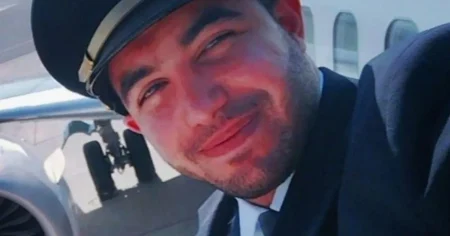



On a seemingly ordinary Wednesday afternoon, passengers aboard Flydubai Flight 1073 settled into their seats for a routine journey from Dubai to Tel Aviv, expecting nothing more than a short hop across the region. Instead, they found themselves at the center of a terrifying ordeal that would turn a commercial flight into a scene of chaos, fear, and quick-thinking bravery. According to the Emirati attorney general, the flight’s co-pilot, 29-year-old Hamam al-Hammami, suddenly attacked the captain, Capt. Smit Machchhar, inside the locked cockpit using a crash axe—a tool kept in the flight deck for emergency situations. The assault caused the aircraft to plummet thousands of feet, sending alarms blaring and passengers gripping their seats as the plane lurched downward. A handful of passengers, realizing something was desperately wrong, stormed the cabin and managed to subdue the attacker, while the crew squawked emergency distress signals and diverted the plane to Tabuk Airport in Saudi Arabia. The captain, injured but alive, was treated at the scene, and the flight was ultimately grounded with more than 170 passengers, most of them Israelis, shaken but safe. The suspect was taken into custody in Abu Dhabi, and the world began to ask a disturbing question: who was this man, and what led him to such an act?
As details emerged, the portrait of Hamam al-Hammami became more unsettling. He was not a stranger to the world or a shadowy figure operating on the fringes of society; he was, on paper, a professional pilot with a civilian career and a connection to a British university. Buckinghamshire New University confirmed that al-Hammami had been studying for a distance-learning degree in aviation management at the time of the alleged attack. The university was quick to clarify that he had not undertaken any pilot training there, but the link to a respected institution nevertheless added a layer of complexity to the story. A since-deleted LinkedIn profile, which appeared to belong to him, also claimed he studied at the university, though it did not mention any employment with Flydubai, the Emirati government-owned low-cost airline. The profile was later removed, as were his social media accounts, leaving behind only fragments of a digital footprint that investigators and journalists would soon piece together. The image that emerged was of a man who had access to education, a career in aviation, and the trust that comes with sitting in a cockpit—and yet, beneath that surface, there were signs of a deeply troubling mindset.
Those signs became impossible to ignore when archived social media posts, first reported by The Telegraph and seen by Metro, surfaced online. An X account bearing al-Hammami’s name, with the handle @PilotHamam, described him as a civilian pilot living in Muscat, Oman. The account was active in 2022, while he was reportedly studying in the UK, and it contained a stream of misogynistic, hateful commentary that seemed to reveal a man seething with contempt for women. In one exchange, a female user described how her husband had discovered she had been texting a man she once loved. Al-Hammami replied with shocking brutality: “I’d stomp on your head, wipe the floor with you, make you an example to others and then divorce you :).” The casual smiley face made the words even more chilling, as though violence and domination were matters of amusement. In another post, he appeared to endorse striking a woman, writing that a man “gave her a pre-emptive slap so she would redefine her boundaries, just as Russia slapped Ukraine to adjust its borders :).” He added that if she “so much as breathed” he would “stomp her head.” These were not offhand remarks; they were a pattern, a window into a worldview where women were objects to be controlled, punished, and silenced.
The archived posts went beyond violent fantasies and delved into predatory behavior. The account holder bragged about creating dating profiles to get Saudi women to send pictures of themselves, boasting, “I asked women to send me nudes and they did it. Cheap whores!” He referred to women from the Gulf as “stupid” and mocked a man as a “simp”—a slang term used to disparage men who show women sympathy or attention—after that man expressed compassion toward a woman. His venom extended to the LGBTQ+ community as well; he called being gay an “injustice” and “deviant behaviour.” Reading these posts in sequence, one sees a person who seemed to view human relationships not as connections but as battles for dominance, and who took pride in manipulation and cruelty. The fact that he was pursuing a degree in aviation management while writing these things raises uncomfortable questions about how such attitudes can coexist with professional responsibility. It also highlights the ways in which online spaces can become echo chambers for hatred, where users find validation for their darkest instincts and gradually lose any sense of accountability. For those who knew him only as a colleague or classmate, there may have been no visible signs—or perhaps there were signs that no one wanted to see.
After the failed hijacking attempt, the digital trail took another disturbing turn. CNN reported that two posts appeared on the since-deleted LinkedIn profile following the attack. One depicted a photograph of Ayman al-Zawahiri, the jihadist who led Al Qaeda after Osama bin Laden’s death. The image was a stark suggestion of ideological alignment, and Israeli Prime Minister Benjamin Netanyahu was quick to link the incident to “Islamist radicalisation.” While investigators have not yet fully established al-Hammami’s motives, the combination of his violent social media history, his apparent admiration for a terrorist leader, and his alleged actions on the flight paints a troubling picture. The response from authorities and institutions has been measured but firm. Flydubai has not publicly commented on the pilot’s employment status beyond confirming the incident, and the Emirati attorney general has described the attack in detail, noting that the co-pilot attempted to take control of the aircraft’s flight controls after assaulting the captain. The university expressed concern for the injured pilot, crew, and passengers, but otherwise distanced itself from al-Hammami, emphasizing that he was not trained as a pilot there. Meanwhile, the passengers who subdued the attacker have been hailed as heroes, and the captain’s survival is a testament to his resilience and the quick response of those around him.
This incident forces us to confront uncomfortable truths about radicalization, mental health, and the hidden lives of people we trust with our safety. It is easy to imagine a pilot as a paragon of calm and competence, but the reality is that human beings are complex, and sometimes deeply troubled individuals slip through the cracks. The archived posts are a reminder that hateful rhetoric online is not always harmless venting; it can be a precursor to real-world violence. At the same time, we must be careful not to leap to conclusions before the full investigation is complete. The legal process will determine al-Hammami’s fate, and the victims of this attack—especially Capt. Machchhar, who suffered physical injuries and unimaginable stress—deserve justice and support. For the passengers on Flight 1073, the trauma will likely linger for years; they will replay those terrifying moments when the plane plunged and they had to decide whether to storm the cockpit. Their bravery should not be forgotten. Nor should the broader lessons: the need for better screening of aviation personnel, the importance of monitoring extremist content online, and the responsibility of institutions to take seriously reports of troubling behavior. In the end, this story is not just about one man’s alleged crimes. It is about the fragility of trust, the dangers of unchecked hatred, and the resilience of ordinary people who refuse to let fear win. As the investigation unfolds, we can only hope that the truth comes to light, that the survivors find peace, and that this tragedy becomes a catalyst for meaningful change rather than just another headline.