


1. The Discovery Beneath the Waves
The Mediterranean Sea has always been a place of mystery, a vast blue expanse that has carried civilizations, trade, and conflict for thousands of years. But beneath its shimmering surface lies another world entirely—a silent, sunken museum where ancient stories rest in the sand and seagrass. It was into this hidden world that a team of Italian police divers descended on what seemed like an ordinary routine mission. The divers, part of the police force based in the nearby town of Olbia, were conducting an underwater safety operation off the coast of Porto Rotondo, a picturesque harbor town on the island of Sardinia. Their task was not archaeological; it was practical, involving the kind of checks and inspections that keep coastal waters safe for boats and swimmers. But the sea had other plans. As the divers moved through the quiet depths, something caught their eye—a fragment of broken terracotta, half-buried in the seabed, its edges softened by centuries of water and time. It was a small, unassuming piece of clay, but it was clearly not a natural rock or a modern piece of debris. It was something ancient, something made by human hands, and it hinted at a much larger secret lying just out of sight. The divers surfaced with curiosity and a sense of wonder, knowing they had stumbled upon something special. They reported their finding, and the decision was made to return for a closer look. Little did they know that this second dive would pull back the curtain on a remarkable piece of Roman history, preserved for two thousand years in the cold, dark waters of the Mediterranean. The discovery would not only capture the attention of local authorities but also remind the world that the past is never really lost—it is simply waiting to be found.
2. The Second Dive and the Treasures It Revealed
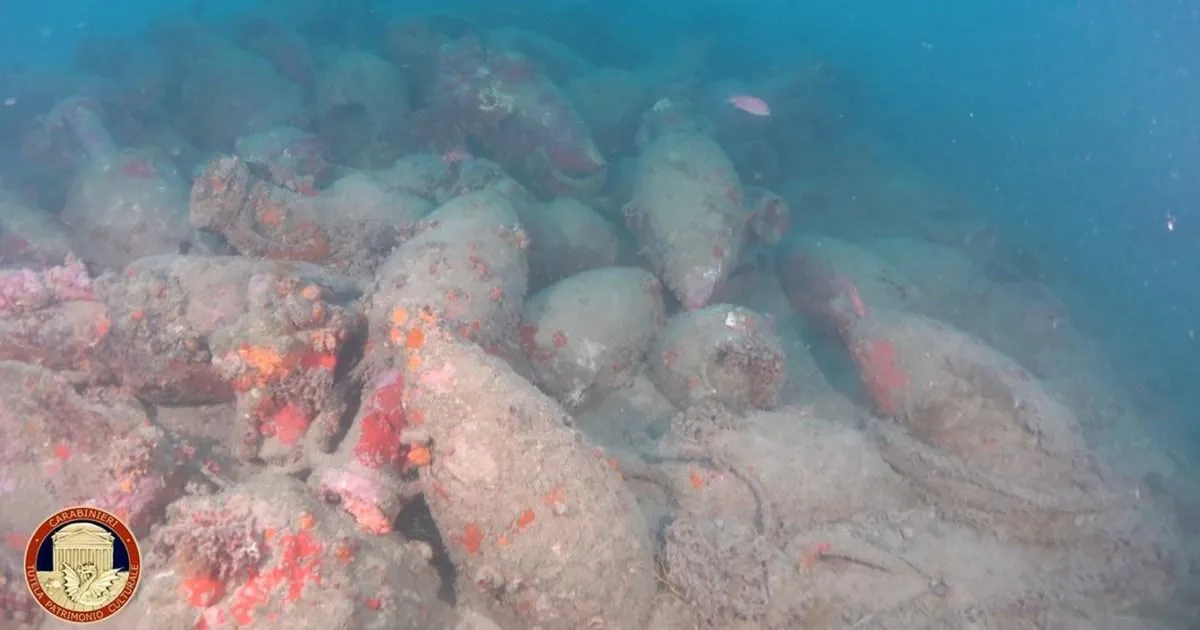
When the divers returned to the site, they approached it with a new level of care and precision, aware that they were no longer simply inspecting the seafloor but uncovering a piece of history. What they found on that second descent was nothing short of extraordinary. A series of largely intact artifacts lay scattered among the seagrass, their shapes recognizable even after two millennia beneath the waves. Through what officials described as “careful dredging action,” the team was able to identify and recover three complete terracotta objects, the most significant of which was a large transport basin—a vessel that would have been used to hold goods during long sea voyages. Alongside the basin, there were other, smaller items, each one offering a glimpse into the daily workings of an ancient trade route. Perhaps the most striking image from the recovery was that of an intact amphora, still nestled in the seagrass as if it had been placed there just moments before. Amphorae were the shipping containers of the Roman world, sturdy clay jars used to transport wine, olive oil, grain, and other staples across the empire. They were the lifeblood of commerce, moving goods from one corner of the Mediterranean to another, and their presence on the seafloor tells a story of a ship that once carried these precious cargoes. The divers carefully lifted the artifacts from their resting place, handling them with the reverence they deserved. Each piece was encrusted with the patina of age, but the craftsmanship was still evident—the curves, the rims, the sturdy handles all spoke of a time when pottery was not just functional but a testament to the skill of its maker. For the divers, this was no longer a routine operation; it was a once-in-a-lifetime encounter with the ancient world, a moment where the line between past and present seemed to blur in the clear blue water.
3. A Glimpse into Roman Trade and Daily Life
The discovery of these artifacts is far more than a collection of old pots; it is a window into the complex and sophisticated world of Roman trade. Based on a preliminary analysis, experts have hypothesized that the items date back to a period between the second half of the first century BC and the first century AD. This was a time of immense expansion and prosperity for the Roman Empire, when its ships dominated the Mediterranean and its trade networks stretched from the Iberian Peninsula to the eastern provinces. The potential origins of the artifacts—Lazio, Campania, or the Iberian Peninsula—are particularly telling. Lazio and Campania were the heartlands of Roman culture, home to bustling ports and workshops that produced goods for export. The Iberian Peninsula, meanwhile, was a vital source of olive oil, wine, and other commodities that were shipped across the sea in vast quantities. To hold one of these terracotta vessels is to hold a piece of that ancient economy in your hands. Imagine the hands that shaped the clay, the kiln where it was fired, the dock where it was loaded onto a ship, and the sailors who watched over it during a treacherous voyage. These artifacts were not decorative; they were workhorses, built to withstand the rigors of sea travel and the rough handling of port workers. Yet their survival is a testament to their durability and to the countless journeys they made. The amphora hidden in the seagrass may have once held wine from a sun-drenched vineyard in Campania, destined for a wealthy household in some distant Roman city. Or it may have carried olive oil from the groves of Iberia, a staple of the Roman diet and a key ingredient in their cuisine, medicine, and even cosmetics. The transport basin, too, would have played a crucial role in the daily operations of a merchant ship, perhaps used for mixing or serving food to the crew, or for storing provisions during long voyages. Together, these objects paint a picture of life aboard a Roman merchant vessel—a life of hard work, danger, and adventure, but also one of connection, linking people and places across the vast expanse of the Mediterranean.
4. The Work of Specialists and the Promise of More Discoveries
Now that the artifacts have been brought to the surface, the real work begins. Specialists will examine each piece in meticulous detail, using a range of techniques to determine their exact age, origin, and the conditions they experienced during their long underwater burial. The preliminary hypothesis points to a date between the first century BC and the first century AD, but further analysis could refine this timeline and reveal more about the specific workshops where the pottery was made. By studying the clay, the style of the vessels, and any traces of their original contents, researchers hope to piece together the story of the ship that carried them and the route it was traveling when it met its fate. There is also the tantalizing possibility that this is not an isolated find. The presence of these artifacts on the seafloor could indicate a larger archaeological site nearby—perhaps the wreck of a Roman merchant ship, its hull and cargo scattered across the seabed, waiting to be discovered. If that is the case, the area off Porto Rotondo could become a significant site for underwater archaeology, offering a rare and detailed look at Roman maritime life. The announcement by the Sassari Police Headquarters has already generated excitement within the archaeological community, and the hope is that further exploration will yield even more treasures. Every artifact recovered from the sea is a piece of a puzzle, helping historians to understand not only the grand narrative of the Roman Empire but also the everyday lives of the people who lived, worked, and traveled within it. The careful, methodical work of these specialists is a reminder that archaeology is not about quick thrills or dramatic discoveries alone; it is a patient, painstaking process of uncovering and interpreting the past, one fragment at a time. And with each new find, our understanding of history grows a little richer, a little more complete.
5. A Mediterranean Full of Sunken Stories
The discovery off the coast of Sardinia is part of a much larger pattern of remarkable finds in the Mediterranean, a sea that has served as a crossroads of civilizations for millennia. Earlier this year, Italian authorities announced the discovery of a Roman merchant shipwreck in the Ionian Sea, found during a routine maritime patrol. That vessel, filled with amphorae, was dated to the late Imperial era, a period spanning roughly from 284 AD to 641 AD. The two discoveries, though separated by hundreds of miles and hundreds of years, are connected by the same thread: the enduring presence of Roman trade and travel across the Mediterranean. They also highlight the role that modern technology and vigilance play in uncovering ancient history. Routine patrols, underwater safety checks, and even fishing operations have all led to significant archaeological finds, proving that the past is not confined to museums and excavation sites. It is all around us, beneath our feet and beneath our waters, waiting for a chance to be seen. The Mediterranean has been described as a giant museum without a roof, and every year it gives up new secrets. Some are found by accident, like the artifacts off Porto Rotondo; others are the result of years of dedicated searching. But each discovery adds to the rich tapestry of human history, reminding us of the countless generations who came before us and the enduring legacy they left behind. For the divers who made this find, the experience must have been surreal—a moment of contact with a world that existed two thousand years ago, a world that was in many ways so different from our own, yet also strangely familiar. The people who made and used these vessels had hopes and fears, families and communities, just as we do. They traded, they traveled, they faced storms and shipwrecks, and they left behind these small, clay witnesses to their lives.
6. The Enduring Legacy of the Ancient World
As the recovered artifacts are carefully transported to a laboratory, where they will be cleaned, studied, and eventually preserved for public display, it is worth pausing to reflect on what they mean. These are not just ancient objects; they are tangible links to a past that continues to shape our present. The Roman Empire may have fallen, but its influence lives on in our languages, our laws, our architecture, and even in the way we trade and travel. The amphorae and basins found off the coast of Sardinia are humble objects, but they are also symbols of a civilization that transformed the world. They remind us that history is not a distant, abstract concept but something that can be touched, held, and experienced. They also remind us of the importance of preserving our shared heritage, both on land and beneath the sea. Every artifact that is recovered, studied, and protected is a victory against the forces of time, erosion, and neglect. It is a promise that future generations will be able to learn from and be inspired by the achievements of those who came before them. The discovery off Porto Rotondo is a beautiful example of how curiosity, diligence, and a little bit of luck can bring the past back to life. It is a story that began with a routine dive and ended with a treasure trove of history, a story that will continue to unfold as researchers delve deeper into the mysteries of these ancient vessels. In the end, the most remarkable thing about this discovery is not the age of the artifacts or their historical significance, but the human connection they represent. They are a message in a bottle, sent across two thousand years, telling us that we are not alone in our journey through time. And as long as there are people willing to look, to wonder, and to explore, the sea will keep sharing its secrets, one fragment at a time.