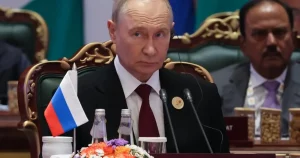

Imagine being a parent in Russia right now, trying to keep your family safe in a world that feels increasingly unstable. You switch on the news and hear that President Vladimir Putin has approved the sale of gas masks to ordinary civilians for the first time in more than three decades. It is the kind of announcement that would have felt unthinkable only a few years ago, yet here it is, delivered as routine news. From March 1 next year, Russian families will be allowed to purchase certified civilian filtering masks, including versions designed specifically for children, and even sealed protective chambers meant for babies. The decision lifts a restriction that had been in place since 1992, shortly after the collapse of the Soviet Union, when gas masks and related equipment were placed on a list of items that ordinary people could not legally buy. Now that ban is gone, and the message is impossible to ignore: the Russian state is preparing its civilian population for something terrible. Naturally, this has triggered a renewed wave of World War III anxiety across the world, especially as it comes against the backdrop of a grinding war in Ukraine and steadily deteriorating relations between Moscow and NATO. The question on many minds is whether this is genuine, practical preparation for a catastrophic conflict, or another calculated act of psychological intimidation designed to frighten both Russians and the West.
To understand why this feels so alarming, you have to remember the context in which the ban originally existed. When the Soviet Union fell apart, the new Russian leadership inherited a vast military and civil defense apparatus, but also a desire to move away from the paranoid militarism of the Cold War. Part of that involved restricting access to gas masks and other protective equipment, so that they would not be floating around in the hands of criminals, extremists, or ordinary citizens who might misuse them. For three decades, that restriction remained in place. Now, suddenly, it is being lifted, and the timing could hardly be more loaded. Fears that Putin might be preparing for direct conflict with NATO have been building for months, ever since his invasion of Ukraine began to stall and Western support for Kyiv kept growing. Earlier this month, reports emerged of a joint NATO operation that had intercepted Russian submarines allegedly attempting to destroy a vital undersea cable in the Arctic, an act that, if successful, could have caused massive disruption to global communications. At the same time, Putin himself seemed to taunt the West at a press conference, smirking when asked whether he would target British drone sites, saying only that it was a “military secret.” These are not the actions and words of a leader easing tensions. They are the moves of someone who wants to keep the other side guessing, while simultaneously preparing his own people for the possibility of war.
The practical details of the gas mask sales reveal just how far the state is willing to go. These are not just simple masks for filtering dust or smoke; they are serious pieces of civil defense equipment. Properly fitted with the right filters, they can protect the wearer from airborne chemical agents, toxic industrial substances, and biological contaminants. They also offer a degree of protection against radioactive dust, the kind of fallout that would be produced by a nuclear explosion. The fact that versions are being prepared for children, and that sealed protective chambers are being made available for babies, suggests that Russian authorities are thinking about whole families surviving together in a contaminated environment. That is a chilling thought for any parent. The Emergency Situations Ministry, known by its Russian acronym EMERCOM, has also said that counterfeit, substandard, and uncertified masks will be removed from the market to ensure quality control. On the surface, that sounds reassuring, and it is likely to be presented that way: look, we are making sure that if you need to buy a gas mask, you are getting one that actually works. But the underlying reality is less comforting. Why would a country need to crack down on counterfeit gas masks unless it seriously believed that civilians might soon have to rely on them? The move seems designed to make ordinary Russians feel as though they must be ready for an attack, while also reinforcing the state’s narrative that the West is a hostile threat.
Some Russian voices have been surprisingly open about what they think this all means. Pro-Kremlin military commentator Yury Baranchik described the decision to allow citizens to buy gas masks for their entire families as “particularly relevant,” pointing to ongoing renovations of Soviet-era bomb shelters in several cities. He said the lifting of a ban that had lasted more than thirty years was good news, “especially for the West.” That last phrase drips with irony, as if he is warning Western leaders that they should be worried, not relieved, by Russia’s preparations. Baranchik even went further, suggesting that it would be beneficial to supplement the gas mask sales with “real-world testing” on the Novaya Zemlya archipelago, the remote Arctic island chain that served as the Soviet Union’s principal nuclear testing ground. That is a demand to resume actual nuclear bomb testing, something that has not happened in Russia for decades. Meanwhile, videos have emerged of young recruits in military training schemes practicing with gas masks, and the authorities appear eager to normalize the idea of civilian defense against chemical, biological, or nuclear attack. To a skeptical observer, this looks less like genuine preparation and more like a campaign to scare the Russian population into believing that they are under existential threat from the West, and that their government is the only thing standing between them and disaster.
This is not happening in isolation. The gas mask announcement is just one part of a much broader program to restore Russia’s decaying civil defense infrastructure, which has been neglected since the end of the Cold War. EMERCOM chief Alexander Kurenkov said earlier this year that more than twenty thousand shelters were being restored across eighty-two Russian regions, a massive undertaking. The scale of the effort becomes even more striking when you look at the numbers behind it. A reported ministry assessment found that in 2022, only sixteen percent of Russia’s shelters and anti-radiation refuges were fully serviceable, while a staggering sixty-seven percent were completely unusable. That means the country had allowed its bomb shelters to rot for decades, confident that they would never be needed. Now it is spending enormous amounts of money to bring them back to life, reportedly around 155 billion roubles, or approximately 1.35 billion pounds. That kind of investment does not happen on a whim. Either Russian leaders genuinely believe that a war is coming and they need to protect their population, or they are deliberately fostering a sense of siege and existential danger to justify their policies and rally the nation behind them. Perhaps it is both. The psychological effect on ordinary Russians cannot be overstated. When your government starts renovating bomb shelters and selling gas masks for babies, the threat begins to feel very real, no matter how much you trust or distrust the authorities.
The darkest dimension of this story is the nuclear element, which hangs over everything like a shadow. Less than a year ago, Russian Defence Minister Andrei Belousov reportedly called for “preparations for full-scale nuclear tests immediately” at a meeting of the Russian security council. He said that the forces and facilities at the central test range on the Novaya Zemlya archipelago were ready and capable of carrying out such tests within a short time frame. Putin did not give an immediate go-ahead, but he did not dismiss the idea either. Instead, he demanded “proposals on the possible start of work to prepare nuclear weapons for testing.” That is an ominous half-step, a way of leaving the door open. Novaya Zemlya is not just some random location; it is the place where the Soviet Union tested the Tsar Bomba in 1961, the most powerful nuclear weapon ever detonated by humanity. The symbolism of returning to that site for new tests would be unmistakable. Combined with the gas masks, the baby chambers, the restored shelters, and the bellicose rhetoric, it all points toward a nation that is at least preparing for the possibility of nuclear war, whether as a genuine strategy or as a terrifying piece of theater. For the rest of the world, the only honest response is to admit that no one knows for sure what Putin intends. But in the meantime, Russian families are being told to buy gas masks, children are learning to use them, and the ghosts of the Cold War are being deliberately summoned back into everyday life. That alone is enough to keep people awake at night, on every side of the conflict.