


Paragraph 1
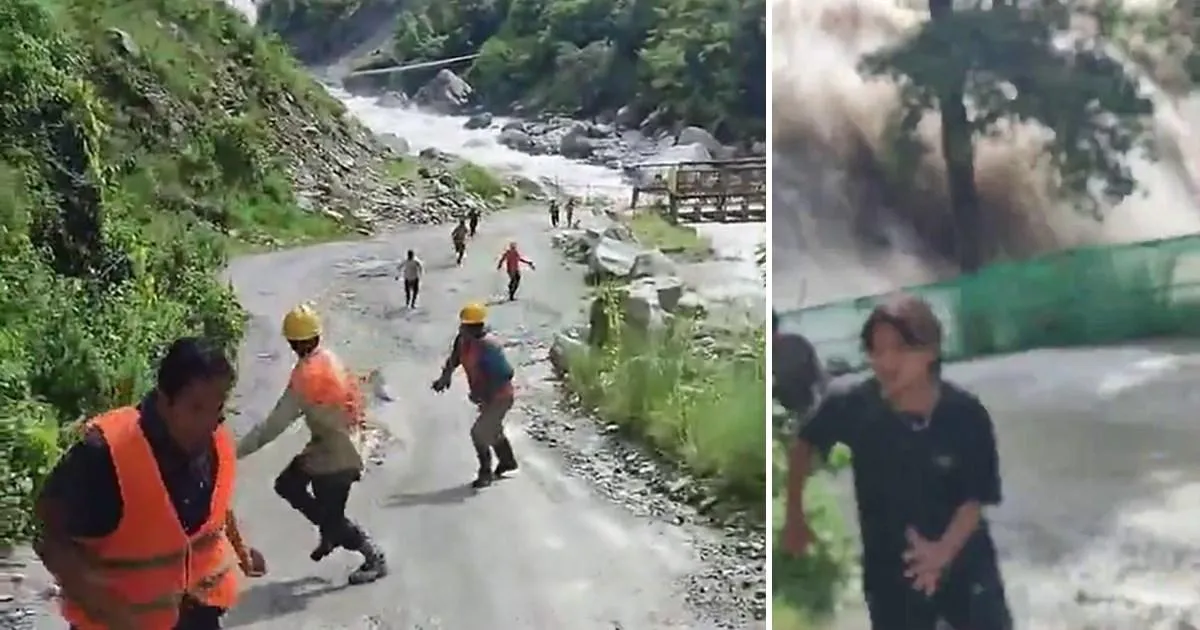
There are moments in life when the world shifts without warning, and the everyday sound of wind and stone is replaced by a roar so huge that it seems to come from the earth itself. In a terrifying video that has emerged from the high mountains of Nepal, a group of workers are seen running for their lives as a colossal wall of mud and water tears through the valley behind them. The footage is raw, shaking, and difficult to watch, not because it is graphic in the way we usually imagine violence, but because it captures something even more primal: the exact instant when ordinary people realize they are about to die. They scramble across loose rock and steep slopes, their bodies moving with the frantic energy of pure survival, while the flood thunders closer. The person holding the camera is breathing heavily, half-sprinting, half-stumbling up a hill, muttering prayers and curses under his breath. Behind him, the sound of waves crashing against stone is almost deafening, a unnatural rhythm that seems to swallow all other sound. The workers do not look back, not until they have reached higher ground. When one of them finally turns, there is something frozen in his eyes, a mixture of exhaustion, shock, and disbelief. This is not a movie scene or a dramatic reenactment. This is what a nightmare looks like when it happens in daylight, to people who had simply started another day of work, expecting nothing more than dust, tools, and the quiet routine of a mountain job.
Paragraph 2
The catastrophe that caused this terror was not a sudden cloudburst or a seasonal storm. According to the United States Geological Survey, a glacial collapse high in the Himalayas triggered a massive flash flood that swept through parts of Nepal and Tibet with the force of an explosion. The burst released a deadly combination of water, ice, rocks, and mud that tore through narrow gorges and flattened everything in its path. In Nepal, the numbers are almost too grim to process: at least 270 people are confirmed dead, and more than 800 are still missing. In Tibet, nearly 600 people have not been found, and three have been declared dead. Each number represents a person with a name, a family, a set of hopes and routines. Some were working in construction, repairing roads and bridges in remote areas. Others were farmers tending their lands near riverbanks. Many were young, strong, and far from home, trying to earn enough money to send back to their villages. When the flood hit, there was no time to warn them. Their houses, their tools, their tiny roadside shops, all of it disappeared in a matter of minutes. Rescue workers are still digging through layers of mud and debris, calling out names, listening for the faintest sound of life. But as the hours pass and the rivers remain swollen, the hope begins to fade. The scale of this disaster is hard to wrap around, but the human cost is not. It is in the empty chairs at kitchen tables, in the unanswered phone calls, in the clothes still hanging in homes where no one will sleep tonight.
Paragraph 3
The short video that has been shared around the world is more than just footage of a disaster. It is a window into the exact moment of trauma, and that makes it profoundly uncomfortable to watch. The person filming seems to be standing on a hillside, perhaps a few hundred meters above the riverbed, when the sound of rushing water first reaches the microphone. Immediately, his voice rises in panic, and the words “Oh my God, oh my God” repeat over and over, almost like a prayer. The camera swings wildly, capturing the blurred shapes of other workers who have also realized what is happening. They are not walking. They are running, pushing their legs to move faster than they ever thought possible, stumbling over loose stones and small bushes, their arms pumping, their chests burning. The flood is not a neat wave like you might see in the ocean. It is a violent, churning brown mass that rolls over boulders and tears trees out of the ground as if they are matchsticks. It moves with terrible speed, eating the valley, and the sound of it grows louder with every heartbeat. There is a moment near the end of the clip when the camera turns back toward the flood, and a loud bang echoes through the mountains. It might be the sound of a boulder slamming into a wall of rock, or a building collapsing, or something else entirely. But in that instant, the viewer understands how close these workers were to being swallowed whole. They made it to safety, gasping for air, their hands shaking. But many others did not. And the guilt of surviving, of having been just a little bit faster or a little bit higher than someone else, will likely stay with those workers for the rest of their lives.
Paragraph 4
As the world watches the devastation unfold, governments and aid organizations are mobilizing to help. In the United Kingdom, Prime Minister Andy Burnham has announced that the country has pledged £5 million to support the emergency response effort. Speaking during a visit to South Wales, Burnham described the emerging picture from Nepal as “devastating.” He emphasized that immediate action was being taken so that British nationals could access support twenty-four hours a day, seven days a week. The situation is personal for many families in the UK: at least thirty-three British nationals are believed to be missing in the wake of the flood. Burnham acknowledged that this is a deeply distressing and devastating situation for those families, and he promised that the government would provide every possible form of support. He also revealed that the UK has offered to send emergency responders to the region, though he noted that accepting such assistance is ultimately a decision for the Nepalese government. Behind the political statements and the financial pledges, there are real people waiting by landlines and mobile phones, refreshing news pages every few seconds, hoping for a call that may never come. They are mothers and fathers, siblings and friends, people who just a few days ago were making plans for dinner, arguing about holidays, and wondering whether to buy a new jacket. Now their lives are suspended in a cruel state of uncertainty. The £5 million will help with rescue operations, medical care, and rebuilding shattered communities, but no amount of money can replace a missing person or erase the memory of that roaring wall of water. What the survivors need is not just money, but presence, patience, and the knowledge that the world has not turned away.
Paragraph 5
Beyond the immediate horror, there is a deeper and more troubling dimension to this disaster. Glacial collapses of this kind are not random acts of nature. They are increasingly linked to climate change, as rising global temperatures weaken the delicate structures of ice that have stood for thousands of years. The Himalayas are home to some of the largest glaciers outside the polar regions, and they are melting at an alarming rate. As ice retreats, it leaves behind unstable slopes and glacial lakes that can break their natural barriers without warning. When a glacial collapse happens, it can trigger a glacier lake outburst flood, sending millions of gallons of water racing down valleys that are often densely populated. The people who live and work in these regions are already among the most vulnerable in the world. Many are poor, isolated, and dependent on the land for survival. They do not have access to early warning systems, evacuation plans, or insurance policies. They wake up each morning and go to work in the shadow of towering peaks, aware that the mountains can be dangerous but powerless to predict what will happen next. This flood was not a singular event. It is part of a pattern, a slow-moving crisis that has been building for decades. Scientists have been warning for years that the Himalayas are a disaster waiting to happen. And still the glaciers retreat, still the lakes swell, still the communities remain exposed. The video of the workers running for their lives is not only a record of a tragedy. It is a warning. It asks us to think about what it means to live on a changing planet, where the ground beneath our feet can no longer be trusted. It asks us to look at the people who are least responsible for the warming climate yet are suffering the most from its consequences. And it asks us to consider, as we look at their terrified faces, what we are willing to do before the next mountain breaks.
Paragraph 6
In the end, this is a story about the fragility of life and the stubbornness of the human spirit. The workers in the video are alive, but they will never be the same. They will carry the sound of that crushing water in their ears, the image of their friends running beside them, the smell of wet earth and diesel and fear. Their escape was a miracle, and somewhere in Nepal and Tibet, families are holding their loved ones a little tighter today. But for too many families, the miracle did not come. There are bodies still buried under the mud, and there are thousands of people waiting in shelters, wearing borrowed clothes, counting what little they have left. The international response, including the UK pledge of £5 million, is important and necessary, but it is only the beginning. The rebuilding of these communities will take years, and the emotional wounds will take even longer to heal. In the days ahead, the news cycle will move on, and new disasters will compete for our attention. But for the survivors, there is no moving on, only a slow, painful process of finding a way to live after witnessing the unthinkable. What we can offer, as people far away watching from the safety of our homes, is not just money or prayers. We can offer sustained attention, a refusal to forget, and a willingness to demand that political leaders treat the climate crisis with the urgency it deserves. The mountain that collapsed was old, ancient beyond memory, but it was fragile. So are we. The video of those workers running for their lives is a call to remember our shared vulnerability and our shared responsibility. And if we listen closely, behind the panic and the crashing waves, we might hear another sound: the quiet, unquenchable hope that appears whenever humans choose to help each other, to run toward those who are suffering, and to believe that even after the worst flood, life can and will begin again.