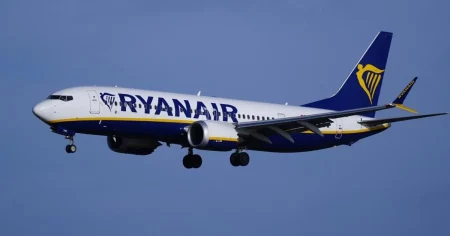

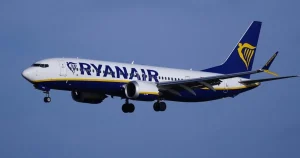

The calm of a routine flight shattered in an instant. Passengers aboard Ryanair Flight 1879 were settling in for a short hop from Thessaloniki, Greece, to Memmingen, Germany. It was a standard journey, the kind that fills the skies thousands of times a day. But for those on board, this trip would become a terrifying fight for survival. The peace was violently broken not by turbulence, but by a deafening bang and a violent shudder that ripped through the aircraft. What began as a normal flight quickly descended into chaos as a catastrophic engine failure sent debris tearing through the plane’s hull, smashing a window and creating a crisis at 30,000 feet. The ensuing panic, heroism, and investigation have now been laid bare in a preliminary report by the National Transportation Safety Board (NTSB), revealing a complex chain of failures that nearly ended in tragedy.
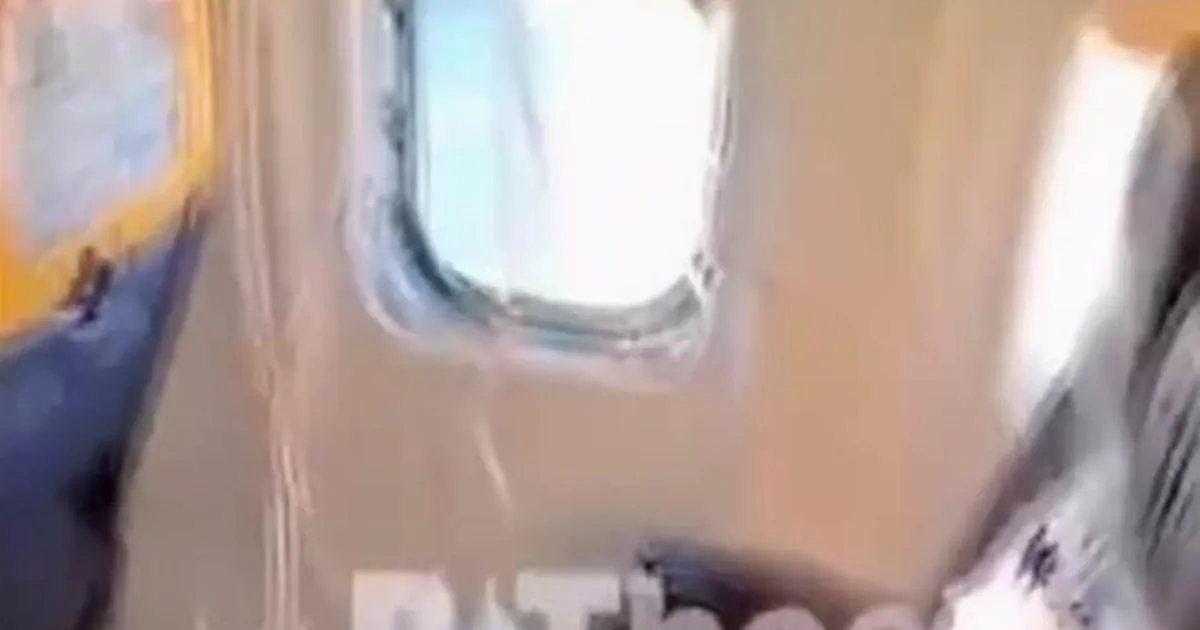
The most harrowing part of the ordeal centered on one seat: 11F. The report confirms that the passenger in that seat was partially sucked out of the shattered window as the cabin depressurized in a violent rush. That passenger was Ljubiša Karović, a 61-year-old man who had been sleeping, completely unaware of the danger until the world around him exploded. As the air tore from the cabin and the aircraft lurched, he was physically pulled towards the hole, his body becoming lodged in the window frame. In that moment of pure terror, his wife, Svetlana Grković, acted with extraordinary courage and instinct. She lunged forward and grabbed him, holding on with all her strength, refusing to let the sky take him. Her desperate grip became the only thing keeping him from being sucked out of the plane entirely. For agonizing minutes, she served as his anchor, a testament to the power of human love in the face of unimaginable fear. The report’s confirmation of this event underscores just how close this flight came to a fatal outcome, transforming a statistic into a story of a family clinging to each other against the forces of physics and fate.
The source of the disaster was a catastrophic failure within the aircraft’s right engine. According to the NTSB’s preliminary findings, a fan-blade failure triggered the entire sequence of events. The engine, a common type fitted to Boeing 737s, suffered a severe internal breakage where three fan blades separated and fractured in flight. These high-speed metal fragments acted like shrapnel, blasting through the engine casing and the side of the aircraft. One of these fragments struck the window beside seat 11F, shattering it instantly. This break in the fuselage caused the cabin to rapidly depressurize, which automatically triggered the overhead oxygen masks to drop down. The cabin crew, who were just beginning to prepare the inflight service, reported feeling a loud vibration and seeing smoke before the masks deployed. The pilots immediately initiated an emergency descent, which is a controlled, rapid dive to reach a breathable altitude, and successfully turned the aircraft around to make an emergency landing back in Thessaloniki. The plane was safe, but the intricate mechanics that were supposed to guarantee a smooth journey had failed in spectacular and terrifying fashion.
The investigation has delved deep into why these blades failed, uncovering a trail of maintenance and compliance issues. The NTSB’s forensic examination of the engine pointed to several broken fasteners that had not been fitted with the necessary enhancement components. This was a direct violation of a safety directive issued by the Federal Aviation Administration (FAA) in 2025, which was itself a response to two earlier, similar blade-out incidents on other aircraft. The directive was a clear warning that these parts were prone to fatigue and required specific reinforcement. That some of these recommended fixes were missed highlights a systemic problem in pre-flight maintenance and inspection procedures. Furthermore, the investigation discovered other unsettling details. Bird remains, including feathers, were found in the engine’s Integrated Drive Generator (IDG) oil cooler, a component that uses fans or fuel to prevent overheating. This suggests a possible bird strike, but it is unclear if this was a contributing factor to the failure or a separate, pre-existing occurrence. Additionally, another mandated enhancement to brackets on the engine’s exhaust nozzle had also not been completed, with a due date not until July 2028. Each of these findings paints a picture of a maintenance culture that was not fully compliant with critical safety advisories, allowing for a deadly chain of mechanical failures to align.
This incident is a grim reminder that fan-blade failure is a recurring and often deadly threat in aviation. While modern aircraft have multiple redundant safety systems, the failure of an engine’s fan blades can create a nearly unstoppable cascade of destruction. History is littered with examples, most notably the 1989 Kegworth air disaster in Leicestershire, England. In that tragedy, a British Midland Boeing 737-400 suffered a fan-blade fracture in its left engine. In a horrifying twist, the pilots misdiagnosed the problem and shut down the right engine, which was actually functioning normally. This error caused the plane to crash into the side of the M1 motorway, killing 47 people. That incident led to significant changes in pilot training and engine design, but it did not eliminate the underlying vulnerability. The Ryanair flight was saved from a similar fate by the skill of its pilots and the strength of its crew, but the echoes of past failures are unmistakable. The fact that a present-day flight could still be endangered by a known mechanical weakness is a sobering thought for anyone who has ever buckled themselves into an airline seat.
As the investigation continues, the full picture is still coming into focus, and the airline is staying quiet. Ryanair has stated it will not comment until the NTSB’s comprehensive investigation is concluded, leaving many questions unanswered for the public. The preliminary report is just the first step in a process that will involve detailed metallurgical analysis, examination of maintenance logs, and interviews with the pilots—who, with 8,270 flight hours under their belts, were seasoned veterans. For the passengers, especially Ljubiša Karović and his wife Svetlana, the memory of that terrifying descent will never fade. It is a story of a simple vacation turning into a nightmare, and of a wife who became an impromptu hero. The incident serves as a profound reminder that the miracle of flight is the result of complex engineering and strict oversight, and that even the smallest lapse in attention to detail can have life-altering consequences. The sky briefly showed its most dangerous face on that flight, but it also showed the incredible resilience of the human spirit, proving that sometimes, the most powerful safety system on any aircraft is the people sitting inside it.