



Unconfirmed Explosions Near Russian Naval Base Raise Questions Amidst Increased Weapons Production
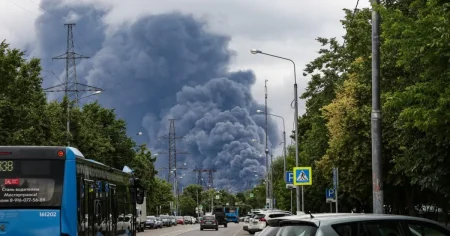
Two mysterious explosions have reportedly occurred near Severomorsk-1, a critical naval airbase and weapons storage facility for Russia’s Northern Fleet, located in the Murmansk region. Video footage purportedly capturing one of the blasts shows vehicles shaking from the force of the detonation. The base houses a significant arsenal, including Ka-27 helicopters, fighter jets, bombers, and maritime surveillance aircraft. Additionally, mobile anti-aircraft missile sites and electronic warfare antennas are positioned in the vicinity. While the nature of the explosions remains unconfirmed, online speculation suggests the possibility of an ammunition detonation. Andrii Kovalenko, head of Ukraine’s Center for Countering Disinformation, pointed out that Severomorsk-1 also serves as a weapons testing site, including for Zircon missiles. The base’s strategic importance lies in its role in controlling Arctic sea routes, supporting both surface vessels and nuclear submarines. It also houses command centers, repair docks, and fleet control points. Furthermore, ships of the Northern Fleet are equipped with Kalibr missiles, which Russia has deployed in the Ukraine conflict. The Northern Fleet also conducts reconnaissance missions and monitors NATO activity in the Arctic. Tormod Kværna, a seismology expert at NORSAR, mentioned that their station recorded a signal potentially indicative of a large explosion. As of yet, the Kremlin has not addressed the alleged incident.
The reported explosions coincide with a significant increase in Russia’s weapons production, driven by the ongoing conflict in Ukraine. Despite Western sanctions, a recent report by the Royal United Services Institute (RUSI) highlights Russia’s ability to ramp up manufacturing of key weaponry. The report attributes this to cautious decision-making by Western governments and delays in intelligence sharing. This increased production underscores Russia’s commitment to sustaining its military operations. However, the impact of sanctions on Russia’s long-term military capacity remains to be seen. The events at Severomorsk-1, while still shrouded in some uncertainty, add another layer of complexity to the ongoing geopolitical tensions surrounding the war in Ukraine. The lack of official confirmation from Moscow further fuels speculation and raises questions about the true nature and extent of the incident.
Severomorsk-1’s strategic location underscores its importance in projecting Russian power in the Arctic region. The base’s ability to support both surface and subsurface naval operations, coupled with its proximity to crucial sea lanes, makes it a vital asset for Russia’s strategic interests. The presence of advanced weaponry, including Kalibr missiles and potentially Zircon hypersonic missiles, further amplifies the base’s significance. The reported explosions, if confirmed, raise concerns about the security of these assets and the potential for accidental or deliberate incidents. The timing of the alleged explosions, amidst a backdrop of heightened tensions with the West and increased weapons production, adds to the intrigue surrounding the event.
The lack of official comment from the Kremlin leaves room for speculation and interpretation. While Ukraine has suggested the possibility of weapons testing, the lack of corroborating evidence leaves open the possibility of other explanations, including accidents or even deliberate acts of sabotage. The secrecy surrounding the incident underscores the sensitivity of the location and the importance Russia places on its military capabilities in the Arctic. Furthermore, the absence of independent verification makes it challenging to assess the full extent of the damage, if any, and its implications for Russia’s military readiness. The incident also highlights the challenges of monitoring military activities in remote and strategically important regions.
The report from the Royal United Services Institute (RUSI) on Russia’s weapons production adds a crucial dimension to the context surrounding the Severomorsk-1 incident. The fact that Russia has been able to increase its weapons production despite Western sanctions points to the resilience of its military-industrial complex. This raises questions about the effectiveness of sanctions as a tool for constraining Russia’s military capabilities. Furthermore, the report’s findings on the cautious approach of Western governments and delays in intelligence sharing suggest that there may be room for improvement in the coordination of sanctions efforts. The heightened production also underscores the long-term nature of the conflict in Ukraine and the challenges in finding a resolution.
The ongoing conflict in Ukraine and the resulting geopolitical tensions serve as the backdrop against which the reported explosions at Severomorsk-1 should be viewed. The incident adds to the already complex and volatile situation, further highlighting the risks of escalation. The lack of transparency from the Kremlin, combined with the strategic importance of the base, creates an environment ripe for speculation and potential miscalculation. The incident emphasizes the need for clear communication and de-escalation efforts to prevent further tensions from arising. Furthermore, it underscores the importance of independent verification and open-source intelligence in understanding events in strategically sensitive regions. The incident at Severomorsk-1 serves as a reminder of the potential for unintended consequences in a climate of heightened military activity and geopolitical uncertainty.