


Two weeks after the middle-of-the-night evacuation, the Royal Gateway development in Canning Town feels less like a place where people live and more like an abandoned film set. The buildings — Sovereign Tower, Prince Court, Thanet Tower and Vincent Court — rise against the east London sky, but their windows are dark, their balconies empty. Official warning signs plastered across the entrances carry the stark phrase “risk to life,” and yellow hazard tape cordons off the ground floor. A construction worker standing outside Sovereign Tower tells Metro that nothing has been fixed yet. “As far as I know, there is no work going on. They are still surveying the building. I’m here for a few days to help, that’s all.” The development, once a bustling community of private renters and homeowners, has been described by residents as a ghost town. It is an apt description. The cafes, yoga studio, climbing centre and shops that once lined the ground floor are closed, their windows dark, their doors locked. The only movement comes from security guards and the occasional resident granted permission to retrieve belongings. The silence is unnatural, broken only by the distant rumble of traffic and the cable car gliding over the Thames. For two weeks, people have been waiting — waiting for information, waiting for work to begin, waiting for someone to tell them whether they will ever go home. And the longer the silence stretches, the more it feels like abandonment dressed up in bureaucratic language.
Among the displaced is a medical researcher who rents privately. She is still paying rent for a flat she cannot live in, even as she sleeps on friends’ sofas and moves her few belongings from one temporary home to another. “We all feel abandoned,” she says. There has been little information from the management, no visible repairs, no timeline for return. She has given up hope of moving back and is now looking for somewhere else to rent, but the financial damage is already done. She describes herself as “massively out of pocket” and calls the whole situation “really unjust.” Her story is not unique. Hundreds of residents have been left without a permanent home since the evacuation, and some families left the premises in nothing but their night clothes. There is no dignity in being woken at 3am and told to leave everything behind. People lost routines, belongings, a sense of safety in the very place where they were supposed to feel most secure. Another resident, a homeowner who paid more than £300,000 for a flat, is now back at his parents’ house. He had worked hard to get a foot on the property ladder, and in a single moment, through no fault of his own, he found himself back at the start — or worse. “We want answers, but none are forthcoming,” he says. “For the time being, I own a flat in a ghost town.” That phrase, repeated by so many, captures a particular kind of grief: the grief of owning something that no longer functions as a home, and of being responsible for it without being able to live in it.
The pain extends far beyond the residents. The ground floor of the Royal Gateway was once a small economic ecosystem, a place where people met, exercised, drank coffee and supported local businesses. Around a dozen units hosted cafes, a yoga studio, a climbing centre and a range of shops. All of them have been forced to close, seemingly without warning. One business owner describes the sudden collapse of everything he had been building. “We went from making regular money building up a client base to nothing,” he says. “The future is bleak. It is difficult enough for small businesses so to start again is a non starter, we invested a lot in lifting out our business and now it’s just being left to rot.” His words echo the frustration of the residents. For small business owners, a forced closure is not a temporary pause; it can be the end of years of sacrifice, savings and dreams. They did not cause the crack in the building, yet they are being asked to pay for it with their livelihoods. The shuttered shopfronts make the estate feel even more lifeless, and their absence removes the daily human contact that made the development feel like a neighbourhood. The loss is not just financial; it is social. The cafes and studios were places where people knew each other’s names, where friendships were formed, where the isolation of city living was softened by familiarity. Now all of that is gone, and the silence around the buildings is a reminder that a community, once scattered, is not easily put back together.
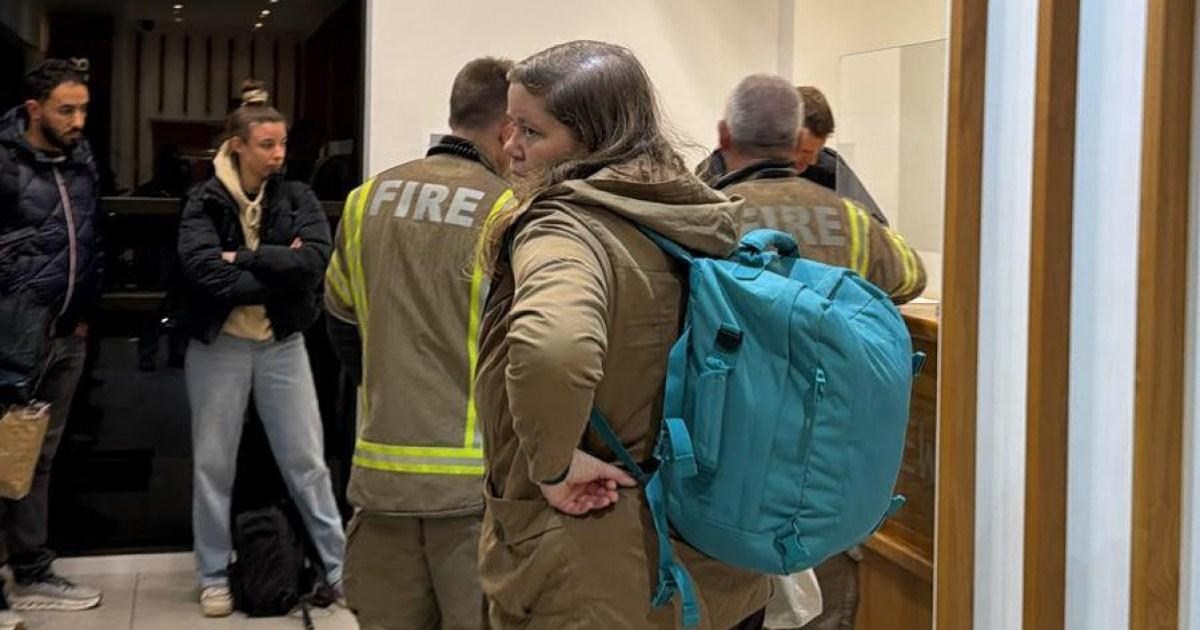
The crisis began on October 23, when firefighters were called to reports of a dangerous structure at a residential building on Hoy Street in Canning Town. It was around 3am. Residents were roused from sleep by alarms, by urgent knocking, by the presence of firefighters in the hallways telling them to leave immediately. Some had time to grab coats and phones; others carried children still wrapped in blankets. Crews assisted with the evacuation, taking residents to a rest centre, and then the scene was left with the building’s management. The structural issue, according to a statement from Prime Property Management, was identified during work to prepare building safety cases for the development. Structural engineers raised concerns after reviewing the building’s drawings, and a site inspection on October 21 confirmed those concerns. Now engineers are urgently investigating whether similar risks exist in the transfer slab beneath Prince Court and Thanet Tower. In a statement, Prime said it recognised “the enormity of asking anyone to leave their home.” It said these were not decisions made lightly, but that safety was the immediate priority. A dedicated phone line and email address have been set up for those affected, and support is available out of hours. But for residents, a helpline is not an answer. They want to know what happened, why they were not told sooner, who will pay for their temporary housing, and what will happen to their homes.
Newham Council has said it is working with Prime Property Management and other partners to support affected residents in Centurion Tower, St Vincent Court, Sovereign Tower, Thanet Tower and Prince Court. In accordance with its duties, the council has served Dangerous Structural Notices for St Vincent Court, Centurion Tower and Sovereign Tower. But the official statements, however carefully worded, do little to soothe the fear and anger rising among those displaced. This is not just a technical problem with concrete and steel. It is a human crisis that exposes how fragile housing security has become. Private renters are still legally responsible for rent on flats they cannot occupy. Homeowners are still responsible for mortgages on properties that may be worthless. Families are scattered across London, sleeping on sofas, in temporary accommodation, in childhood bedrooms at their parents’ houses. The psychological weight is enormous. People describe feeling invisible, abandoned, trapped in a system that expects them to wait patiently while their lives are put on hold. The lack of visible work on the buildings makes it worse: if the risk is truly to life, why are crews not swarming the site? If the risk is not immediate, why can’t people go home? The absence of answers breeds a sense of betrayal. The institutions responsible seem distant, slow, and more concerned with legal liability than with the human cost of their decisions.
The Royal Gateway has become a symbol of what can happen when routine safety reviews uncover something terrifying beneath the surface. There are no easy solutions. Engineers will need time to determine whether the transfer slabs are safe, whether the crack is contained, whether the buildings can be repaired or must be demolished. In the meantime, residents are making impossible choices. Some have already started looking for new housing, even though their money is still tied up in homes they cannot use. Others have given up hope of ever returning, but cannot afford to leave. Business owners are watching their life’s work collect dust. And the community that once made this development feel alive is scattered, perhaps never to reconvene. What the residents want, more than anything, is honesty and accountability. They want someone to look them in the eye and tell them what is happening. They want compensation, clear timelines, and support that feels real rather than performative. They want to stop being treated as names on a list and start being treated as people. The engineering reports will eventually provide technical answers, but the deeper question remains: what do we owe people when their homes become dangerous through no fault of their own? Until that question is answered, the ghost town will remain, a hollow shell filled with the memory of a community and the echo of unanswered questions.