


Paragraph 1: The Discovery of a Silent Secret
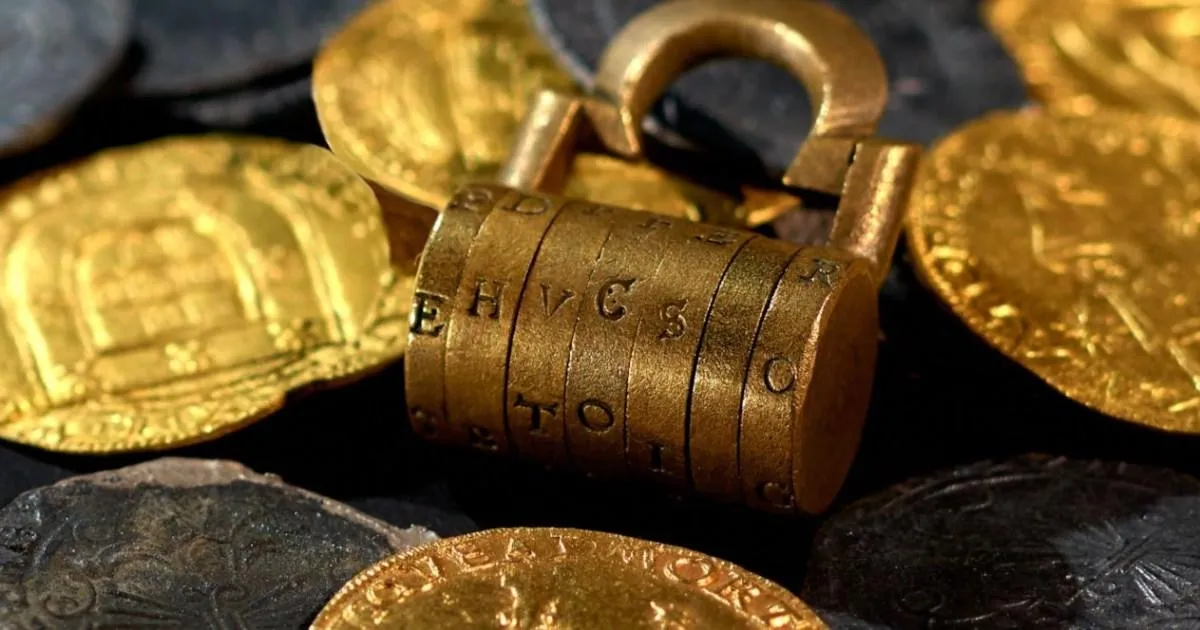
There is something deeply romantic about the idea of buried treasure, and the story of the Elizabethan padlock feels like it was pulled straight from the pages of a swashbuckling novel. Picture a windswept beach in Wales, the grey sea churning under a heavy sky, and a lone metal detectorist walking slowly across the sand, listening for the faint electronic whine that might signal something hidden below. That was Peter Hughes, a man whose patience and curiosity would eventually lead him to one of the most remarkable underwater discoveries in British history. Over a period spanning more than twenty years, between 1996 and 2017, Hughes combed the sands of Margam beach near Port Talbot and found an astonishing collection of treasure from the wreck of the Ann Francis, an Elizabethan merchant ship that had been lost in a storm in 1583. Among the hundreds of gold and silver coins, there lay a small brass padlock, roughly the size of an ancient coin, with letters engraved across its face and a tiny handle on top. It was unassuming, almost easy to overlook. But this little lock held a secret that would puzzle experts for years. It had remained uncracked for more than four centuries, its internal mechanism frozen in time, and nobody could figure out how to open it without destroying the artefact itself. The padlock was not just a piece of metal; it was a mystery, a quiet challenge from the past, and it waited patiently for someone to find the key, or at least the right way of thinking.
Paragraph 2: The Tragic Voyage of the Ann Francis
To understand why the padlock matters, we have to go back to the world of Elizabethan England, a time of exploration, trade, and constant danger on the high seas. The Ann Francis was a merchant vessel, a hardworking ship that carried goods between Britain and Spain, braving the unpredictable waters of the Atlantic and the English Channel. In 1583, she was on her way home from Spain, presumably laden with valuable cargo, when a violent storm swept across the coast of South Wales. The ship ran aground on Margam beach, and in the chaos of wind and waves, she was lost. There is no record of how many souls were aboard or how many survived, but the ship itself sank into the sand, taking its treasures with it. For centuries, the wreck lay undisturbed beneath the beach, a hidden time capsule of Tudor commerce and daily life. The coins and the padlock were not just random objects; they were part of the ship’s working equipment, perhaps securing a chest of valuables belonging to the captain or a wealthy merchant. When Peter Hughes began finding these artefacts, he was essentially opening a window into a lost world. Each coin told a story of trade and wealth, but the padlock was different. It was personal. It was designed to protect something precious, and its very existence hinted at secrets, fears, and hopes. The discovery of the wreck was itself a feat of perseverance, because the treasure was not found all at once. It emerged gradually over two decades, as if the sea was slowly giving back what it had taken. And among all the glittering gold and silver, the unassuming brass lock demanded the most attention, because it refused to give up its own secret.
Paragraph 3: A Puzzle That Defied the Experts
The padlock was an extraordinary object, not only because of its age but because of its condition. It was exceptionally well preserved, with the engraved letters on its surface still clearly visible. To the naked eye, it looked like a small, sturdy lock, perhaps the kind that might have secured a travelling chest or a strongbox aboard the ship. But the letters were a mystery. They were not random scratches; they formed part of a combination mechanism, an early form of security that was rare and sophisticated for its time. In an era when most locks used keys, a combination lock was a mark of status and ingenuity. The owner of this lock would have been someone who had something valuable to protect, and they had chosen a device that could only be opened by knowing the correct sequence of letters. The problem was that no one in the modern world knew that sequence. For years, experts at Museum Wales, also known as Amgueddfa Cymru, studied the lock. They examined its surface, measured its dimensions, and considered how it might work. But they were afraid to force it open. The lock was not just a puzzle; it was a precious artefact, and any attempt to pry it apart could damage it irreparably. So the experts took a different approach. They teamed up with researchers at Cardiff University, who had access to advanced imaging technology that could see inside objects without breaking them. The solution was a CT scan, the same kind of scanner used in hospitals to look inside the human body. By creating a detailed three-dimensional image of the padlock’s internal mechanism, the researchers could finally see how the letters aligned with the hidden notches and tumblers inside. It was a marriage of ancient craftsmanship and modern science, and it would finally crack the code that had held for over four hundred years.
Paragraph 4: The Moment the Lock Finally Opened
The breakthrough came when Dr David Williams, a researcher at Cardiff University’s Musculoskeletal Biomechanics Research Facility, studied the CT images. His work usually involved examining bones and biological structures, not Elizabethan padlocks, but the principles were the same. He needed to see how the internal components fit together, and the scanner gave him a perfect view. In the images, he could see exactly how the notches lined up with the letters on the outside of the lock. The combination, it turned out, was ANCE. It was a strange, incomplete word, just four letters that did not obviously spell anything meaningful. But it was enough. When the museum experts carefully set the lock to the correct sequence, there was a satisfying click, and a small slab at the end of the padlock pulled out, revealing a key-like item inside. After more than four centuries, the lock had finally yielded its secret. Dr Williams later described the experience with a mixture of scientific pride and wonder. He noted that using such advanced medical technology to investigate a 400-year-old padlock was certainly a first for his team, and the thrill of seeing the internal mechanism revealed was unforgettable. The actual opening had to wait until later in the evening, when the museum experts could test the combination under controlled conditions, but the result was exactly what the scans had predicted. It was a moment of pure triumph, the kind of quiet victory that researchers live for. The lock was opened without any damage, its mechanism intact, and the mystery was solved. But even as the experts celebrated, a new question began to form. The combination was ANCE, but what did it mean? Was it a name? A word fragment? A code that made perfect sense to its original owner, but was now as cryptic as a message from a forgotten language?
Paragraph 5: A Rare Window into Elizabethan Life
The significance of this padlock goes far beyond the satisfaction of solving a puzzle. According to Alastair Willis, a senior curator at Museum Wales, Elizabethan combination locks have been found in Britain before, but it is extremely rare to find one in such exceptionally good condition, and even rarer to find one linked to a dated shipwreck. That connection to the Ann Francis gives the lock a unique historical context. It is not just a random object from a museum drawer; it is a piece of a real story, a ship that sailed, a storm that struck, and a world that disappeared beneath the waves. The craftsmanship of the lock itself is a testament to the skill of Elizabethan metalworkers. Creating a combination mechanism in the sixteenth century required precision and patience, and the fact that it still works after four hundred years is a remarkable tribute to its maker. But the mystery of the combination is what makes this artefact truly compelling. ANCE is not a word in English, at least not a complete one. It could be part of a larger name, perhaps a place name or a personal name that was abbreviated. It could be a word in another language, or a reference to something that meant something deeply personal to the lock’s owner. Alastair Willis himself admitted that now the lock has been opened, the team is left wondering what the code meant to the person who once relied on it to protect their valuables. The answer is probably lost to history, but that does not make the question any less fascinating. In a way, the combination being so ambiguous makes the lock even more human. We all have our own private codes, our own passwords and phrases that carry meaning only to us. The owner of this lock carried a secret with them, and although we now know the letters, we will never know the story behind them.
Paragraph 6: The Past Is Never Fully Revealed
Perhaps the most beautiful thing about this discovery is that it reminds us how the past is never fully revealed, no matter how much we learn. The CT scan solved the mechanical puzzle of the padlock, but it could not solve the human puzzle. Why ANCE? Was it the name of a loved one, a child, a hometown, a ship? Or was it simply a random sequence chosen for security, with no emotional meaning at all? We will never know, and in that uncertainty lies a strange kind of poetry. The padlock is now a treasure of Museum Wales, a small object that carries a vast weight of history. It connects us to the men and women who sailed on the Ann Francis, to their hopes and fears, their belongings and their losses. The ship was carrying treasure, but it was also carrying lives, and the padlock was part of that human story. When Peter Hughes found it in the sand, he could not have known that it would take decades of scientific effort to unlock its secret, or that the answer would raise more questions than it solved. But that is the nature of archaeology and history. Every answer leads to new mysteries, and every artefact is a doorway into a world that we can only partially understand. The sea gave back this small brass lock, and with it, a moment of connection to a distant past. It sat for over four hundred years, waiting, and now it has spoken. The combination is ANCE, the lock is open, and the story continues, not because we know everything, but because we still wonder. And in that wonder, the past comes alive again, one small click at a time.